
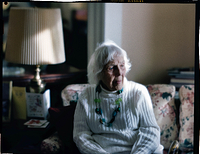
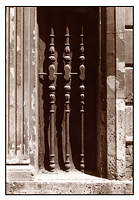

I've been printing with Slavich Unibrom graded paper and Ilford MG IV for a couple years. Yesterday, by chance, I wound up with a side-by-side comparison of both papers. (there was a url link here which no longer exists) printed on both - 11x14 on the Ilford, 8x10 on the Slavich.
Guess what? I cannot tell the difference between the papers. In other words, the image is the same, as closely as I can discern by eye. The only visual clue I have as to which print is on which paper is by the size; Ilford on the 11x14, Slavich on the 8x10.
Looking back at my printing notes I see that the exposures are the same for both. The only difference being the contrast filter used for the Ilford. In this case, the filter is a 2.5. Development time for the Slavich was 2 minutes, 3 minutes on the Ilford using PF 130 1:2. I fixed and selenium toned each print exactly the same.
"OK, Big Deal!" you say. I say that's pretty significant. It means I can use both papers interchangeably with respect to tone values; with little difference in exposure; and identical compatibility with my new film of choice, TMY-2. If I have a difficult negative, I can use split grade printing on the MGIV and the rendering is the same as if printed on the graded paper. I still like using single weight paper as much as possible and Slavich is available in single weight.
Its a startling bit of compatibility between the two manufacturers that seemingly have no ties with each other, and are physically nationally and geographically.
Since the demise of Kodak B&W papers, I've been searching for a paper(s) that I can lock in as a standard for 100% of my work. Think I just found the system that will fulfill that need.
Guess what? I cannot tell the difference between the papers. In other words, the image is the same, as closely as I can discern by eye. The only visual clue I have as to which print is on which paper is by the size; Ilford on the 11x14, Slavich on the 8x10.
Looking back at my printing notes I see that the exposures are the same for both. The only difference being the contrast filter used for the Ilford. In this case, the filter is a 2.5. Development time for the Slavich was 2 minutes, 3 minutes on the Ilford using PF 130 1:2. I fixed and selenium toned each print exactly the same.
"OK, Big Deal!" you say. I say that's pretty significant. It means I can use both papers interchangeably with respect to tone values; with little difference in exposure; and identical compatibility with my new film of choice, TMY-2. If I have a difficult negative, I can use split grade printing on the MGIV and the rendering is the same as if printed on the graded paper. I still like using single weight paper as much as possible and Slavich is available in single weight.
Its a startling bit of compatibility between the two manufacturers that seemingly have no ties with each other, and are physically nationally and geographically.
Since the demise of Kodak B&W papers, I've been searching for a paper(s) that I can lock in as a standard for 100% of my work. Think I just found the system that will fulfill that need.


