• Welcome to Photrio!
    Registration is fast and free. Join today to unlock search, see fewer ads, and access all forum features.
    Click here to sign up

Ilford FP4 125 - What am I doing wrong? Why are my prints consitantly bad?

Valencia

A
Valencia

  • 1
  • 1
  • 59
Tied to the dock

D
Tied to the dock

  • 4
  • 0
  • 97

Recent Classifieds

Forum statistics

Threads
203,096
Messages
2,849,753
Members
101,663
Latest member
Urkis
Recent bookmarks
1

ted_smith

Member
Allowing Ads
Joined
Feb 19, 2008
Messages
493
Location
uk
Format
Multi Format
What do I keep doing wrong?

Ilford FP4 125 - I used it once back in 2008 using my (then) Nikon F80 and it's built-in on-camera flash - I shot two rolls of it. The result were very flat with very few shades of anything near black - they were just washed out looking grey prints. I figured it was most likely me and my built in flash and lack of understanding about B&W film.

The rolls I had left from then have been in my fridge ever since (though still within their use by date, just), unused, as I've been too scared to use it since, despite learning lots since. Still, I had a need the other day and I know my photographic style and kit has improved since then too so I gave it a second try during a day out with friends. So, this time, I shot another roll of it using my Nikon F5 and SB-800 speedlight.

I was using aperture priority and centre-weighted metering with 75% metering concentrated within the circular area of the viewfinder which was always placed around the chest of the subjects. No compensation was used - it was outdoors and sunny with variable shades. Based on questions I've asked previously, I always tend to rate my films at less than their box speeds - typically 50% less, so if it's ISO100 I'll rate at EI50, or thereabouts. With this 125 film, I rated it at EI80 to try and ensure I got a denser negative than previously. My SB-800 was set at -1 power using TTL mode (not TTL-BL as I was only interested in the face or main subject) and the flash mode was SLOW+REAR so it just acted as fill in flash.

Sent the film off to the lab and back came my prints looking fairly poor again! Nothing like the results I've had with Acros & Neopan.

What on Earth am I doing wrong? Everything you read about this film tells me it's the best thing ever, yet I just fail with it every time - I don't have the same problems with Fuji Acros, Neopan, or any of the Fuji brands. Why does this Ilford FP4 125 keep taking my legs away?! It must be something I am doing wrong.

Picture here :

61300008.JPG


61300014.JPG


61300015.JPG


Ted
 
"Sent the film off to the lab and..." <---------- That's your problem right there.

You can't count on a lab to 1) develop conventional b&w film correctly or 2) print b&w negs decently. It looks like your negatives may be good--at least they have plenty of shadow detail, so a good printer could probably produce *much* nicer prints.
 
Could it be the lab? I don't know about labs in your area, but here in the US it is hard to find a lab that does good B&W work.

Dave
 
What do I keep doing wrong?

Ilford FP4 125 - I used it once back in 2008 using my (then) Nikon F80 and it's built-in on-camera flash - I shot two rolls of it. The result were very flat with very few shades of anything near black - they were just washed out looking grey prints. I figured it was most likely me and my built in flash and lack of understanding about B&W film.

The rolls I had left from then have been in my fridge ever since (though still within their use by date, just), unused, as I've been too scared to use it since, despite learning lots since. Still, I had a need the other day and I know my photographic style and kit has improved since then too so I gave it a second try during a day out with friends. So, this time, I shot another roll of it using my Nikon F5 and SB-800 speedlight.

I was using aperture priority and centre-weighted metering with 75% metering concentrated within the circular area of the viewfinder which was always placed around the chest of the subjects. No compensation was used - it was outdoors and sunny with variable shades. Based on questions I've asked previously, I always tend to rate my films at less than their box speeds - typically 50% less, so if it's ISO100 I'll rate at EI50, or thereabouts. With this 125 film, I rated it at EI80 to try and ensure I got a denser negative than previously. My SB-800 was set at -1 power using TTL mode (not TTL-BL as I was only interested in the face or main subject) and the flash mode was SLOW+REAR so it just acted as fill in flash.

Sent the film off to the lab and back came my prints looking fairly poor again! Nothing like the results I've had with Acros & Neopan.

What on Earth am I doing wrong? Everything you read about this film tells me it's the best thing ever, yet I just fail with it every time - I don't have the same problems with Fuji Acros, Neopan, or any of the Fuji brands. Why does this Ilford FP4 125 keep taking my legs away?! It must be something I am doing wrong.

Ted
It looks a bit over exposed to me. Try it at box speed first before making any light-meter adjustments or run a test to establish the optimum ISO rating for your camera.
 
Hi Ted

First off I don´t think your prints look bad at all, great graytones but sure an overall low contrast. But when you send it of to a lab it is hard to say where in the process it has gone "wrong". If you rate your film at half the iso speed and just send the film off the guys at the lab probably process it at it´s normal speed. Further on when they actually do the prints its up to the machine to interpret your negs and do something with them, that is mostly a lottery game unless the lab is truly professional and do every print by hand and you can tell them how you want your prints. I don´t think that is the case as it is very rare (and expensive).

As a comparison, I have the past years sent a few rolls of Kodaks BW400CN to labs and have always been extremely disappointed in the results. This has always been because the lab has done a crappy job and their machines could not handle the negs in a proper way.

Obviously the best thing to would be to develop and print yourself but I imagine that you don´t want/can do it so I´ll leave that. The first thing I would try is to shoot the film at it´s standard speed. But unless you can talk to the lab´s staff and ask them to make the prints with more contrast or to develop the film longer (more contrast in the negs) its probably not much that can be done from your part. I don´t think you are doing anything wrong when you shoot, the problem lies in development and printing I suspect.
 
It looks a bit over exposed to me. Try it at box speed first before making any light-meter adjustments or run a test to establish the optimum ISO rating for your camera.

I agree. Shoot box speed. Blindly reducing the film speed when you are not doing the developing is not a way to go. Reduce that film speed when you control the developing and printing and you have a real reason to do so. The overexposing possibly reduced the overall contrast.

Steve
 
It is impossible for us on a forum to tell what is "wrong" (if, indeed, anything is wrong) from these scans. I can tell you that I (as well as many, many others) could likely take those negatives and print them at several different contrast grades and/or light to dark ranges.

According to your account, the variable here is the FP4, as opposed to other films. Films are different. FP4 is a good film, but if your lab does not do a good job on it, and likewise does do a good job with the Fuji films, then use the Fuji films. I know you don't want to "waste" the film, but would you rather waste the shots and the processing costs?

I also agree with using box speed. Box speed in a camera such as you describe, with anything near normal development, should give a printable negative.
 
Many labs use colour paper to print B&W nowadays, it's cheaper to use with their C-41 minilab. I can't tell by the scans you posted, but maybe it's a good idea to make sure these are true black and white paper.
 
FP4 prob

I had similar difficulties, gave up on the lab. They can fould up a ball bearing, not to mention scratching film etc. I would suggest you first develop it yourself, not a too big problem, with daylight tanks. Once you know how to get good negatives, then take it to the lab to print, and if they don't give good results, either make em do it over or switch labs. There are some pro labs like Dalmation that are good, don't know the $$.
Second possibility- develop the film yourself, get a cheap scanner or have it scanned on a flatbed, then print digitally.

B/w is fun but it requires a long learning curve, IMHO.:
 
Home development in a daylight tank is easy. One can load the tank using a changing bag.

Steve
 
They look like cheap lab 35mm prints to me, and that's a bit hit and miss depending on where you use, I've seen & had far worse before I began processing my own.

Having printed commercially for many years including doing all the B&W work for a large pro lab for a while it would be all to easy to take an easy option and print flatter, makes printing faster and less wastage but degrades the quality. However we always went for quality first and taht does cost a little more.

You get what you pay for, FP4 has long been one of the best films around so it's not the film at fault.

Ian
 
Last edited by a moderator:
Based on questions I've asked previously, I always tend to rate my films at less than their box speeds - typically 50% less, so if it's ISO100 I'll rate at EI50, or thereabouts. With this 125 film, I rated it at EI80 to try and ensure I got a denser negative than previously. My SB-800 was set at -1 power using TTL mode (not TTL-BL as I was only interested in the face or main subject) and the flash mode was SLOW+REAR so it just acted as fill in flash.

Seems to me you rated it at MORE than box speed. If you wanted denser negatives you should have rated it at 64. Also, flash used on camera fills in the shadows and makes for a flatter negative.
JOHN
 
Ted:

I think the prints look quite good. In particular the first one.

I'd be interested in seeing an example of what you consider to be a better print.
 
seems for me - Lab did mistake
Neg Dev : over diluted & old & Low temperature / Because film has very low Gamma but no missed details .
 
I had similar difficulties, gave up on the lab. They can fould up a ball bearing, not to mention scratching film etc.

That's the whole reason why I went back to b/w and home processing.
 
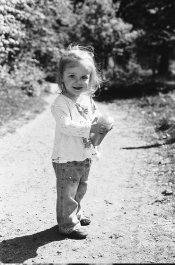
To me, the first image looks flat, your lab's printing is too low in mid-tone contrast, but typical of non-custom lab prints.
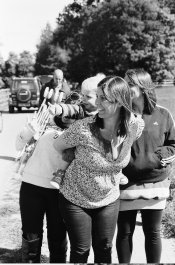
Second print looks ok-ish, technically. I'm sure it could benefit from dodging and burning but the negative was perhaps not particularly compelling.
Third image looks washed out. I suspect you weren't adequately shading the lens, and you might have some haze or something in the lens too, there's a lot of flare mudding the shadows in his face.

Use a lens-shade and if a lot of light falls on the lens be sure its clean coated glass, soup and print yourself, and shoot more.
Also, don't use a film because everyone says its good. Use a film because you've shot a few rolls and seen something you like from it. Look for success and then repeat what worked for you.
 
"Sent the film off to the lab and..." <---------- That's your problem right there.

You can't count on a lab to 1) develop conventional b&w film correctly or 2) print b&w negs decently. It looks like your negatives may be good--at least they have plenty of shadow detail, so a good printer could probably produce *much* nicer prints.

What he said! :wink:
 
Shoot another roll of FP4 at box speed, send it off to Ilford Photo's processing lab and see what comes back.
 
fp4 is a beautiful film when processed by someone who knows what they are doing. I would, as others have said, rate it at box speed. I'd also ditch the flash and stick with a straight-forward exposure. To me, these in-camera flashes aren't something worth using, particularly for fine art work. Is there a particular reason that you don't process on your own? it's much much cheaper than having a lab do it, and though it is a pain at first, you eventually learn to love it.
-Austin
 
Here you go. Your pics are fine, just printed too low in contrast.
 

Attachments

  • 61300008.jpg
    61300008.jpg
    854.9 KB · Views: 284
  • 61300014.jpg
    61300014.jpg
    824.1 KB · Views: 274
  • 61300015.jpg
    61300015.jpg
    776.9 KB · Views: 266
Nice, Chris! The OP will thank you!

Steve
 
Looking at the original pictures posted, and comparing them to Chris Crawford's edited versions of those pictures, it's obvious that the lab didn't print the negatives to their full capacity.

Ian Grant's account of safety versus quality hits the head on the nail.

What you can do, when it comes to having your lab developing your film, is to interview them. Ask them what chemistry they use, and how long they would normally process the FP4+ film. When you know that, you have at least one constant in your process. Then, exposure is entirely under your control. FP4+ has quite a bit of tolerance for exposure differences, but I would send them a test roll, where you bracket your exposures in normal contrast lighting. This way you can know more what to expect from them after they print all the versions. It's basically the only control you have when you send film to a lab. It will never be perfect until you find someone, usually charging a lot more, that pays attention to every frame they print. The extra money usually goes to cover the cost of all the prints that didn't turn out well.

Or, like others have suggested, you can do it at home on your own, because that allows you processing control as well.
 
Dear Ted,

I don't think your prints look too bad either.....but

When you send a monochrome film to most labs ( not all ) they frequently print it onto colour paper. To me monochrome films look inherently flat on colour paper, have an apparent confused grain structure due to the dyes used to construct colours in colour paper, and you will invariably have a colour caste. If you are using that service just for proof prints thats aok.

If you want a quality print go to a lab that prints onto mono and also controls their monochrome processing well. Someone suggested using our own lab, if you do the one thing I can absolutely guarantee is that the process is spot on, we will 'push or pull' process, we care for the negs, and we print
on mono paper....

Simon. ILFORD Photo / HARMAN technology Limited :
 
The third picture of the man holding the child is suffering from flare from the sky, which is lowering contrast in the image. Other than that, ditto what everyone else has said.

Peter Gomena
 
Photrio.com contains affiliate links to products. We may receive a commission for purchases made through these links.
To read our full affiliate disclosure statement please click Here.

PHOTRIO PARTNERS EQUALLY FUNDING OUR COMMUNITY:


Ilford ADOX Freestyle Photographic Stearman Press Weldon Color Lab Blue Moon Camera & Machine
Top Bottom