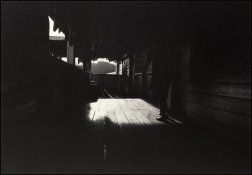
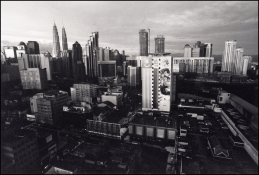
One month down the road and I'm still mostly where I was: contemplating. It's not easy to decide between all these papers. I've made some small progress though.
APUG'er jelke and I did a small paper exchange. He received Kentmere, I got some of Jelke's Adox Variotone (Glossy). I tried it out over the weekend (dismal weather here). And whow, this Adox/Moersch/Harman Variotone paper is really good!
I made four prints (18x24cm/7x9.5") of the same 35mm Neopan 400 negative, a reference negative that I know well. Two of the prints were left untoned, the other two were Selenium toned, for 4' and 10' respectively (Adox Selentoner 1+15).
--------------------------------------------------------------------
Some observations:
- Adox Variotone has an excellent tonal scale, from full black to brilliant white, and with subtle detail in the shadows. Untoned it is definitely nicer to my eye than my to-go-to paper, Kentmere FPVC (Glossy is the only finish still available). I did not make a direct comparison (same everything) between Variotone and Kentmere, but I have printed my reference negative on Kentmere in another size (30x40cm/12x16") before. Kentmere has muddier shadows and not as nice a tonal scale. That said, the difference isn't huge; both are fine papers on their own.
- Adox Variotone is tough. It's thick- as thick as Kentmere, and both are thicker than Adox MCC 110. I like thicker papers. Variotone doesn't kink easily; I tried and found it pretty much idiot-proof. This paper is 'mechanically' excellent.
- Adox Variotone Glossy's surface looks roughly the same to me as Kentmere FPVC Glossy. I dried all four sheet of Variotone to room temperature air (overnight). This gives a nice egg-shell finish. Very familiar, no surprises here.
- About toning in Selenium then:
APUG'er MarcoB 'warned' me in advance that Selenium works a bit differently on Kentmere than it does with most other papers. He was right! Selenium gives Kentmere a very visible boost in contrast/punch, by noticeably darkening the shadows, changing the tonal curve there quite a lot. Selenium is almost a must-use for Kentmere FPVC, it really helps you get the most out of this paper.
In the case of Adox Variotone the results are more subtle. There is no such dramatic increase in Dmax, not such an extra punch. In fact I couldn't see much of a change in contrast at all; maybe I'm spoilt with Kentmere in this respect.
The colour effects are also different. Kentmere turns purple-reddish, Variotone goes more towards brownish. Both discolourations are appealing, I wouldn't call one better than the other.
I toned one Variotone print for 4', another for 10'. There is a small difference, but most of the toning seems to happen in the first few minutes. Even with a untoned print kept next to the toning print it I found it difficult to know when the change in colour was still happening and when it had slowed down; I should have toned a bit shorter for meaningful results. Now both times gave more or less the same result.
Kentmere and Variotone tone (i.e. change colour) about as fast, but because Variotone's change in appearance is less towards the punchy, the toning process seems to happen slower- I don't believe it really is slower, only different (i.e. change in colour rather than Dmax).
--------------------------------------------------------------------
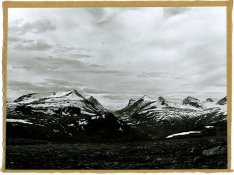
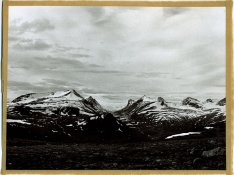
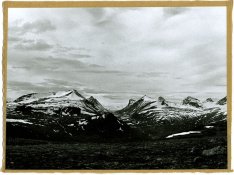
Below are uncorrected flatbed scans of three Variotone prints of my reference negative (29 June 2008, Sarek N.P., Sweden: view towards the valley Njoatsosvágge, from a location near Sähkok mountain). The first is untoned, the second Se-toned for 4', the third for 10'.
Not all three prints were exactly identically exposed, I did some burning of the sides and sky, and this wasn't very exact; these prints/scans are really just a play-around, not science. The colour of the scans on my laptop screen (uncalibrated, again no science) matches those of the actual prints quite well.
What am I trying to show? That Adox Variotone responds well to Selenium, that is turns a brownish colour rather than Kentmere's purple-red, that Se-toning does not so much affect the overall contrast (not as much as with Kentmere that is), and that the tonality of this paper is fine (and excellent if you were to look at the prints themselves, instead of at scans).
1. Adox Variotone, developed in Amaloco AM6006 (neutral developer), no toning
2. Adox Variotone, developed in Amaloco AM6006 (neutral developer), toned in Selenium 1+15 for 4'
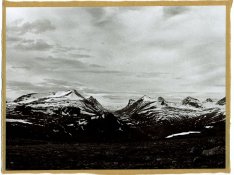
3. Adox Variotone, developed in Amaloco AM6006 (neutral developer), toned in Selenium 1+15 for 10'
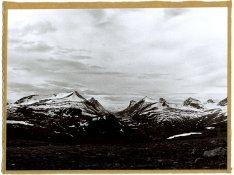
Variotone is an excellent paper that tones well in Selenium. Kentmere is also a fine paper, one that tones differently, not worse or better. Variotone has the edge in terms of tonality but I find Kentmere a fine paper in its own right (it *requires* Selenium toning though).
I think I will be perfectly happy working with Kentmere FPVC Glossy for some time to come. Or maybe not :confused:.



 ) to stick to one film and developer and learn to exploit that till the end of a decade?