• Welcome to Photrio!
    Registration is fast and free. Join today to unlock search, see fewer ads, and access all forum features.
    Click here to sign up

I was thinking about "outflanking" prints and I just don't get how it's better.

Cigar again

H
Cigar again

  • 0
  • 0
  • 11
Rainy Day Trees

A
Rainy Day Trees

  • 7
  • 1
  • 108

Recent Classifieds

Forum statistics

Threads
203,160
Messages
2,850,738
Members
101,705
Latest member
kyuut
Recent bookmarks
3

rpavich

Member
Allowing Ads
Joined
Aug 24, 2015
Messages
1,518
Location
West virginia, USA
Format
35mm
Just reading through some APUG threads and I've come across the idea of "outflanking" prints, and I confess that I just don't get how it's better than test strips. I read someone say; "if you think you should burn for 15 seconds then burn for 30 seconds because you want to know how far is too far"

That just doesn't make sense to me. If you over shoot on purpose, then you've wasted one iteration just as much as you've wasted if you had underestimated a burn time.

Can someone enlighten me?
 
If you overshoot you know it's somewhere between your two attempts (including the zero second initial one). If you undershoot you still don't have a range in which you're certain.
 
If you overshoot you know it's somewhere between your two attempts (including the zero second initial one). If you undershoot you still don't have a range in which you're certain.
I understand that part of it but what I don't get is why that's good.

Assume you think it's between 2 seconds and 20 seconds, so you shoot way high and use 30 seconds.

How is that better than trying 18 seconds if both are wrong?

You still have to try again based on your wrong guess.
 
Be careful, you are entering a phantom zone that has no end.
 
I understand that part of it but what I don't get is why that's good.

Assume you think it's between 2 seconds and 20 seconds, so you shoot way high and use 30 seconds.

How is that better than trying 18 seconds if both are wrong?

You still have to try again based on your wrong guess.

By saying 2 and 20 seconds are your too high and too low estimates you are outflanking your expected correct exposure (of 11).
You are, I think, being too literal.
In any case, I think the technique is more applicable to grade and contrast (although time and grade are intimately linked)
 
Test strips only test in specific areas, it doesn't test the whole print.

I make my first print somewhere in the middle (close to normal) then I go twice as far as I think I need to to fix it, this saves me time because it "sets a fence" on the other side or tells me I underestimated yet again. With this method the third print is normally very close and I can se where burn and dodge may help because I have real examples of what burn and dodge would do.
 
i love outflanking, its a great way to keep the paper companies in business !
cliveh is on the money, you have to be careful because once the jin is out of the bottle
youwon't have enough glasses to pour, and once you drink the magic you won't be able to stop
 
The opposite of Out Flanking is Creeping.
You can waste much more paper by creeping up to a density or contrast - than going past and coming back.


QUOTE=rpavich;1953844467]Just reading through some APUG threads and I've come across the idea of "outflanking" prints, and I confess that I just don't get how it's better than test strips. I read someone say; "if you think you should burn for 15 seconds then burn for 30 seconds because you want to know how far is too far"

That just doesn't make sense to me. If you over shoot on purpose, then you've wasted one iteration just as much as you've wasted if you had underestimated a burn time.

Can someone enlighten me?[/QUOTE]
 
Whenever I see a reference to "Out Flanking" I think of "sink the Bismarck!".

Out Flanking is just as usable with test strips.

And particularly useful with whole sheet test strip prints.
 
Sometimes I out flank because I may see different ways of interpreting a negative. I can't know for sure which I prefer until I do...
 
Darkroom printing process is a personal journey. Not all journeys are the shortest and most efficient, but do whatever you like. You'll be judged by the output only. I've got a good handle on my enlarger light output so my intuitive guesses are usually really close (except when I forget to stop down the lens after focusing wide open.) If I'm off on my first test patch (a piece from a sheet of 8x10 paper ripped in half 3 or 4 times) placed on an important part of the print, then my second patch is usually right on, or requires only a second or 2 adjustment for the first entire print exposure. But if someone does it differently, like using a full 8x10 paper for test strips, have at it. Whatever works for you.
 
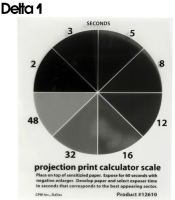
One of these will do it easily. http://www.bhphotovideo.com/bnh/con...oCFUiFfgodZH4Gow&is=REG&ap=y&m=Y&A=details&Q=

attachment.php
 

Attachments

  • Capture.PNG
    Capture.PNG
    228.2 KB · Views: 337
Out Flanking is just as usable with test strips.

And particularly useful with whole sheet test strip prints.

Exactly! And what Mark and Eddie said. I'm with Eddie... it's not just about trying to get the "right" exposure... sometimes you don't know what you're missing if you don't see what it looks like printed much darker or much lighter. And like Mark wrote, it can save steps in burning and dodging because you can see with your eyes what different amounts are going to do.

I didn't know they still made those exposure wheel thingies. I remember having a Kodak one when I was a teenager.... I used it when I first started printing, but then not so much after that.
 

Exactly! And what Mark and Eddie said. I'm with Eddie... it's not just about trying to get the "right" exposure... sometimes you don't know what you're missing if you don't see what it looks like printed much darker or much lighter. And like Mark wrote, it can save steps in burning and dodging because you can see with your eyes what different amounts are going to do.

I didn't know they still made those exposure wheel thingies. I remember having a Kodak one when I was a teenager.... I used it when I first started printing, but then not so much after that.

I have a Kodak one. It tells me a lot about dodging and burning exposures from one print.
 
I sort of know what a one stop exposure difference makes and I wing it from there. I'm an intuitive photographer and darkroom worker. Others, particularly engineer types prefer to have things quantified with step wedges and/or test strips. That's okay if it feels right for you.
 
i always found it hard to tell what an exposure and burning/dodging was going to look like from a strip or even a 1/2 strip of the print
and found making whole test prints after they DRIED DOWN gave me the best indication. while i was kind of joking / tongue in cheek about
keeping the paper suppliers in business, if you make a lot of photographs you might end up with 3 or 4 test prints for some
and more for the more diffiuclt ones. its best not to be stingy with paper, it gives you a better idea if what you are doing works or not,
and who knows maybe the next day after a good night sleep after your bleary eyed printing session ( that ended at 4am ) you might like
one of the other prints better. and with good notes you might be able to reproduce it, except for the developer, unless you saved some of the
finished tray and seasoned a new tray with it ( sometimes helps ).
 
i always found it hard to tell what an exposure and burning/dodging was going to look like from a strip or even a 1/2 strip of the print
and found making whole test prints after they DRIED DOWN gave me the best indication. while i was kind of joking / tongue in cheek about
keeping the paper suppliers in business, if you make a lot of photographs you might end up with 3 or 4 test prints for some
and more for the more diffiuclt ones. its best not to be stingy with paper, it gives you a better idea if what you are doing works or not,
and who knows maybe the next day after a good night sleep after your bleary eyed printing session ( that ended at 4am ) you might like
one of the other prints better. and with good notes you might be able to reproduce it, except for the developer, unless you saved some of the
finished tray and seasoned a new tray with it ( sometimes helps ).

I agree, switching from test strips to full sheets made a big difference for me.
 
I no longer use test strips. I use full sheets of paper and end the end save paper that way.
 
The last time I printed, years ago, I used test strips to get in the ballpark. Then I "outflanked" (though didn't know that was what it was called). I was learning, so there were times I also just made the same print with each filter to see what happened and how it looked. I wouldn't say I got good at it, but doing full sheets gave me a better idea of what I wanted, and what the changes (time or filter) would give me.
 
These are all good reasons to outflank instead of "creep". But I don't know if these two thoughts have been exactly put forth...

Lootens explains the reason to print test strips with extremely long exposures... to reveal possibilities that you might not otherwise have seen. His example shows a dramatic sky which looks OK at 10 seconds but he went on to print using 60 seconds.

The way I look at it, it's a confidence booster. When you see a strip that is "obviously" too dark and declare to yourself "that's too dark". You realize that you know something definite.
 
Thanks for the thoughtful replies everyone!

PS: I actually have one of those exposure wheel things; I like it and use it much of the time
 
Fact is that the more you print the more intuitive it becomes and your judgement of what will be about right becomes far better at which point you wou won't bother test strips so much. So trust your instincts and print lots and then you won't worry about these minor technicalties of whether one way is better than another.
On the other hand, if you only print once in a blue moon, then you'll never get really good at it whichever way you do it because you'll lack the judgement of what is right anyway.
 
Fact is that the more you print the more intuitive it becomes and your judgement of what will be about right becomes far better at which point you wou won't bother test strips so much. So trust your instincts ...

I don't know... I've been printing for more than 30 years. I think I'm a pretty good printer.

I use test strips every print, often several in different areas to determine a basic trial exposure complete with preliminary dodging and burning. I then make a full-sheet print, dry it down and then, with notepad and pencil in hand, make sketches and notes about how I want to change the print. My years of experience help me to arrive at an amount to change (e.g., 20% more exposure, dodge more here, etc.). But, as I hone in on a fine print, I outflank. I make a print too dark, one too light, one too contrasty, one too flat. Usually this happens organically during the refining process. All these prints get tacked up on a viewing board (with approximate gallery lighting) and evaluated together after having dried (simple drydown compensation just doesn't work).

Often, I like several of the options, but, by having made prints at the outside of my tolerance, I know what bandwidth I wish to stay in. I was going to say "having made prints at the extremes," but that's not really correct. The differences between just right and too much are often very, very subtle: 15 seconds more in the print developer, a fraction of a contrast grade, a second more or less exposure. The point is, you need to get to the point where you don't like the result and then move back toward center. This is really all there is to outflanking.

Of course, we all work differently. It's the end result that counts.

Best,

Doremus

 
Proper exposure and development go a long way toward nailing printing exposure. So does a contact sheet. 5x7 8x10 11x14 16x20 each require 1 stop more exposure than the next smaller size FROM 35 mm only.

Also my test strips cover important highlights and shadows. 1"x 8" generally works. Position with red filter or strip of mat board next to where the strip goes.

If I am printing a portrait, the strip goes across the eyes. Generally no more than one is required. Then look at your contact to decide if burn or dodge is required.

I reiterate, get your exposure/development down cold , and you will not go chasing your tail all over the darkroom to make a print.

Last tip. make your contact at 11x14 enlarger head height, take 5/10% of for the glass , close one stop for 8x, open one for 16x. You will be able to make an acceptable , not great, print first try. Mark the 11x14 position with tape or marker.

One last last tip, work with one film and one developer, and eliminate variables or you will spend all your time making tests.

I forgot, vc filter are same exposure for middle grey only, highlights & shadows change from grade to grade. I suggest you make tests to keeps whites consistent.
 
Photrio.com contains affiliate links to products. We may receive a commission for purchases made through these links.
To read our full affiliate disclosure statement please click Here.

PHOTRIO PARTNERS EQUALLY FUNDING OUR COMMUNITY:


Ilford ADOX Freestyle Photographic Stearman Press Weldon Color Lab Blue Moon Camera & Machine
Top Bottom