• Welcome to Photrio!
    Registration is fast and free. Join today to unlock search, see fewer ads, and access all forum features.
    Click here to sign up

I this LED light box can be scaled down for your enlarger

Forum statistics

Threads
203,435
Messages
2,854,671
Members
101,841
Latest member
Jannis
Recent bookmarks
0

Mainecoonmaniac

Member
Allowing Ads
Joined
Dec 10, 2009
Messages
6,295
Format
Multi Format
But this gentleman said this DIY light bank draws 100 watts which is equivalent to 1K in tungsten. It's dimmable so it's a plus for darkroom use.

https://www.youtube.com/watch?v=jLia59KfkSw

I would think if this was used with an enlarger, you would have to put some white plexiglas to diffuse the tiny specular LEDs.
 
That is slick. Having built some light boxes in this manner, I think his $$ is underestimated, unless maybe the plexi was laying about.
I haven't used the strips, but the component LED's have a voltage drop of about 3.2 and draw maybe 40mA, so about 120mW. A 1000W lamp would use over 800 component bulbs, which would take a robot to construct. They are also about .75c apiece, but it would be bright.

A small breadboard with maybe 20 component LED's could fit in my enlarger in place of the cold lamp, when that goes.
 
For my Beseler 45 head, I was trying to convert the condenser to an LED light source. I tried the LED strips and even with several thick layers of diffusion I could still see the individual lights. It's a challenging project.

I gave up and bought an LPL with the VCCE head. It's the greatest thing since forever.
 
parker, that's why I don't think the strips would work in the enlarger. The component LED's on a breadboard can be packed tightly, and their diffusion angles come in a wide range (the 180's are obviously more expensive.) I think there is something to it this, but I need another project right now like I need an extra hole in my head.
 
I have made an UV LED light box for alt processes. It's faster that the fluorescent box I made. I used the ones on aluminum stars soldered in series. My LED box is almost twice as fast as my fluorescent one.

But I've always wanted to convert my Beseler 45MXT into an 8x10 enlarger with LEDs. No time now :sad:
 
Great enlarger

I gave up and bought an LPL with the VCCE head. It's the greatest thing since forever.

UC Davis Art Studio darkroom has quite a few of them. They withstand student use pretty well.
 
I wonder if instead of diffusing LED banks, one could bounce them off a white surface? It would add to the size of the light head but may be something there.

I used to dupe 35mm slides onto 8x10 Velvia in an old Beseler printmaker 35 enlarger. I lined the lamp box with white paper, left the lamp in place, and replaced the front door with black foamcore with a cheap little flash unit taped to it, so the light came in the front and lit up the bulb and the lining. Worked great and gave me a "daylight" balanced enlarger with very even lighting. I used lighting gel scraps and ND scraps in the filter drawer to dial in the color and exposure. Got some really in-your-face 8x10's, back when you'd show agencies your work on a light box.
 
parker, that's why I don't think the strips would work in the enlarger. The component LED's on a breadboard can be packed tightly, and their diffusion angles come in a wide range (the 180's are obviously more expensive.) I think there is something to it this, but I need another project right now like I need an extra hole in my head.

Indeed, I decided I would rather just use something that works and get the job done that spend untold amounts of time trying to rig something up. Plus, the Beseler 45VXL was just YUUUGE!

In the process of fooling with this I did get ahold of some amazing LED sign diffusion material that looked promising but is now gathering dust. If anyone jumps on this project I'd be happy to send it along.
 
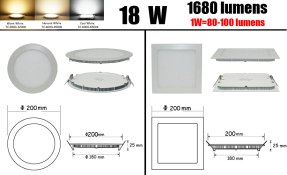
I converted my Bessler 45 enlarger to LED using one of these 18 Watt round lights that I purchased on Ebay.

I pulled off the condenser cone and set this on top of the condenser lens. You need to plug the light leaks to make it operational.

http://www.ebay.com/itm/6W-9W-12W-1...hash=item3a84f084c8:m:mpwaldlmjbV0Pjn2b2BbHGw


18W-1.jpg
 
When constructing a uniform light source based on a diffusing chamber...Whatever you do, the key is to ensure there is no direct path from light source to the exit port. Integrating spheres often use a baffle.

Flock interior with a flat white paint using titanium oxide as pigment (like Behr ultra flat white) or, even better, powdered PTFE as pigment.


Also ensure that when you look back into the exit port within the cone of the projected light path, all you see is a uniform white surface.


You can build up an integrating "sphere" out of a cardboard box if you had to, and get sufficient uniformity for scientific work.


Labsphere has a very good white paper available on their website which discusses how an integrating sphere works. I highly recommend reading it if you're interested in building a diffusing head or similar.
 
Last edited by a moderator:
I probably tested 20 different variations with and without the condensers, white paint inside the head, various light bulbs, diffusion glass etc. The only thing that worked was a 150W equivalent LED bulb along with a star shaped 1/2 stop ND gel filter to reverse the gradient.

With this I was only able to evenly light a 6x7 negative. To convert to 4x5 coverage would almost certainly require a custom LED array that would be a close match with the old Zone VI cold light.
 
Photrio.com contains affiliate links to products. We may receive a commission for purchases made through these links.
To read our full affiliate disclosure statement please click Here.

PHOTRIO PARTNERS EQUALLY FUNDING OUR COMMUNITY:


Ilford ADOX Freestyle Photographic Stearman Press Weldon Color Lab Blue Moon Camera & Machine
Top Bottom