
• Welcome to Photrio!
    Registration is fast and free. Join today to unlock search, see fewer ads, and access all forum features.
    Click here to sign up

I shoot film and my print is digital...'

Bad patch

H
Bad patch

  • 1
  • 0
  • 0
Valencia

A
Valencia

  • 2
  • 1
  • 68

Recent Classifieds

Forum statistics

Threads
203,098
Messages
2,849,774
Members
101,664
Latest member
logan.perrin
Recent bookmarks
0
Well, not every chaotic pile is a collection, in my view.

I put my piles in boxes so I call my photographs collections. Perhaps I am taking liberties.

The reason the SPARS Code for photographs idea came to me is that I was looking at images in the Gallery and thinking that there was no way many of those images originating on film are the digital equivalent of contact prints. I think there is a whole lot of monkeying around going on in the scanning software and Photoshop (or other digital image editing software) before they are posted, and that some film photographers are exaggerating their purity to the medium. I view the SPARS Code for photography sort of like a Catholic going to confession. "Forgive me Father for I have sinned", the sin being moving sliders around in a digital image edit program. Except that it is a congregational confession.
 
Last edited:
I put my piles in boxes so I call my photographs collections. Perhaps I am taking liberties.

Oh, in that case we're both collectioneurs.

I view the SPARS Code for photography sort of like a Catholic going to confession. "Forgive me Father for I have sinned", the sin being moving sliders around in a digital edit program.

You made me chuckle.

I figure the sliders are probably there for being monkeyed with. As far as I'm concerned, it's all fair game. As long as an AAA is still an AAA, of course.

Can we still debate about the choice for the 'A' for 'analog', though? Seems to me, 'A' might also refer to 'AI'.
 
I figure the sliders are probably there for being monkeyed with. As far as I'm concerned, it's all fair game. As long as an AAA is still an AAA, of course.

As long as you are being honest that you are monkeying around with your film image in a digital image editing program, monkey away.

Can we still debate about the choice for the 'A' for 'analog', though? Seems to me, 'A' might also refer to 'AI'.

It really should be an "F" for film, but I was trying to follow the SPARS Code lettering.
 
I was thinking that in the interests of transparency, we need to develop a SPARS code for photographic prints. A photograph that is from a film negative, not modified or modified using traditional darkroom techniques, and wet printed would be designated AAA. A photograph that is from a film negative, scanned (or scanned and edited in Photoshop), and printed as a C-print with a Noritsu or equivalent machine would be designated ADA. A photograph that is from a film negative, scanned (or scanned and edited in Photoshop), and printed as a inkjet print would be ADD. A photography that is from a digital camera, unedited or edited in Photoshop, and is printed as a inkjet print would be ADD. Those descriptions and designations may require some refinement. For example, you could have a DAA or a DAD if you used a film recorder to transfer a digital image to film.

How would you classify optical scanning without any digital application…?
 
How would you classify optical scanning without any digital application…?

Maybe I am being dense, but what is optical scanning without any digital application. The film scanning I am familiar with uses software, and usually there are adjustments available. Maybe there are some inexpensive scanning solutions that scan without giving you control over the result. One you have the scan from either, you can of course use Photoshop or other digital image editing software for further adjustment.
 
Maybe I am being dense, but what is optical scanning without any digital application. The film scanning I am familiar with uses software, and usually there are adjustments available. Maybe there are some inexpensive scanning solutions that scan without giving you control over the result. One you have the scan from either, you can of course use Photoshop or other digital image editing software for further adjustment.

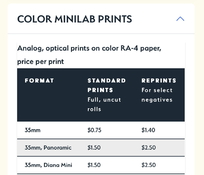
Blue Moon uses the optical method for prints from the negative rather that using any digital source…!
 

Attachments

  • IMG_2935.jpeg
    IMG_2935.jpeg
    148.2 KB · Views: 71
Blue Moon uses the optical method for prints from the negative rather that using any digital source…!

From Blue Moon's website:

"When we talk about optical printing, we are referring to analog printing done by optical printing machines. Our machines use real light shown through real lenses to expose real photosensitive paper right through your very own negatives! We are proud to be one of the last labs in the world to offer this color printing option to our customers. Honor your analog images by printing them the way they were intended!"

What Blue Moon does would be deemed AAA. No scanning is involved.

Your previous use of the word "scanning" for what Blue Moon does confused me:

How would you classify optical scanning without any digital application…?
 
From Blue Moon's website:

"When we talk about optical printing, we are referring to analog printing done by optical printing machines. Our machines use real light shown through real lenses to expose real photosensitive paper right through your very own negatives! We are proud to be one of the last labs in the world to offer this color printing option to our customers. Honor your analog images by printing them the way they were intended!"

What Blue Moon does would be deemed AAA. No scanning is involved.

Your previous use of the word "scanning" for what Blue Moon does confused me:

I misspoke…!
 
From Blue Moon's website:

"When we talk about optical printing, we are referring to analog printing done by optical printing machines. Our machines use real light shown through real lenses to expose real photosensitive paper right through your very own negatives! We are proud to be one of the last labs in the world to offer this color printing option to our customers. Honor your analog images by printing them the way they were intended!"

What Blue Moon does would be deemed AAA. No scanning is involved.

Just out of curiosity, has anyone had film printed optically by Blue Moon, and if so would they be willing to share a few negatives and the prints here, please?
 
I'm waiting for @Nikon 2 to post his prints when he gets them. He's got some on order, I understand. I'd certainly be interested, although of course it's always within the limitations of viewing a digital rendition of a real-world print and all that. But even so!
 
Just out of curiosity, has anyone had film printed optically by Blue Moon, and if so would they be willing to share a few negatives and the prints here, please?

My order from Blue Moon is on the way…!
 
Great, thanks for sharing.

Wouldn't it be great if we could compare the same negative optically printed and scanned on say a Frontier and printed (RA4)

I know there will be limitations viewing them on a digital platform but will there be a visible difference?
(BTW I would gladly pay the costs involved)
 
Great, thanks for sharing.

Wouldn't it be great if we could compare the same negative optically printed and scanned on say a Frontier and printed (RA4)

I know there will be limitations viewing them on a digital platform but will there be a visible difference?
(BTW I would gladly pay the costs involved)

I’ll share the results from Blue Moon...
 
Great, thanks for sharing.

Wouldn't it be great if we could compare the same negative optically printed and scanned on say a Frontier and printed (RA4)

I know there will be limitations viewing them on a digital platform but will there be a visible difference?
(BTW I would gladly pay the costs involved)

wouldn’t scanning an optical print to post online completely defeat the point of the comparison?
 
wouldn’t scanning an optical print to post online completely defeat the point of the comparison?

Yes, I think you would need to do a side by side comparison in person. Of course, there are a number of variables involved, but the digital intermediate step should be readily apparent. Those aren't exactly drum scanners in the Noritsu and Fuji Frontier machines. They are still pretty good for 8x10 and smaller. By the way, I was very unimpressed with RA4 prints from scanned black and white negatives processed in a Noritsu machine.
 
Last edited:
By the way, I was very unimpressed with RA4 prints from scanned black and white negatives processed in a Noritsu machine.

The other day, my fiancee was gifted a B&W RA4 print of a portrait of hers. I think we can still get the digital original so I can make a decent inkjet print from it.
 
wouldn’t scanning an optical print to post online completely defeat the point of the comparison?

It could but then we might see some difference (if one exists) in the side by side comparison.
It's only a simple experiment, not a full technical test.
 
Photrio.com contains affiliate links to products. We may receive a commission for purchases made through these links.
To read our full affiliate disclosure statement please click Here.

PHOTRIO PARTNERS EQUALLY FUNDING OUR COMMUNITY:


Ilford ADOX Freestyle Photographic Stearman Press Weldon Color Lab Blue Moon Camera & Machine
Top Bottom