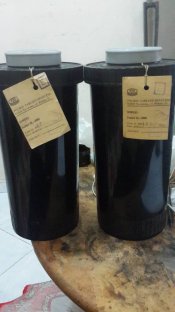
Where I've seen the rubber band used is with the stainless caps that used to come with stainless tanks. I agree, I doubt you'd get good results with it on a non-circular cap rim.



I looked into it.. and it became clear to me thatWhere I've seen the rubber band used is with the stainless caps that used to come with stainless tanks. I agree, I doubt you'd get good results with it on a non-circular cap rim.
yes dear brother..Never heard of Kalt either than here at Apug. But I do not want to make myself the standard either.
The design of these caps look like the those from a certain generation of Kindermann tanks, a german manufacturer long gone.
The funny thing with these is, that back then I did not even knew that SS tanks existed, let alone being made in Germany: never saw them in a shop, nor in a book or magazine. Only now I found them in old, german Kindermann catalogs. And so far I only came across some empty boxes for them. In general these german tanks seem rather being made for export.
I totally respect your opinion.I have many tanks of different types. My suggestion is that you try to solve this problem in a different way. High quality stainless steel tanks like Nikors had their lids and bottoms hand matched at the factory. They either didn't leak at all or leaked very little. Over time the lids and bottoms became mismatched and leaking became more common. Kindermann solved the problem by using plastic lids and caps. It was known that over time the lids would need to be replaced. I solved the leak problem in some tanks with stainless steel lids and caps by getting some 1/2 inch (approx. 12.5mm) wide rubber bands of the right circumference and putting them around the tank where the bottom meets the cap. You should be able to find a used stainless steel tank with a stainless steel lid and cap from an eBay seller who is willing/able to ship to your location. When will such a tank wear out? Maybe never. Two other possibilities may work for you. Yankee made plastic tanks which fit stainless steel reels and Kindermann also made tanks where the bottom, the lid and the cap are all plastic. These all plastic Kindermann tanks also accept stainless steel reels so you will still accomplish your goal of using less chemistry than, for example, Paterson type tanks.
I have another Polish tank that hears five rolls at once, Corox, but it is actually an evil tank that consumes a lot of chemistry. If you want to develop two rolls together, you must use 700 ml chemistry,,
While that tank that I am looking to prepare and repair, it consumes less than half a liter only..
I apologize to you, brother, I made a mistake in the ambiguity.I'm confused. Two rolls in 700 ml is better economy than one roll in 500 ml. Further, most 35mm stainless tanks only need 250 ml for a 35mm roll; I can do 35mm in my Paterson plastic tank in 290 ml (and two rolls of 120 on the same spiral in 500 ml).
Developing two films within one reel, this is a very difficult step and it needs someone like you who has blind experience and also loves to paddle..@mohmad khatab That makes perfect sense, I just hadn't caught that one of your tanks was a Paterson type and the other stainless. That's about what I'd expect, then. I do two rolls of 120 in my Paterson with 500 ml, but that's by loading the rolls end to end on a single spiral.
Either way, I'll stand behind the suggestion to use the design I linked above -- if nothing else, to test the fit with standard PLA before spending on an upgraded filament. There are black PLA and PETG filaments (printable with nearly any machine that has a heated bed) that are opaque enough for this, and PETG is chemical resistant (the same basic plastic used in drink bottles, with a treatment to make it print better). If the lid doesn't fit your stainless tank, then print the entire tank in black PETG -- cost should be almost the same as PLA, and it'll work for your need. The design is sized to take stainless reels, so should use the same amount of liquid.
.
The Polish tank is large and can develop five rolls at once. If you want to develop one roll, you must bring 400 ml, and if you want to develop two rolls, you must bring 700 ml.,
This is our miserable life in Egypt and the Arab countries.I hate when politics gets in the way of life.
The only other option I can come up with at the moment is to go ahead and print the lid (and tank, if necessary) with your cheap recycled filament (in black), with high infill and thick walls, then seal it with a two-part epoxy or acrylic resin (even polyester resin, like used for fiberglass) to keep the chemicals off the (potentially porous and reactive) printed plastic.
Yes, dear brother.That manufacturer is wellknown, but I did not know that they made tanks too.
A single-reel Jobo tank from that period even took 750mm. BUT this was for the reel in extended state.
If your reel can be extended to 60mm, you could use less fluid when developing just one 35mm film. Check this.
Concerning your leaking tank the best option to my mind would be to somehow get a new cap as spare as described above.
Concerning a makeshift sealing you might try a painter's masking tape, the extra-deep corrugated crepe version for roundings, to get around those knuckles.
hello brother,To clear up a few things: I do not suggest using a rubber band with a Paterson type tank. I do not suggest using a rubber band with a Kindermann type tank. I do not suggest using a rubber band with the cap of a stainless steel tank with a stainless steel lid, on the cap. I suggest that the OP should obtain a stainless steel tank and reel set where the tank, the lid and the cap are all stainless steel. If leaking takes place, it will do so where the tank meets the lid. It is along this seam that the rubber band should be placed. I don't get much leaking from the cap itself if it is seated properly.
On a separate note, if the OP wants to save money on chemistry, he might consider using a developer full strength and replenishing it. Even tanks which use a higher volume of chemistry per roll will benefit from the economy of replenishment.
Dear brother ,Dynachrome, one issue is the differenciation between "lid" and "cap".
It seems this is not only a issue for non-native speakers, when I look into dictionaries.
You advise a steel tank, others may advise just no steel tank, but a plastic tank with known tight sealing. However Mohmad had repeatedly noted here and in other threads that he has dfficulties obtaining products from abroad and would like to get along as best as possible with the things he already got.
hello brother,,Yes you may. I am American and I live in the U.S. Your English is much better than my Arabic. I have enough film developing equipment to sink a ship. If it would be helpful, I could send you a tank. You may contact me offline.
There are designs on Thingiverse for a complete developing tank for stainless type reels (that is, without a core). It might be simpler to print the complete tank (resized in the slicer to fit the reel(s) you already have) than to find a downloadable file for the pour-through lid and inversion cap to fit your existing stainless tank. I'd recommend printing in black, not the red used for the example print for the link -- I presume they used red for visibility...
There are designs on Thingiverse for a complete developing tank for stainless type reels (that is, without a core). It might be simpler to print the complete tank (resized in the slicer to fit the reel(s) you already have) than to find a downloadable file for the pour-through lid and inversion cap to fit your existing stainless tank. I'd recommend printing in black, not the red used for the example print for the link -- I presume they used red for visibility...
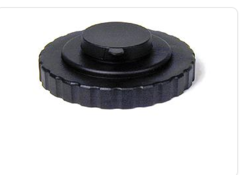
Where can I find the 3D printing file for this single cover?
Without precise dimensions, you can't find that cover. The diameter that fits to the tank body is critical, and without knowing that, no one could produce one of those in CAD or print one with any likelihood of it fitting. If you have the necessary measuring instruments, whoever you know who has a 3D printer can probably draw one up in whatever 3D CAD software they're used to using.
| Photrio.com contains affiliate links to products. We may receive a commission for purchases made through these links. To read our full affiliate disclosure statement please click Here. |
PHOTRIO PARTNERS EQUALLY FUNDING OUR COMMUNITY:  |