
• Welcome to Photrio!
    Registration is fast and free. Join today to unlock search, see fewer ads, and access all forum features.
    Click here to sign up

I do not like the extolled XTOL

Recent Classifieds

Forum statistics

Threads
202,847
Messages
2,846,471
Members
101,564
Latest member
swedafone
Recent bookmarks
0
All this talk about Xtol makes me want to use up my current developer inventory and work with it again. Replenished it was an astonishing developer. Particularly with TMax / Acros / Delta films (except D3200 which wasn't ideal). Stunning with Fp4 too.

Hi Thomas, I've found the same; Xtol has worked perfectly for me since 2008, but I don't like how it looks with D3200 (for that I like Ilfotec DDX). I've used Xtol more than any other developer, but honestly of the five or so developers I've tried they've all been great, reliable and easy to use. I just follow the directions and have been happy every time.
 
...
If Xtol has a mythical reputation to go impotent as plain water, then so does Microdol 1:3 have an equally undeserved reputation to lower film speed.
Why fool with Xtol? What's so good about it? Can it do one single thing Microdol 1:3 can't do? I don't write this with a confrontational attitude; I really don't know.

XTOL is a great all around developer which is very forgiving. XTOL slightly raises the film speed. All you need to know to answer your question in shown below, but replenished XTOL is even better.

XTOL.PNG
 
XTOL is a great all around developer which is very forgiving. XTOL slightly raises the film speed. All you need to know to answer your question in shown below, but replenished XTOL is even better.

View attachment 174121
Sirius:
As that graphic is no longer easily accessible, you should consider starting an APUG "Article" thread with it included.
 
Based on that chart, I don't know why anyone would choose HC-110 over D-76.
 
How is it not accessible? I have it on my hard drive for each on computer and they are backed up. We all know that digital files last forever, right?
 
Which publication does it come from? I was looking for it last night and couldn't find it.
 
It used to be hosted on the Eastman Kodak website as a standalone link. It was fairly hard to find, as it didn't show up on the most obvious index pages.
When Kodak Alaris took over total (not just maintenance) responsibility for the technical documentation for Kodak photographic still film and Kodak photo chemistry, all the links to the data on Eastman Kodak's website were disabled.
Unfortunately, while Kodak Alaris replaced those links with a significant number of new links, they didn't replace all the links.
Documentation respecting all the current Kodak still film and photo chemistry products can be found on the Kodak Alaris site, as can some of the most useful Kodak general reference documentation, but almost all the historical references are not linked to. And that chart is one that is no longer available through the normal channels.
 
Do you know what pub number it was? Google can turn up a surprising number of documents that are dead links on the Alaris site.
 
Based on that chart, I don't know why anyone would choose HC-110 over D-76.
I'm not sure that anyone chooses any of the developers listed solely on the factors listed in that chart.
If you are most concerned about grain, HC-110 dil B on that chart is better than all but X-Tol.
And of course, HC-110 is the only developer of the bunch that keeps as well as HC-110.
 
Never used HC-110, but isn't its magic power mostly on different dilution? So it may be important to find out what dilution was used in that publication.

I have mainly used Xtol, Harvey 777 and split Pyrocat. All are excellent. Harvey 777 definitely does some magic with the highlight....
 
Never used HC-110, but isn't its magic power mostly on different dilution? So it may be important to find out what dilution was used in that publication.
The chart states dilution B.
And for clarity, to the best of my knowledge, the chart isn't part of another publication.
 
I find the chart to be misleading, as we don't know how long the line segments (the discrete part) are. If the line is one mile long, for instance, one inch of a difference means nothing, whereas most folks here interpret the chart in absolute terms.
 
I find the chart to be misleading, as we don't know how long the line segments (the discrete part) are. If the line is one mile long, for instance, one inch of a difference means nothing, whereas most folks here interpret the chart in absolute terms.

Yes, nothing about how developers actually end up producing negatives with differing tonality. HC110 negs do not look the same as Xtol negs; you get high intensity highlights, with some understated midtones, while Xtol yields more midtown separation and less intense highlights. Theshadow detail comes into play of course, so film should be exposed differently based on what developer is used.
 
if i had known back then ( 14 years ago ) what i know now, i would do what les mclean does which is mix
another developer ( he uses rodinal FWIR ) in with it, and since i dont' use rodinal
it would probably end up being dektol. seeing mixed dektol and caffenolc work well, maybe dektol and xtol will work well too.. and i'd be using it now.
 
Last edited:
Or why they would choose it at all, for that matter.

Hilarious. HC-110 is a very popular developer. Easy to prepare exactly how much developer you need so that you are using fresh chemicals every time you need them. I've tried D-76 many times and don't see one bit of difference between that and HC-110 with my negatives. Since I prefer to use fresh developer every time, I always now choose HC-110.
 
Hilarious. HC-110 is a very popular developer. Easy to prepare exactly how much developer you need so that you are using fresh chemicals every time you need them. I've tried D-76 many times and don't see one bit of difference between that and HC-110 with my negatives. Since I prefer to use fresh developer every time, I always now choose HC-110.
You're preaching to the choir. I love HC-110. My point was that the chart makes it look like an underperformer.
 
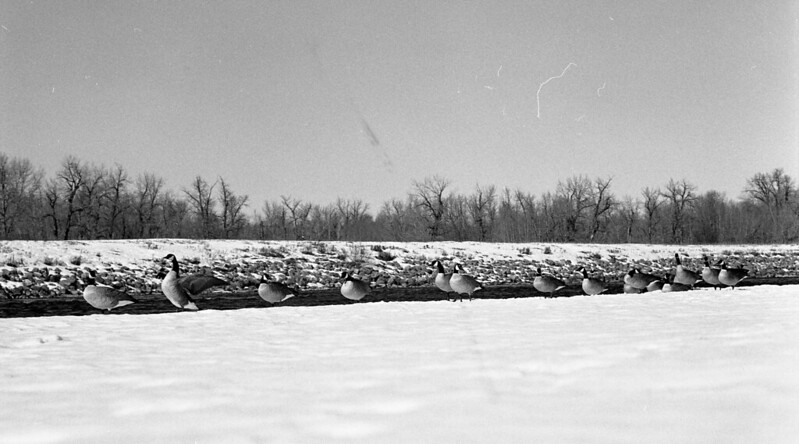
I didn't like it at first either, found jnainians assesment about flat images to be true. Well, that was in replenished stock solution with fuji acros. I can say after trying it diluted on kodak tri-x it passed expectation. 1:1 xtol on tri-x 400:
Canada Geese by Aaron, on Flickr

I switched from digital to make photos like this.
 
Last edited:
Photrio.com contains affiliate links to products. We may receive a commission for purchases made through these links.
To read our full affiliate disclosure statement please click Here.

PHOTRIO PARTNERS EQUALLY FUNDING OUR COMMUNITY:


Ilford ADOX Freestyle Photographic Stearman Press Weldon Color Lab Blue Moon Camera & Machine
Top Bottom