

• Welcome to Photrio!
    Registration is fast and free. Join today to unlock search, see fewer ads, and access all forum features.
    Click here to sign up

I am going to be developing photographic paper using the reagent from Instax film. Any advice?

22886.jpg

A
22886.jpg

  • 1
  • 0
  • 12
22890.jpg

A
22890.jpg

  • 0
  • 0
  • 9

Recent Classifieds

Forum statistics

Threads
204,342
Messages
2,867,382
Members
102,230
Latest member
sesuone
Recent bookmarks
0

nascarfann

Member
Joined
Apr 4, 2018
Messages
72
Location
Us
Format
35mm
I am going to be developing photographic paper using the reagent from Instax film. I have had quite a few people tell me that it is a bad idea, and that I should just use a monobath, but I am going to do it anyways. I have already successfully developed 35mm film with Instax pod reagent, and now I am planning on trying it with photographic paper. Any advice?
 
Low volume per pod, chemistry not optimized for b&w or RA4 (as in: completely different purpose and chemistry), viscosity may be an issue, costs.
 
I'm curious as to why you're wanting to try something like this.

Before offering really useful advice, it is kind of handy to know your actual goals. [Not knowing your goals leaves me with the suggested advice of "Don't", but that seems like it could either be the most useful or the most useless advice, depending on why you're actually poking around such an idea.]
 
I'm curious as to why you're wanting to try something like this.

Before offering really useful advice, it is kind of handy to know your actual goals. [Not knowing your goals leaves me with the suggested advice of "Don't", but that seems like it could either be the most useful or the most useless advice, depending on why you're actually poking around such an idea.]
Because I want to try an alternative process that no one has ever tried before. My goal is to make some photograms.
 
Because I want to try an alternative process that no one has ever tried before. My goal is to make some photograms.
The 'goo' doesn't contain any normal developing agent and does not contain any fixing agent. What did you get when you used it on film?
 
The 'goo' doesn't contain any normal developing agent and does not contain any fixing agent. What did you get when you used it on film?
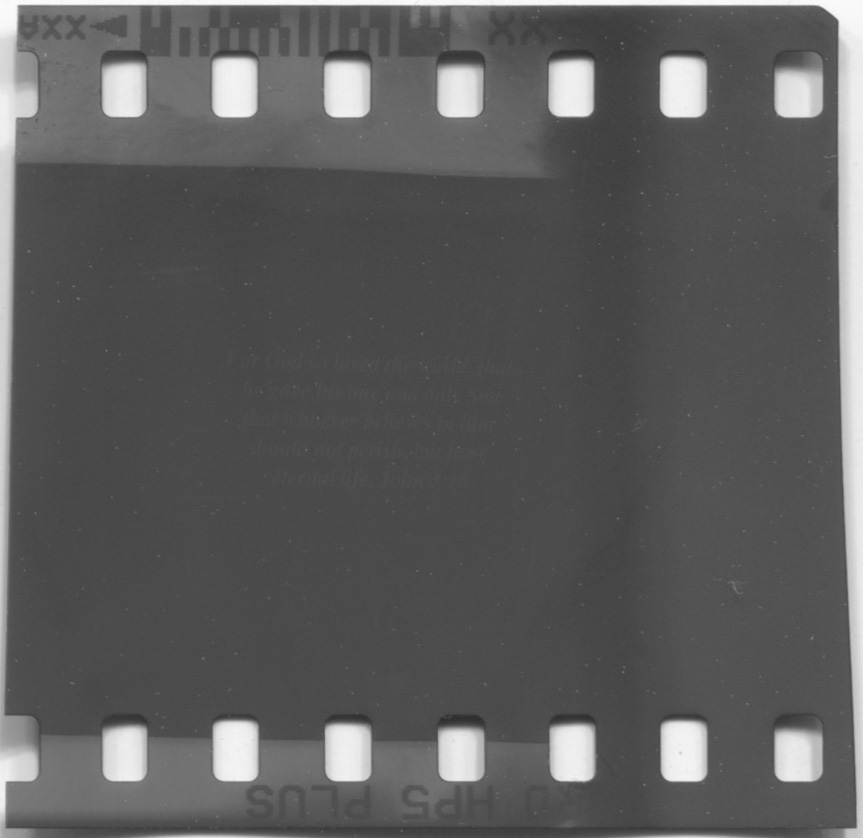
I got an image, though it seems to be faint and quite low contrast.
vYK8ZCI.jpg
gqFGGZE.jpg
 
Look here: United States Patent 3993638 by Lee Fleckenstein, for one of the initial patents on the Kodak (and now Fuji) instant film. The pod contains a Phenidone in low concentration that works as an ETA with the incorporated RDR (Redox Dye Releaser).

It will work, but weakly.

We see that above.

PE
 
Look here: United States Patent 3993638 by Lee Fleckenstein, for one of the initial patents on the Kodak (and now Fuji) instant film. The pod contains a Phenidone in low concentration that works as an ETA with the incorporated RDR (Redox Dye Releaser).

It will work, but weakly.

We see that above.

PE
Thank for the info. Does the pod contain fixer?
 
No. Not with the formulas that I am familiar with.

PE
Interesting, I wonder why my 35mm film I developed with Instax reagent has not faded yet after a few weeks. What are the several shutdown methods instant film uses?
 
Last edited:
Instant films use methods such as peel apart or acid / timing. When the film becomes acid enough, no more development or dye release will take place. Other chemicals can be added to the film to destroy the developing agent or the dye release mechanism to prevent further imaging.

If you develop film in the dark, then wash it, it is possible that no further development will take place. Formation of Silver Oxide is possible at the pod pH. IDK what your film is like, but I suggest that you try fixing a small piece to see if it clears further.

PE
 
Instant films use methods such as peel apart or acid / timing. When the film becomes acid enough, no more development or dye release will take place. Other chemicals can be added to the film to destroy the developing agent or the dye release mechanism to prevent further imaging.

If you develop film in the dark, then wash it, it is possible that no further development will take place. Formation of Silver Oxide is possible at the pod pH. IDK what your film is like, but I suggest that you try fixing a small piece to see if it clears further.

PE
Thank you for you help. So fixer clears film? I did not know that, I have the film soaking in kitchen salt fixer right now. How do instant films prevent the photo from disappearing if they only stop development rather than fix?
 
That will not fix the film, as in remove the silver salts. You need actual photographic fixer, ie a thiosulfate solution.
Henry Fox Talbot used salt to fix film! It seems to be working.
 
And those images cannot be safely examined under normal light, due to their relative impermanence.
Much discussion here about how salt water can stabilize images and, under fairly extreme circumstances, partially fix them: https://www.photrio.com/forum/threads/saltwater-as-fixer.34755/page-2

I wish cliveh was reading this thread. He's fixed/stabalized his salt prints with salt water and there seems to be a magic concentration ( that is sometimes elusive ) that does it the best. He's been doing it for some time, and I think he's been quite successful at preserving them. You are right tough if it wasn't for Sir John Herschel suggesting hypo who knows what salted paper prints we'd have to look at today.
 
Last edited:
Henry Fox Talbot used salt to fix film! It seems to be working.
You never get to see the millions of prints from the mid-1800s that were not stored in a cool, dark place and that faded and fogged beyond recognition as a result. We only get to admire the few that fared remarkably well for some reason or another.
 
Just curious....instant photos like Polaroid must have a fixer somewhere in there. But since these are not washed, how does the silver halide come out of the paper even as it is "fixed" to the fixer? I know from using Type 55's that the negatives were to be treated with sodium sulfite and/or washed with plain water to preserve them. And the positives were to be coated with this gooey material from a stick.

I have no clue how the darn things all work the way they do. Or did.

:Niranjan.
 
B&W instant is different than color instant. We are discussing color instant.

Color instant transfers a dye immage away from the Silver onto the mordant layer. B&W transfers a Silver image to a reciever that makes the Silver Halide become a metal image. They are not the same. In any event, you would have more chance using the pod from a B&W instant material than color.

Fixing is not totally necessary for B&W and is not at all important for color instant. In color, the Silver is located in one place and the dye is located in another place where we see it. In any case, for image permanence of a B&W image on film, fixing is needed and fixing means Hypo.

PE
 
B&W instant is different than color instant. We are discussing color instant.

Color instant transfers a dye immage away from the Silver onto the mordant layer. B&W transfers a Silver image to a reciever that makes the Silver Halide become a metal image. They are not the same. In any event, you would have more chance using the pod from a B&W instant material than color.

Fixing is not totally necessary for B&W and is not at all important for color instant. In color, the Silver is located in one place and the dye is located in another place where we see it. In any case, for image permanence of a B&W image on film, fixing is needed and fixing means Hypo.

PE
Thanks for the info. I found this here http://www.chemistryislife.com/the-chemistry-of-instant-polaroid-film which says that instant film contains Potassium thiosulfate. Not sure if this website is correct, it has a disclaimer that "All content and webpages on this website were created by High School students!" It would make more sense if it contained hypo since my clipping of 35mm film was out in bright light and has not faded. Would Polaroid Originals black and white reagent be better?
 
Photrio.com contains affiliate links to products. We may receive a commission for purchases made through these links.
To read our full affiliate disclosure statement please click Here.

PHOTRIO PARTNERS EQUALLY FUNDING OUR COMMUNITY:


Ilford ADOX Freestyle Photographic Stearman Press Weldon Color Lab Blue Moon Camera & Machine
Top Bottom