
• Welcome to Photrio!
    Registration is fast and free. Join today to unlock search, see fewer ads, and access all forum features.
    Click here to sign up

I actually tried it....

Forum statistics

Threads
203,313
Messages
2,852,825
Members
101,776
Latest member
devixluvic
Recent bookmarks
2

Pfiltz

Member
Allowing Ads
Joined
Nov 20, 2011
Messages
175
Location
NW TN. USA
Format
Multi Format
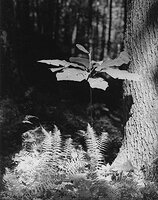
I've read on other forums about PN's and thought I would try it. I shot just one yesterday, due to time constraints. I metered for an ISO of 3. The image came out or looked to come out, close, but still would need tweaking for the next sheet.

My question is, now that you have a PN, how do you separate it from the backing to use it as a negative for printing purposes?

Did I mention that this stuff is FUN! :wink:
 
You don't separate it. You either use it as it is or apply wax or oil to the back to make it more transparent.


Steve.
 
OH!

I read some where that folks boiled the paper, and gently peeled it off. I tried that with HOT tap water, and my fingers couldn't take it... I try your approach :smile:
 
Just use it as-is for contact printing, also you can use pencil etc. on the back of the paper neg (or a sheet of tracing paper if you don't want to make permanent adjustments) in order to hold back selected areas.

If you want to make a larger version of the contact-print, then re-photograph it and use that neg in the enlarger. Pulling the film used for the copy might be helpful, depending on what the contact-print looks like.

I don't know anyone who is stripping the emulsion off paper for use in an enlarger. Is there anyone?
 
Remember that when you contact print it, you position it emulsion to emulsion, otherwise your print will be very soft.
Stripping the image might be possible with RC, but I doubt you could get it clean enough to enlarge, I've never tried it though.
 
Good point from Bdial, it has to be said just in case. Also a thick piece of glass on top, or using a contact-printing frame, will help in maintaining the resolution of the neg.
 
Another neat thing when doing a contact print with a paper negative is note the different results you get with the type of paper. RC will get you a smoother result, while FB will incorporate some of the paper's texture into the finished print, making it look more like an antique. See my gallery for a few examples with FB.
 
And then there's Harman Direct Positive, which I'm dying to try in the pinhole I'm going to build over Christmas.
 
I highly recommend you endeavor to experiment with X-Ray film.
 
I love paper negatives. I know Joe Van Cleave is around here somewhere, and I learned what I know by reading his posts over at f295.org. He likes to use graded paper, but I've had a lot of fun with VC paper. I preflash the green sensitive emulsion and shoot through a yellow filter... they have a neat ortho look to them. I like the atmospheric feeling and aerial perspective that the strong blue sensitivity gives. I've had trouble with my contact prints being soft ( with both film and paper negatives ).. I think I need a heavier piece of glass. Have fun!
 
I've had trouble with my contact prints being soft ( with both film and paper negatives ).. I think I need a heavier piece of glass. Have fun!

How important is the weight of the glass? I've been using framing glass and noticed some uneven softness in places
 
Photrio.com contains affiliate links to products. We may receive a commission for purchases made through these links.
To read our full affiliate disclosure statement please click Here.

PHOTRIO PARTNERS EQUALLY FUNDING OUR COMMUNITY:


Ilford ADOX Freestyle Photographic Stearman Press Weldon Color Lab Blue Moon Camera & Machine
Top Bottom
