• Welcome to Photrio!
    Registration is fast and free. Join today to unlock search, see fewer ads, and access all forum features.
    Click here to sign up

HP5+, Pyrocat, Extreme Minimal Agitation

Recent Classifieds

Forum statistics

Threads
203,006
Messages
2,848,589
Members
101,595
Latest member
Kellaphoto
Recent bookmarks
4

jstraw

Member
Allowing Ads
Joined
Aug 27, 2006
Messages
2,699
Location
Topeka, Kans
Format
Multi Format
Curious if any one is doing this with HP5+ (Pyrocat [MC or HD], Extreme Minimal Agitation) and if so, what dilutions as times are you using.

Thanks.
 
Why would someone want to use what I see as a semi-stand development with rapid exhaustion developer?

What is the goal?
 
Well, the reason I want to do that with HP5+ is to make negatives as good with a faster film, as the ones I'm making that way with FP4+ already.

Initially, the goal was to get the edge effects and accutance of a staining developer in EMA with a product with a long shelf life that I could buy in liquid form and measure out in small quantities, on a per-use basis. I tried Pyrocat MC in glycol with FP4+ and I like the results.
 
Are the results with such a developer that much different than simply using the standard agitation? If I understand correctly, the developer already is the type to enhance edge effects.
 
TFC, I'm using 1.5:1:200 at 60min for TF4+ with an SBR of 6, per Sandy King's input. I'm thinking of trying that. with a upward time adjustment of 1.125:1, since I'm seeing that with most developers, that's about what HP5+ requires compared to FP4+.

I was hoping to get some input from others using that film, developer and agitation method.

Robert, I'm after the micro-contrast that occurs with the localized exhaustion of the developer in contact with the high-density areas of exposure. It's a feature, not a bug.
 
Good luck with your project. I used Pyrocat-MC for a couple of years, at the same time as a friend of mine was doing Pyrocat-HD. Different films, Tri-X, FP4+, TMY-2, Neopan 400. We were both very happy with it, and both arrived at agitation every three minutes.
Then, at almost the same time, we both encountered problems with uneven development. He ended up with TMax and I went with Xtol and Edwal 12. He has recently revisited Pyrocat, but with rotary development. A little bit less acutance, but nice negatives that seem to print very well.

For me, I never went back, because I didn't find that much of an improvement in acutance or sharpness, not enough to matter. The replenished Xtol is mighty sharp, and doesn't suffer from the weird highlight tonality that I get from extreme minimal agitation. But you may shoot subject matter that's a little different and it is more noticeable.

I think you can probably have some good luck with it. All I'm saying is that if you get unevenly developed negatives, don't be surprised. It may never happen to you, but I think it's fair to let you know there is a distinct possibility of it.
 
Last edited by a moderator:
TFC, I'm using 1.5:1:200 at 60min for TF4+ with an SBR of 6, per Sandy King's input. I'm thinking of trying that. with a upward time adjustment of 1.125:1, since I'm seeing that with most developers, that's about what HP5+ requires compared to FP4+.

I was hoping to get some input from others using that film, developer and agitation method.

Robert, I'm after the micro-contrast that occurs with the localized exhaustion of the developer in contact with the high-density areas of exposure. It's a feature, not a bug.

That seems like an awfully long time. How do the negatives print? Minimal agitation doesn't like overdevelopment. I use 1.5:1:175 for around 40 minutes at 70°F with a normal negative. I agitate vigorously and continuously for the 1st minute and then for 10 seconds halfway through development. They can look pretty thin and still print beautifully because there's so much stain.
 
Well, the reason I want to do that with HP5+ is to make negatives as good with a faster film, as the ones I'm making that way with FP4+ already.

Then use FP4 with a larger aperture.
 
They look fine to me. I'm still running tests and haven't done any finely manipulated prints from negatives produced this way yet. I can scan something soon.

My thinking is that in terms of overall density, the difference between 60 and 40 minutes may not be much. I believe that the local exhaustion occurs in the highlight areas much sooner than where there's shadow density being built.
 
(there was a url link here which no longer exists),
I get the micro contrast. Im actually surprised that developer with such high depletion rates works well being used in that method.

Im ok taking your word for it. :smile:
 
(there was a url link here which no longer exists),
I get the micro contrast. Im actually surprised that developer with such high depletion rates works well being used in that method.

Im ok taking your word for it. :smile:

I'm not (entirely) wed to one developer. I do hate starting over and over...I'm eager to hear what you'd consider a better choice. I did have good luck with 510 Pyro in the past, when I could get it in a ready-to-use form. I was not good at mixing my own.

What do you use that might serve me better than Pyrocat?
 
Curious if any one is doing this with HP5+ (Pyrocat [MC or HD], Extreme Minimal Agitation) and if so, what dilutions as times are you using.

HP5+ and stand/semi-stand in Pyrocat-HD is sublime. Unbelievable edge effects. I develop in BTZS tubes (8x10). It takes 1200ml of diluted developer to fill an 8x10 tube (standing), therefore, my dilution is 1:1:240 (5ml A + 5ml B + 1200ml water).
My development time is 1 hour. I agitate (by rolling) for the first minute, then about 5 secs every 20 minutes. I always remove the film after I agitate, invert and reinsert.
It is wise to shoot a backup just incase of excessive bromide drag or mottling. I used to have these issues, but inverting the film inside the tube has eliminated them.

I should also add that stand development is not recommended for all types of images. A negative where the local contrasts are high, and lots of textures, would work very well. I once semi-stood a negative which had a softly lit scene with fog... and it just looks yucky.
 
HP5+ and stand/semi-stand in Pyrocat-HD is sublime. Unbelievable edge effects. I develop in BTZS tubes (8x10). It takes 1200ml of diluted developer to fill an 8x10 tube (standing), therefore, my dilution is 1:1:240 (5ml A + 5ml B + 1200ml water).
My development time is 1 hour. I agitate (by rolling) for the first minute, then about 5 secs every 20 minutes. I always remove the film after I agitate, invert and reinsert.
It is wise to shoot a backup just incase of excessive bromide drag or mottling. I used to have these issues, but inverting the film inside the tube has eliminated them.

I should also add that stand development is not recommended for all types of images. A negative where the local contrasts are high, and lots of textures, would work very well. I once semi-stood a negative which had a softly lit scene with fog... and it just looks yucky.

In a sense, this is very similar to what I'm doing. Thanks for the input.

I can see that I do need to have a method for more continuous-tone images.
 
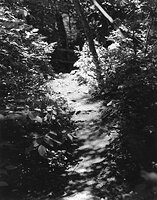
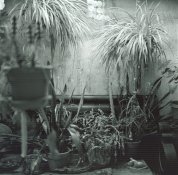
Those are really something, Rod. I don't see exposure information on those. Any idea how long those exposures were?

The Panoramic was 2m 35s

The 6x9 was 1m 55s

You may enjoy OBSIDIAN AQUA, it is dirt cheap to make and use, lasts indefinitely and makes very nice negatives. That and 510-PYRO are all I use these days...

RR
 
It was asked, how easy the negatives were to print, which are produced with FP4+ in Pyrocat MC 1.5.1.200 for 60min.

Here's an absolutely straight grade 2 print on Arista EDU VC. Print time is 20.1 seconds at f16. Development is 2 minutes in Liquidol 1:9. Toning is six minutes in Legacy Pro selenium.

I did nothing but straighten the scan and crop the edges in Photoshop.

Apologies for the scan lines. My scanner is lousy.
 

Attachments

  • fp4pmc151200aedug2mttmbsel396_6min.jpg
    fp4pmc151200aedug2mttmbsel396_6min.jpg
    499.9 KB · Views: 436
It was asked, how easy the negatives were to print, which are produced with FP4+ in Pyrocat MC 1.5.1.200 for 60min.

Here's an absolutely straight grade 2 print on Arista EDU VC. Print time is 20.1 seconds at f16. Development is 2 minutes in Liquidol 1:9. Toning is six minutes in Legacy Pro selenium.

I did nothing but straighten the scan and crop the edges in Photoshop.

Apologies for the scan lines. My scanner is lousy.


Lovely tonal range. Clearly a nicely exposed and developed negative...


:wink:


RR
 
Goodness me! No! It surely is well exposed and developed.


RR

Whew. The ellipse and the wink threw me.

I should also mentioned that by "straight, grade 2 print," I mean there was no deviation from my proper proof (minimum time for maximum black) for that film and paper combination. That's just a baseline proof. I can certainly understand why many don't want to spend an hour souping film but there's nothing wrong with the result.
 
Why would someone want to use what I see as a semi-stand development with rapid exhaustion developer?

What is the goal?

I would imagine Rapid Exhaustion Dev. is a relative and subjective term to each of us. That said, edge effects and more importantly micro contrast manipulation / control is a direct product of developer exhaustion, reduced agitation and length of time in concert with one another.

I have used strictly FP 4 and HP 5 and Pyrocat HD for nearly 10 years with Extreme Reduced Agitation development and can speak to almost any environmental conditions which can be photographed.

I have and will continue to say, the process, as near a magic bullet as you could hope for is much more about the creative manipulation of scene contrast than any sharpness gain, perceived or otherwise.

If there is interest I can share what my HP 5 development times are.

Cheers, SS
 
Photrio.com contains affiliate links to products. We may receive a commission for purchases made through these links.
To read our full affiliate disclosure statement please click Here.

PHOTRIO PARTNERS EQUALLY FUNDING OUR COMMUNITY:



Ilford ADOX Freestyle Photographic Stearman Press Weldon Color Lab Blue Moon Camera & Machine
Top Bottom