

• Welcome to Photrio!
    Registration is fast and free. Join today to unlock search, see fewer ads, and access all forum features.
    Click here to sign up

hp5, hc110 dilution h problem

ptloboscarmelEIR3.jpg

A
ptloboscarmelEIR3.jpg

  • jhw
  • Dec 15, 2025
  • 0
  • 0
  • 20
Tree Farm

H
Tree Farm

  • 1
  • 0
  • 41

Forum statistics

Threads
201,213
Messages
2,820,529
Members
100,589
Latest member
rando
Recent bookmarks
0

cjbecker

Member
Allowing Ads
Joined
Dec 9, 2010
Messages
1,400
Location
IN
Format
Traditional
I am going to run some tests soon but there was something wrong and I hope the fellow apugers can help me out.

I shot a roll of hp5 at iso 640.

Developed it in hc110 dilution h for 15 mins at 20c, which the recommended time for dilution b is 7.5 minutes at 20c for hp5 at 800, I doubled that time to get the time for dilution h.

The agitation was once every minute.

The negatives that I got were very light, or very un dense.

The thing that I can’t understand is how could the negatives come out so light/un dense when I shot it a 640 and developed with a common time for iso 800. The negatives should be denser.

Here is a straight scan, I did not let the scanner do anything.
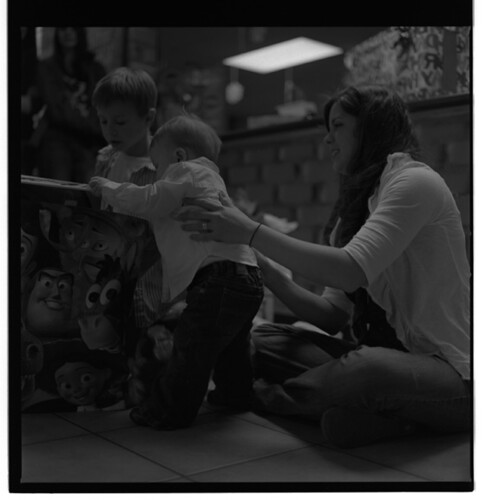


Any hints or help would be great, thank you.

I would using a incident meter and was metering for the bright side of the face to get acceptable shutter speeds. Would that been enough to make the negatives this un dense? I hope the problem was my metering because hc 110 is very nice to use.
 
Last edited by a moderator:

hpulley

Member
Allowing Ads
Joined
Oct 6, 2010
Messages
2,207
Location
Guelph, Onta
Format
Multi Format
Why did you use dilution H? Don't use low dilutions for push processing. Also make sure that you use the minimum recommended HC-110 per roll which is 6mL of concentrate which means dilution B for 35mm processing most of the time. You can get away with a 120 roll at dilution H because you end up with the same amount in 500mL of working solution but with just 250mL of working solution, dilution H is too low for one roll of 35mm film, not enough developer especially for push processing.

Generally dilution B is recommended for pushing or dilution A for really hard pushes.
 
Joined
Jan 21, 2003
Messages
15,712
Location
Switzerland
Format
Multi Format
It seems you are not in natural lighting, but rather artificial lighting, in which case the film speed is actually lowered.

In order to get an accurate assessment of what has gone wrong, shoot a roll outdoors in broad daylight, using the Sunny 16 rule.
So, roughly 1/500th second exposure at f/16, which would equate to an exposure index of 500.

Then develop it, and please take hpulley's comments above seriously, about having enough HC-110 concentrate for each roll of film. It is important.

If you still don't have enough density and highlight brightness, you need to develop the film longer, regardless of what other people recommend.
It isn't likely to be a shutter problem, because I have never heard of a shutter that is significantly FASTER than the stated shutter speed, causing underexposure.
It could also be a metering problem, which is why I am suggesting using the Sunny 16 rule above, to take that aspect out of the equation.

Good luck.

- Thomas
 
OP
OP
cjbecker

cjbecker

Member
Allowing Ads
Joined
Dec 9, 2010
Messages
1,400
Location
IN
Format
Traditional
Why did you use dilution H? Don't use low dilutions for push processing. Also make sure that you use the minimum recommended HC-110 per roll which is 6mL of concentrate which means dilution B for 35mm processing most of the time. You can get away with a 120 roll at dilution H because you end up with the same amount in 500mL of working solution but with just 250mL of working solution, dilution H is too low for one roll of 35mm film, not enough developer especially for push processing.

Generally dilution B is recommended for pushing or dilution A for really hard pushes.

I was shooting 120. My mix was almost 600 parts water and 9.4 parts hc110.

Also I did not know pushing was not good with dilution h, I will try using the dilutions b and a.

The reason that I used dilution h was to get longer developing times.
 
OP
OP
cjbecker

cjbecker

Member
Allowing Ads
Joined
Dec 9, 2010
Messages
1,400
Location
IN
Format
Traditional
It seems you are not in natural lighting, but rather artificial lighting, in which case the film speed is actually lowered.

In order to get an accurate assessment of what has gone wrong, shoot a roll outdoors in broad daylight, using the Sunny 16 rule.
So, roughly 1/500th second exposure at f/16, which would equate to an exposure index of 500.

Then develop it, and please take hpulley's comments above seriously, about having enough HC-110 concentrate for each roll of film. It is important.

If you still don't have enough density and highlight brightness, you need to develop the film longer, regardless of what other people recommend.
It isn't likely to be a shutter problem, because I have never heard of a shutter that is significantly FASTER than the stated shutter speed, causing underexposure.
It could also be a metering problem, which is why I am suggesting using the Sunny 16 rule above, to take that aspect out of the equation.

Good luck.

- Thomas

Yes I was indoors.

Also I will give what you said a try about eliminating the meter and try shooting some outside.
 

holmburgers

Member
Allowing Ads
Joined
Aug 13, 2009
Messages
4,439
Location
Vienna, Austria
Format
Multi Format
Sorry, kind of unrelated, but can someone tell me I'm not crazy?

Dilution A is 1:15, B is 1:31, C is 1:19 and D is 1:39. Ok, why would Kodak choose to arbitrarily make C more concentrated than B? Am I going insane or is Kodak?
 

hpulley

Member
Allowing Ads
Joined
Oct 6, 2010
Messages
2,207
Location
Guelph, Onta
Format
Multi Format
I was shooting 120. My mix was almost 600 parts water and 9.4 parts hc110.

Also I did not know pushing was not good with dilution h, I will try using the dilutions b and a.

The reason that I used dilution h was to get longer developing times.

7.5 minutes is a decent amount of time. Less than 5 minutes is not ideal.

What agitation were you using? I use 4 inversions every minute during the first 10s including the first minute.

Check the film leader too, is it dense or thin? How old is your HC-110? Stored as concentrate or stock? Full bottle or half empty?
 
OP
OP
cjbecker

cjbecker

Member
Allowing Ads
Joined
Dec 9, 2010
Messages
1,400
Location
IN
Format
Traditional
I was shooting 120 so there was no leader.

The hc110 is half full, kept at concentrate and is under 1 year old.

I agitation was consistant for first 15 seconds and then one twist every minute.
 

hpulley

Member
Allowing Ads
Joined
Oct 6, 2010
Messages
2,207
Location
Guelph, Onta
Format
Multi Format
Duh, of course no leader. Sorry... were there any bright highlights like interior lamps in shots that should have been at D-max? If so, are they dense as they should be or also thin?

I think more agitation is needed. 10s per minute is recommended by Ilford.

Kept as concentrate HC-110 should last forever so I doubt that was it. Should have been enough HC-110 for a 120 roll. Try more agitation, dilution B and if those still fail to give you the results you need then it could be that the metering was fooled by interior lights and you underexposed the scenes.
 
Joined
Jan 21, 2003
Messages
15,712
Location
Switzerland
Format
Multi Format
I too am fairly convinced it's underexposure, but possibly in combination with under-development, since it's just dark all over without any bright highlights.

I would check exposure before checking development though. One thing at a time to get to the bottom of what the problem actually is. Just to make sure we are not addressing the symptoms, but rather the problem.

Duh, of course no leader. Sorry... were there any bright highlights like interior lamps in shots that should have been at D-max? If so, are they dense as they should be or also thin?

I think more agitation is needed. 10s per minute is recommended by Ilford.

Kept as concentrate HC-110 should last forever so I doubt that was it. Should have been enough HC-110 for a 120 roll. Try more agitation, dilution B and if those still fail to give you the results you need then it could be that the metering was fooled by interior lights and you underexposed the scenes.
 

Angelo di Mango

Member
Allowing Ads
Joined
Jan 21, 2008
Messages
78
Location
BOURGOIN-JALLIEU, France
Format
Medium Format
I recently shot a roll of HP5+ at iso 800 and souped it in HC-110 dil.B for 7.5mns but as i am not used to this developer, i checked on the Kodak charts and they recommend to agitate every 30 sec,. So I did it and the film came out very well.
So your problem might come from a lack of agitation.
 

MattKing

Moderator
Moderator
Allowing Ads
Joined
Apr 24, 2005
Messages
54,718
Location
Delta, BC Canada
Format
Medium Format
Sorry, kind of unrelated, but can someone tell me I'm not crazy?

Dilution A is 1:15, B is 1:31, C is 1:19 and D is 1:39. Ok, why would Kodak choose to arbitrarily make C more concentrated than B? Am I going insane or is Kodak?

According to Michael Covington's HC-110 resource:

"Dilutions C, D, and E seem to have been designed to match, respectively, the developing times of DK-50, DK-50 1:1, and DK-50 1:2 with sheet film (Carroll, Photographic Lab Handbook, 1979)."

Here's the link:

http://www.covingtoninnovations.com/hc110/

It is useful to remember that HC110 was originally designed to be used (often with replenishment) in commercial/mechanized environments.
 

holmburgers

Member
Allowing Ads
Joined
Aug 13, 2009
Messages
4,439
Location
Vienna, Austria
Format
Multi Format
Thanks Matt, I don't know why they had to break the sequence to do that, but at least there's a reason. I swear I looked... just not hard enough I guess.

I guess that means I'm not crazy.
 

MattKing

Moderator
Moderator
Allowing Ads
Joined
Apr 24, 2005
Messages
54,718
Location
Delta, BC Canada
Format
Medium Format
I was shooting 120. My mix was almost 600 parts water and 9.4 parts hc110.

Also I did not know pushing was not good with dilution h, I will try using the dilutions b and a.

The reason that I used dilution h was to get longer developing times.

When you say 600 parts water and 9.4 parts hc110, do you mean 600 ml water and 9.4 ml hc110, or is the amount of hc110 syrup less than 9.4 ml?

And to be clear, is your hc110 the more concentrated North American version, or the more dilute European version?
 

Gerald C Koch

Member
Allowing Ads
Joined
Jul 12, 2010
Messages
8,131
Location
Southern USA
Format
Multi Format
Thanks Matt, I don't know why they had to break the sequence to do that, but at least there's a reason. I swear I looked... just not hard enough I guess.

I guess that means I'm not crazy.

Don't think sequence -- there is no sequence. As explained the various dilutions have a different purpose that of duplicating the development activity of other Kodak developers. People get into trouble when they make assumptions.
 

holmburgers

Member
Allowing Ads
Joined
Aug 13, 2009
Messages
4,439
Location
Vienna, Austria
Format
Multi Format
Well when a scale is chosen arbitrarily (letters), and that scale usually follows a sequence (alphabetical order), one should be able to reasonably assume that there is some logical order to it. Only 2 dilutions don't follow the pattern; C & H.

Plus given Kodak's reputation for mistakes in their literature...
 
OP
OP
cjbecker

cjbecker

Member
Allowing Ads
Joined
Dec 9, 2010
Messages
1,400
Location
IN
Format
Traditional
When you say 600 parts water and 9.4 parts hc110, do you mean 600 ml water and 9.4 ml hc110, or is the amount of hc110 syrup less than 9.4 ml?

And to be clear, is your hc110 the more concentrated North American version, or the more dilute European version?

yes and it is the north american version.
 

lns

Member
Allowing Ads
Joined
Dec 30, 2006
Messages
431
Location
Illinois
Format
Multi Format
I recently shot a roll of HP5+ at iso 800 and souped it in HC-110 dil.B for 7.5mns but as i am not used to this developer, i checked on the Kodak charts and they recommend to agitate every 30 sec,. So I did it and the film came out very well.
So your problem might come from a lack of agitation.

I don't think the problem is agitation. Dilution H calls for more time and less agitation. When I use Dilution H I only agitate 5 times at the beginning and then 5 seconds every 3 minutes.

I think the problem must be under-exposure. It looks at least two stops under, to my eyes. Could your meter reading have been off?

-Laura
 

yeknom02

Member
Allowing Ads
Joined
Feb 4, 2010
Messages
312
Location
Detroit
Format
Multi Format
Well when a scale is chosen arbitrarily (letters), and that scale usually follows a sequence (alphabetical order), one should be able to reasonably assume that there is some logical order to it. Only 2 dilutions don't follow the pattern; C & H.

Plus given Kodak's reputation for mistakes in their literature...

From what I understand, Dilution H was devised after the fact, and possibly not by Kodak, to simply be half the strength of Dilution B as an alternative for certain films that had development times under 5 minutes. Such short times would be difficult to control.
 

erikg

Member
Allowing Ads
Joined
Feb 10, 2003
Messages
1,444
Location
pawtucket rh
Format
Multi Format
I never bother with Kodak's dilutions with HC-110. I just use a couple that are easy to mix. Usually 1:50. But anyway, sure looks like under exposure to me. Your light source is above and behind your subject which can give some pretty empty shadows.
 
OP
OP
cjbecker

cjbecker

Member
Allowing Ads
Joined
Dec 9, 2010
Messages
1,400
Location
IN
Format
Traditional
I never bother with Kodak's dilutions with HC-110. I just use a couple that are easy to mix. Usually 1:50. But anyway, sure looks like under exposure to me. Your light source is above and behind your subject which can give some pretty empty shadows.

I am leaning towered the side of underexposure on my part of shooting the pictures.

The only thing that does not match up is the fact there are no parts of the negative that are very dinse.
 

DWThomas

Subscriber
Joined
Jun 13, 2006
Messages
4,621
Location
SE Pennsylvania
Format
Multi Format
My understanding has always been that "Dilution H" is totally unofficial and not part of Kodak's documentation. I usually back down a bit from box speed (320 for a nominal 400, 80 for a nominal 100) and agitate for the first 30 seconds (with a couple of raps on the table for bubbles) then 5 seconds per minute (5 inversions with a few degrees rotation between) for the rest of the time. I would not expect to push with that dilution.
 

Lee L

Member
Allowing Ads
Joined
Nov 17, 2004
Messages
3,282
Format
Multi Format
I would [was?] using a incident meter and was metering for the bright side of the face to get acceptable shutter speeds. Would that been enough to make the negatives this un dense? I hope the problem was my metering because hc 110 is very nice to use.

The proper way to incident meter for the bright side of the face (which appears to be away from the camera, and toward the light in the background) would be to hold the dome at the face pointed toward the light source behind the subject. But why meter for the bright side of the face when you're photographing the dark side? This would absolutely underexpose the side of the face toward the camera, even if you 'like' the shutter speeds better.

Proper use of the incident meter would be to hold the light meter at the face and point the dome toward the camera lens. I know there are those on APUG who say proper incident meter use is to point the incident meter dome toward the main light source. You have just demonstrated the problem with that recommendation. Point the incident meter dome from the position of the subject toward the camera lens. My guess is that would have given you a couple of stops more exposure.

HC-110 is a decent developer, and versatile, but it's not the best push developer.

Lee
 
OP
OP
cjbecker

cjbecker

Member
Allowing Ads
Joined
Dec 9, 2010
Messages
1,400
Location
IN
Format
Traditional
The reason I had to meter for the dark side is because I was handholding a 500cm with a 80 2.8 at 1/30, If I was going to meter the other side I would have been at 1/8 or 1/15 and its just a little slow.
 

2F/2F

Member
Allowing Ads
Joined
Apr 29, 2008
Messages
8,031
Location
Los Angeles,
Format
Multi Format
Dilution H to push to 640 is not a problem. It is actually a good technique to use in some cases, IMO. HP5 can really block up in the very highest tones when you push. I find using dil. H preferable to using dil. B to push if shooting in mostly-flat light with bright areas also within the composition. It supports the lower tones and middle tones better and does not blast the highest tones too badly. You pay with more grain and longer developing times. I will usually rate my HP5 at 500, and sometimes at 1000 when using dilution H; then I will push with longer development times. It is a good way to give the film a little punch without having the pix overwhelmed by the high tones.

About the metering, if you meter the lit side of the face and don't include it in the frame, then you get underexposed people in the pix. It looks like that is what happened here. There isn't any of the direct light (which you metered) on the parts of the subjects that we see in the pic. It is all reflected.

With an incident meter, you would measure the light that is illuminating the part of the subject that you want to expose properly. So, in this case, you'd point the dome toward the light that is reflecting back on to your subjects. With light that perfectly even (from a very broad reflected source, such as the walls, floor, and ceiling), you'd just point the meter roughly toward the camera. If that gives you an exposure that you cannot pull off hand held, that's that, unless you can increase the light on your subjects.

The level of light is a physical fact, as is the sensitivity of your film. Cheating shutter speeds by metering in a brighter area so that you can shoot hand held does not change these physical facts. It just underexposes your film. If you cannot add light, there isn't much you can do aside from loading some Delta 3200 (actually ISO 1000 film with very broad exposure latitude) and/or using a tripod. I would have shot 35mm for these shots, since most normal lenses for that format would have given you at least an extra stop – two extra in many cases (f/1.4 lenses). I also probably would have used Delta 3200 even if using 35mm and a fast lens.

To print these, I'd try jacking up the contrast heavily (at least 4, but probably maxed out) and using the maximum aperture on your enlarger lens to start your test strips.
 
Last edited by a moderator:

Photrio.com contains affiliate links to products. We may receive a commission for purchases made through these links.
To read our full affiliate disclosure statement please click Here.

PHOTRIO PARTNERS EQUALLY FUNDING OUR COMMUNITY:


Ilford ADOX Freestyle Photographic Stearman Press Weldon Color Lab Blue Moon Camera & Machine
Top Bottom