• Welcome to Photrio!
    Registration is fast and free. Join today to unlock search, see fewer ads, and access all forum features.
    Click here to sign up

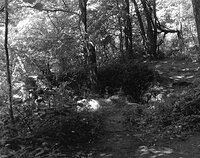
HP5 at ISO1600

Cut

D
Cut

  • 0
  • 0
  • 3
The Kite Surfer

A
The Kite Surfer

  • 3
  • 0
  • 27

Recent Classifieds

Forum statistics

Threads
201,949
Messages
2,832,523
Members
101,030
Latest member
kkiippyy
Recent bookmarks
0

pentaxuser

Member
Joined
May 9, 2005
Messages
20,354
Location
Daventry, No
Format
35mm
a 400 speed film like HP5+ has normal, if not almost less contrast shot at 400 than "average" contrast, .

I am having difficulties with this part of your reply in terms of working out exactly what you mean. Can you help me here?

Thanks

pentaxuser
 

StoneNYC

Member
Allowing Ads
Joined
Aug 5, 2012
Messages
8,345
Location
Antarctica
Format
8x10 Format
I am having difficulties with this part of your reply in terms of working out exactly what you mean. Can you help me here?

Thanks

pentaxuser

HP5+ is lower in contrast shot at box speed than other 400 speed films shot at box speed.
 
Joined
Jan 21, 2003
Messages
15,715
Location
Switzerland
Format
Multi Format
HP5+ is lower in contrast shot at box speed than other 400 speed films shot at box speed.

Sorry, Stone, but that doesn't compute. If your negative contrast is low you develop the film longer. Then your contrast isn't low anymore.
 

StoneNYC

Member
Allowing Ads
Joined
Aug 5, 2012
Messages
8,345
Location
Antarctica
Format
8x10 Format
Sorry, Stone, but that doesn't compute. If your negative contrast is low you develop the film longer. Then your contrast isn't low anymore.

I'm talking standard dev times according to manufacturer...

yes you can adjust that to adjust contrast (as well as temp and dilution, other) I'm talking standard times. the films natural "habits" HP5+ is designed to be pushed, so it's designed to be slightly lower in contrast at box speed with manufacturer given times so as you push it, it will have normal contrast, this is true to an even higher degree with D3200, so it will have a lower contrast at 1600 than HP5+ at 1600.

People don't like to think of it as PUSHING but even zone system adjustments for n1+\- etc, you're pushing or pulling, which adjusts contrast... They just like to think of it as a different thing, but it's not. (My opinion).
 

markbarendt

Member
Allowing Ads
Joined
May 18, 2008
Messages
9,422
Location
Beaverton, OR
Format
Multi Format
HP5+ is lower in contrast shot at box speed than other 400 speed films shot at box speed.

So, lets see the densitometer plot.
 

Mr Bill

Member
Allowing Ads
Joined
Aug 22, 2006
Messages
1,528
Format
Multi Format
the films natural "habits" HP5+ is designed to be pushed, so it's designed to be slightly lower in contrast at box speed ...

The film speed standards for B&W pictorial negative films specify a certain "contrast," so one cannot assign an ASA or ISO speed without meeting this. (Need I say more?)
 

StoneNYC

Member
Allowing Ads
Joined
Aug 5, 2012
Messages
8,345
Location
Antarctica
Format
8x10 Format
This is true. But Stone may or may not also be correct (from a practical perspective, even though his wording is incorrect).

If a group of films have a rating of ISO 400, by definition they exhibit the same specified densities at the ends of a specified exposure range. In other words, over that exposure range, they have the same total contrast as measured by a straight line. However:

-The exposure range specified is only 4 1/3 stops, and does not extend beyond what we would call mid tone densities
-The shape of the curve is not fully considered, and highlight contrast is ignored
-The conditions are met given exposure to a light source of a specific colour temperature
-The conditions are met given a specified developer and process

Thanks, yea it's all relative, but still, pushing 2 stops is going to give more contrast than pushing 1/2 a stop (technically 5/8ths?)
 

Xmas

Member
Allowing Ads
Joined
Sep 4, 2006
Messages
6,398
Location
UK
Format
35mm RF
There is a safety factor in ISO of 1.25 stops...

So pushing speed by 2 stops may be undesirable.

But this is rattys first venture into available darkness as well as bracketing he should have tried crepescule first.
 

Ulrich Drolshagen

Subscriber
Allowing Ads
Joined
Mar 14, 2005
Messages
552
Location
Germany
Format
Medium Format
I am wrestling with low light conditions too. I'd like to share some thoughts on the subject.
If in normal conditions I take abreflected light reading, the meter integrates all light reflected from deepest shadows to the lightest highlights. If I am lucky the subject range does not exceed the taking capability of my film and I get all, no blown out highlights and fine details in the shadows. If not, I probably loose on both ends.
If I am exposing a film with box speed 400 at 1600, I am underexposing it by two stops. I will have to narrow my reading down to the regions of my subject which I can realistically get within that range. Otherwise my meter will integrate into its reading regions which the film does not get anyway and the reading will be biased. So I will have to deliberately exclude deep shadows and the highest highlights from my reading. The easiest way to do so, is to spot meter the scene and take the readings on the midtones. For instance take a reading on a face , increase the exposure by one stop and and let all other tones lie where they may fall(applies to caucasian faces only obviously). I will probably get pitch black shadows and pure white highlights - from lamps for instance. But I will get my main subject about right. Is this correct so far?
 
Last edited by a moderator:

Ian Grant

Subscriber
Allowing Ads
Joined
Aug 2, 2004
Messages
23,414
Location
West Midland
Format
Multi Format
I like HP5 particularly in large format however it does build up contrast when it's pushed to 1600 EU. I used to use it in 35mm to shoot live performances but switched to XP1 and later XP2 pushed to 1600 or 3200 as they gave a better tonal range as they were much less contrasty and much finer grain.

It's not widely realised that XP2 can be push processed, the main reason is when Ilford switched from XP1 (which had a non standard colour dev time in C41) to XP2 they dropped the recommended push processing times. This was because commercial labs hadn't liked processing XP1 as they couldn't be run alongside C41 colour films, XP2 uses the standard C41 dev time.

If you do your own C41 developing then push processing XP2 is a viable proposition.

Ian
 

markbarendt

Member
Allowing Ads
Joined
May 18, 2008
Messages
9,422
Location
Beaverton, OR
Format
Multi Format
I am wrestling with low light conditions too. I'd like to share some thoughts on the subject.
If in normal conditions I take abreflected light reading, the meter integrates all light reflected from deepest shadows to the lightest highlights. If I am lucky the subject range does not exceed the taking capability of my film and I get all, no blown out highlights and fine details in the shadows. If not, I probably loose on both ends.
If I am exposing a film with box speed 400 at 1600, I am underexposing it by two stops. I will have to narrow my reading down to the regions of my subject which I can realistically get within that range. Otherwise my meter will integrate into its reading regions which the film does not get anyway and the reading will be biased. So I will have to deliberately exclude deep shadows and the highest highlights from my reading. The easiest way to do so, is to spot meter the scene and take the readings on the midtones. For instance take a reading on a face, increase the exposure by one stop and and let all other tones lie where they may fall. I will probably get pitch black shadows and pure white highlights - from lamps for instance. But I will get my main subject about right. Is this correct so far?

Most reflective meters have an angle of view and or they "weight" one part of the scene more than the rest, they don't necessarily see or consider the whole scene. To get a reliable reading we need to understand what the meter is seeing and how it is "weighted".

If you can beg, borrow, buy, or hang out with someone that uses an incident meter you can use the incident meter reading as a reference to learn from.

With most any reflective meter if you fill its view with your main subject, say a head, you can get a reliable reading.

That reading then needs to be offset to get the camera setting because heads don't necessarily average to the middle tone the meter expects.

For a blond caucasian Scandanavian that hasn't seen much sun since last October you might increase camera exposure by 1.5-stops from the meter reading to keep their face bright in the final photo. In that situation the meter thinks the subject is too bright. For a Spanish construction worker late in August the adjustment might be just a half-stop. The average light skinned, dark haired German head might be somewhere between those two. Dark skinned subjects may provide you a reading that requires a reduction offset because the meter thinks, wrongly, that the scene is too dark.

This same principle applies to whole scenes. Judging a whole low light scene with a variety of subjects is a real challenge. It is typically easier to pick one subject, meter it and apply an appropriate offset.
 

markbarendt

Member
Allowing Ads
Joined
May 18, 2008
Messages
9,422
Location
Beaverton, OR
Format
Multi Format
I like HP5 particularly in large format however it does build up contrast when it's pushed to 1600 EU. I used to use it in 35mm to shoot live performances but switched to XP1 and later XP2 pushed to 1600 or 3200 as they gave a better tonal range as they were much less contrasty and much finer grain.

It's not widely realised that XP2 can be push processed, the main reason is when Ilford switched from XP1 (which had a non standard colour dev time in C41) to XP2 they dropped the recommended push processing times. This was because commercial labs hadn't liked processing XP1 as they couldn't be run alongside C41 colour films, XP2 uses the standard C41 dev time.

If you do your own C41 developing then push processing XP2 is a viable proposition.

Ian

XP2 is a film that consistently amazes me.
 

miha

Member
Allowing Ads
Joined
Feb 15, 2007
Messages
3,045
Location
Slovenia
Format
Multi Format
Me too! It's really special.

+1

Is it fair to say that it ought to be slightly less sensitive when processing as there are no colours that can go off? I'm asking because I have started to hand process my C41 films and it's not easy to be within 1/3 of a grade Celsius without a tempered processor.
 

markbarendt

Member
Allowing Ads
Joined
May 18, 2008
Messages
9,422
Location
Beaverton, OR
Format
Multi Format
+1

Is it fair to say that it ought to be slightly less sensitive when processing as there are no colours that can go off? I'm asking because I have started to hand process my C41 films and it's not easy to be within 1/3 of a grade Celsius without a tempered processor.

I don't think sensitive is the right word, but I think you have the idea right.

There is no color to balance.

The ultra tight processing specs for C41 color films is to make sure all three color layers balance.
 

Bill Burk

Subscriber
Allowing Ads
Joined
Feb 9, 2010
Messages
9,477
Format
4x5 Format
The images I shot were similar to your 3rd one Stone. Outdoors, at night, with very little light. Except that mine seem to have huge areas where nothing has been recorded on the negative. I dont think HC-110 is the culprit as literally NOTHING is on the film. Surely if exposed properly some part of the image would appear during development. DD-X might make it look better but it is not like HC-110 cant cause the image to form.

I need to take metering more seriously when doing shots like this.

Hey RattyMouse,

I should disclose that I am not a good one to talk about the kinds of photography that looks successful when pushing to 1600, because I "don't get it".

For that available darkness kind of cityscape, you need MORE exposure (to get detail in the blackness) and LESS development (to hold down the light sources). And you need to think about reciprocity law failure too.

If you are familiar with the Large Format Photography site, I'd like you to check out a thread there "Loooooong exposures (at night)" - Vaughn shares Michael Kenna's exposure data.
 

Ulrich Drolshagen

Subscriber
Allowing Ads
Joined
Mar 14, 2005
Messages
552
Location
Germany
Format
Medium Format
So you are spot metering?

Yes, I use an OM3 for subjects that involve pushing HP5 or TriX. If I had to use a hand hold meter along with one of my MF cameras, I would ty to get as close as possible to the most relevant parts of my subject to get a reading.
 

markbarendt

Member
Allowing Ads
Joined
May 18, 2008
Messages
9,422
Location
Beaverton, OR
Format
Multi Format
Yes, I use an OM3 for subjects that involve pushing HP5 or TriX. If I had to use a hand hold meter along with one of my MF cameras, I would ty to get as close as possible to the most relevant parts of my subject to get a reading.

What you say of pushing is partly true.

Underexposure does reduce shadow detail on the film. That detail is lost forever and no amount of extra development can bring it back. That is the biggest reason I avoid pushing.

At the highlight end though, extra development does not blow out the highlights on the film, the detail is still there and very usable, the highlights just get more dense, not lost and if you want them they just need to be burned in during printing.

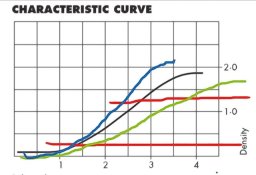
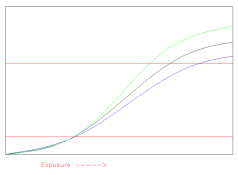
I attached a graph that may help. Black shows normal development. Blue shows more development (a push). Green shows less development (a pull).

The red lines are examples of the limits of what a specific paper grade might print; everything below the bottom line prints black, everything above the top line prints white.
 

Attachments

  • b.jpg
    b.jpg
    67 KB · Views: 108

markbarendt

Member
Allowing Ads
Joined
May 18, 2008
Messages
9,422
Location
Beaverton, OR
Format
Multi Format
Yes.
 

markbarendt

Member
Allowing Ads
Joined
May 18, 2008
Messages
9,422
Location
Beaverton, OR
Format
Multi Format
This one is better. Colors are flipped.
 

Attachments

  • Screen Shot 2014-03-09 at 9.50.10 PM.png
    Screen Shot 2014-03-09 at 9.50.10 PM.png
    20.3 KB · Views: 77
OP
OP
RattyMouse

RattyMouse

Member
Allowing Ads
Joined
Oct 18, 2011
Messages
6,045
Location
Ann Arbor, Mi
Format
Multi Format
Ok, back to me, the OP.

Reading this thread, I'm now a bit confused. I shot HP5 at ISO1600, which would underexpose the film by 2 stops. My images, look like they are underexposed as many respondents said they might be.

Above, Mark wrote"Underexposure does reduce shadow detail on the film. That detail is lost forever and no amount of extra development can bring it back. That is the biggest reason I avoid pushing."

So I'm left to wonder what exactly I can obtain with pushing HP5 or any other film 2 stops. If underexposing the film fails to product an imagine on the film (as my negatives clearly show with 75% of the area blank), then what can I accomplish? Or conversely, what good is exposing the film at ISO1600, and then adding in more EV (thus really exposing it at ISO800 or even back to 400!!)

Just call me,

Dazed and Confused.........

 

markbarendt

Member
Allowing Ads
Joined
May 18, 2008
Messages
9,422
Location
Beaverton, OR
Format
Multi Format
IMO pushing is a technique of desperation.

You give up detail at the bottom end, in exchange for faster shutter speed.

The extra development moves the left-overs up higher on the curve into a more usable range. This effect is greatest in the highlights and least effective in the shadows.

The ISO standard has a safety factor so some underexposure is doable without loss on the print, the negative though still loses detail. Underexpose enough and it effects the print.
 

MattKing

Moderator
Moderator
Joined
Apr 24, 2005
Messages
55,273
Location
Delta, BC Canada
Format
Medium Format
Ok, back to me, the OP.

Reading this thread, I'm now a bit confused. I shot HP5 at ISO1600, which would underexpose the film by 2 stops. My images, look like they are underexposed as many respondents said they might be.

Above, Mark wrote"Underexposure does reduce shadow detail on the film. That detail is lost forever and no amount of extra development can bring it back. That is the biggest reason I avoid pushing."

So I'm left to wonder what exactly I can obtain with pushing HP5 or any other film 2 stops. If underexposing the film fails to product an imagine on the film (as my negatives clearly show with 75% of the area blank), then what can I accomplish? Or conversely, what good is exposing the film at ISO1600, and then adding in more EV (thus really exposing it at ISO800 or even back to 400!!)

Just call me,

Dazed and Confused.........
You ask about what you can obtain by "pushing" films.

I'm talking here about negative film.

What you gain is increased contrast.

That increased contrast means that the areas of your scene that would have been rendered as muddy, near shadows if you didn't increase the development ("push") for the film, are instead moved up the film's curve, with more contrast.

The areas of your scene that are below the "detailed shadow" threshold of exposure don't miraculously evidence negative density - they just stay dark shadows.

The problem with any "push" development is that it also affects the highlights of the scene. In some cases, they become so dense and grainy on the negative that you cannot do anything to make them print well.

The loss in highlight quality that comes with a one stop push is most likely the reason that Kodak doesn't recommend any change in development when T-Max 400 is metered at EI 800.

The problem with your test is that most likely you under-exposed your negatives by more than two stops - your meter was fooled by the highlights that were in your scene into setting an exposure that was more than two stops insufficient. That is a common problem in environments that force us to underexpose film and then try to save as much as we can by increasing development.

One solution to the metering problem is to get closer and take a reading from the near shadow areas that you need to make sure are on the negative.
 
Photrio.com contains affiliate links to products. We may receive a commission for purchases made through these links.
To read our full affiliate disclosure statement please click Here.

PHOTRIO PARTNERS EQUALLY FUNDING OUR COMMUNITY:


Ilford ADOX Freestyle Photographic Stearman Press Weldon Color Lab Blue Moon Camera & Machine
Top Bottom