
After using Tri-X and the Arista variant for some years, I decided to try HP-5+. Did my first roll yesterday, using D-76h 1:1 and Massive Development chart times. When I wet printed, I noticed two major changes - less contrast than Tri-X and more grain - a lot more grain. Agitation is the same - constant for the first minute (inversion) followed by four inversions every minute. Is this just the nature of the film, or is it developer-specific? Any help appreciated. Thanks.
-
Welcome to Photrio!Registration is fast and free. Join today to unlock search, see fewer ads, and access all forum features.Click here to sign up
You are using an out of date browser. It may not display this or other websites correctly.
You should upgrade or use an alternative browser.
You should upgrade or use an alternative browser.
HP-5+ and grain
-
A
- Thread starter presspass
- Start date

Recent Classifieds
-
For Sale Job Lot of Out of Production B&W Paper - UK only.
- Started by Gary Holliday
-
Sold Rollei RPX 135-36
- Started by Roger Thoms
-
For Sale Black & White Paper Sale - Open box - UK only
- Started by Gary Holliday
-
Sold Efke PL 100 M
- Started by Roger Thoms
-
For Sale Omega C760 XL Medium Format Condenser Enlarger with Schneider Enlarger Lens - UK
- Started by Gary Holliday
Forum statistics
I've never made a direct comparison, but something that comes to mind, if you had lower contrast negs (you might increase development of the film), you might have printed on a higher contrast paper to compensate, which could have increased grain appearance, maybe not a fair comparison.
Don't want to muddy the waters here, philosophically, but what is really important (to many) is the look and texture of the grain pattern (and of course, other things like tonal quality and feel of the image.)
Don't want to muddy the waters here, philosophically, but what is really important (to many) is the look and texture of the grain pattern (and of course, other things like tonal quality and feel of the image.)

I've always had trouble getting good contrast from HP5, and yes, it seems to be more grainy. My best results were to expose it at 320 and develop in Microphen adding about 25% to the time. Contrast is better, but still grain. Just nothing like Tri-X.

You haven't indicated which particular flavor of "Tri-X" you are comparing. Specificity helps a lot in attaining a targeted answer to a question. And that helps me in helping you as I only assist where I have a lot of personal experience.
I use both HP5+ and TXP 320 in 5x7 interchangeably for similar kinds of work, both shot at 200 (arrived at by my own film testing). I develop both in PMK Pyro as that allows me to obtain the finest grain and proper contrast (for me) in these films, given that the film is properly exposed for the scene (zone). I tested many developers with each of these films, based on my own desires, before standardizing on pyro.
I find HP5+ to have more contrast and slightly finer grain than TXP – so fine that I cannot grain focus under the enlarger at less than 20"x24". But for the purposes of enlarging a 5x7 negative to anything less than 40"x60", the distinction is negligible.
Yes, developer and process (agitation) make a difference, but proper exposure and recognition of light for the scene trumps both in terms of contrast.
I use both HP5+ and TXP 320 in 5x7 interchangeably for similar kinds of work, both shot at 200 (arrived at by my own film testing). I develop both in PMK Pyro as that allows me to obtain the finest grain and proper contrast (for me) in these films, given that the film is properly exposed for the scene (zone). I tested many developers with each of these films, based on my own desires, before standardizing on pyro.
I find HP5+ to have more contrast and slightly finer grain than TXP – so fine that I cannot grain focus under the enlarger at less than 20"x24". But for the purposes of enlarging a 5x7 negative to anything less than 40"x60", the distinction is negligible.
Yes, developer and process (agitation) make a difference, but proper exposure and recognition of light for the scene trumps both in terms of contrast.

Instead of using the Massive Development chart time what does Ilford recommend for ID-11 which is the same as D-76. I don't know how you can judge a film on the basis of a single roll. If you had developed several rolls and always got the same results that would be a different matter.

Thomas Bertilsson
Member
If your film exhibits poor contrast you develop longer and you may want to consider agitating every thirty seconds.
HP5+ and Tri-X are not identical, but every time you switch films you have to recalibrate how you do things, to make sure your negs suit your work flow, and that's what film developing is, a part of a whole, or part of a system, as an intermediary to carry information from the photographed scene to your paper.
So it's your job to make it work, since it's your work flow. Bracket your exposures, alter developing time, change agitation frequency; all these are tools at your disposal to fix any problem you might have.
HP5+ and Tri-X are not identical, but every time you switch films you have to recalibrate how you do things, to make sure your negs suit your work flow, and that's what film developing is, a part of a whole, or part of a system, as an intermediary to carry information from the photographed scene to your paper.
So it's your job to make it work, since it's your work flow. Bracket your exposures, alter developing time, change agitation frequency; all these are tools at your disposal to fix any problem you might have.
Thomas Bertilsson
Member
I should add to above comment that sometimes when we have exhausted all options of making good vehicles of information out of our exposed film, we may come to the conclusion that the material we chose simply doesn't provide what we need.
One roll of film is not nearly enough to make such a judgment, however. Maybe after a couple of dozen rolls of trying can we be sure.
One roll of film is not nearly enough to make such a judgment, however. Maybe after a couple of dozen rolls of trying can we be sure.

Sirius Glass
Subscriber
I have not ever had a grain problem with HP5+ for 35mm, 120 or 4"x5" when I developed with XTOL replenished.

darkosaric
Member
I use Rodinal almost exclusively. But with HP5+ I did not like results. When I started to use HC-110 with HP5+ problem was solved. I have bottle of HC-110 only for HP5+, tonality and contrast are great.
I use Rodinal almost exclusively. But with HP5+ I did not like results. When I started to use HC-110 with HP5+ problem was solved. I have bottle of HC-110 only for HP5+, tonality and contrast are great.
I had the same problem with HP5+ and Rodinal. I switched to Ilford DDX (that I use for Rollei Retro 80S) and got much better results, certainly a lot less grain.

HP5+ surprised me when I began using it again about 4 or 5 years ago, great tonality and quite fine grain. I used to use it a lot for push processing in the 1970's (pre +) when it was a far better film than Tri-X.
Fast films (non T grain type) are more sensitive to the developer used with them, Rodinal is less than ideal, Xtol would be far better, I get outstanding reuslts with Pyrocat HD
Ian
Fast films (non T grain type) are more sensitive to the developer used with them, Rodinal is less than ideal, Xtol would be far better, I get outstanding reuslts with Pyrocat HD
Ian
Rodinal just does not work well with high speed films unless one really wants grain for the effect. It is really for slow and medium speed films with the emphasis on slow speed films. Despite what some on APUG will say Rodinal is not a "do everything developer" like D-76 or HC-110.
Each film manufacturer fine tunes their developers for their films and vice versa. So when first starting out with a new film you should really read what the manufacturer says.
Each film manufacturer fine tunes their developers for their films and vice versa. So when first starting out with a new film you should really read what the manufacturer says.
Thomas Bertilsson
Member
Rodinal just does not work well with high speed films unless one really wants grain for the effect. It is really for slow and medium speed films with the emphasis on slow speed films. Despite what some on APUG will say Rodinal is not a "do everything developer" like D-76 or HC-110.
Each film manufacturer fine tunes their developers for their films and vice versa. So when first starting out with a new film you should really read what the manufacturer says.
Agree that manufacturer recommendations is a great place to start.
Don't agree regarding Rodinal, but that difference of opinion just shows that often recommendations are based on personal preference.
Sorry for some of the confusion. This is 35 mm HP5 and Tri-X - the ISO 400 variety. I was using the Massive Development time rather than the Ilford time because I was going by previous experience. I have shot several thousand rolls of Tri-X, Neopan 400, and HP5 over the years - the publisher bought the lowest price so we switched back and forth, when photojournalism was analog. I never had this problem with either grain or contrast, so I'm not making the statement from 'just one roll.' Again, sorry for the confusion. Thanks.
Thomas Bertilsson
Member
That certainly adds a twist to the discussion.
My own experience with HP5+ indicates a normal speed of about 500 to 640 and a developer like DD-X 1+4 or 1+9.
My experience with Xtol was that I couldn't get enough highlight contrast to my liking, because the film is slightly low contrast, and Xtol being somewhat compensating.
Grain is slightly more than Tri-X, but once I understood the film I was able to get what I want from it, and could easily switch to it if Tri-X became unavailable.
My own experience with HP5+ indicates a normal speed of about 500 to 640 and a developer like DD-X 1+4 or 1+9.
My experience with Xtol was that I couldn't get enough highlight contrast to my liking, because the film is slightly low contrast, and Xtol being somewhat compensating.
Grain is slightly more than Tri-X, but once I understood the film I was able to get what I want from it, and could easily switch to it if Tri-X became unavailable.

when we have exhausted all options of making good vehicles of information out of our exposed film, we may come to the conclusion that the material we chose simply doesn't provide what we need.
I've made 16x20 prints from 6x6 HP5 negatives that had some grain (not a ton) and some that were virtually grainless. Endless possibilities. It's the Indian, not the arrow.
I get frustrated with both myself and others because all of the developers, lenses, films, etc. that we have today are superior in almost every aspect to what was available for Paul Strand, Edward Weston, Ansel Adams, Walker Evans and all of the greats of American Photography. We all tend to fall into the habit of questioning and/or blaming the materials when things don't work out to our satisfaction, but we should all remember that some of the most talented and hard-working engineering minds have dedicated decades of their lives in the development of these products. (Countdown to someone replying "Oh, but the PAPERS were SO MUCH BETTER back then!" 10, 9, 8, 7....)
You ever notice how golf clubs get better every year, yet the average handicap of the American golfer hasn't changed in almost 40 years? It's because people would rather read about how to get better at golf or spend money on new clubs than do the hard work of actually getting better at golf.
We are all guilty of this! Moral of the story: one camera, one lens, one or two films and one developer.
Paul Strand is a great example. He shot with the same 8x10 and 5x7 cameras for almost 40 years, and used the same 300mm Georz Dagor lens on both cameras! Strand's portrait of Mr. Bennett, one of the greatest portraits in the entire history of photography, was made with that lens on a Graflex. You think our multicoated, computer designed optics aren't better than a freaking Georz Dagor POS? Obsessing over these trivialities is just high tech procrastination. Stop worrying about it and get to work!


For a while I never was very pleased with HP5+ shooting it mostly at 200 ironically following the suggestions of one of my photographic idols, Barry Thornton, however lately and I've dialed it in well using HC-110 at box speed:
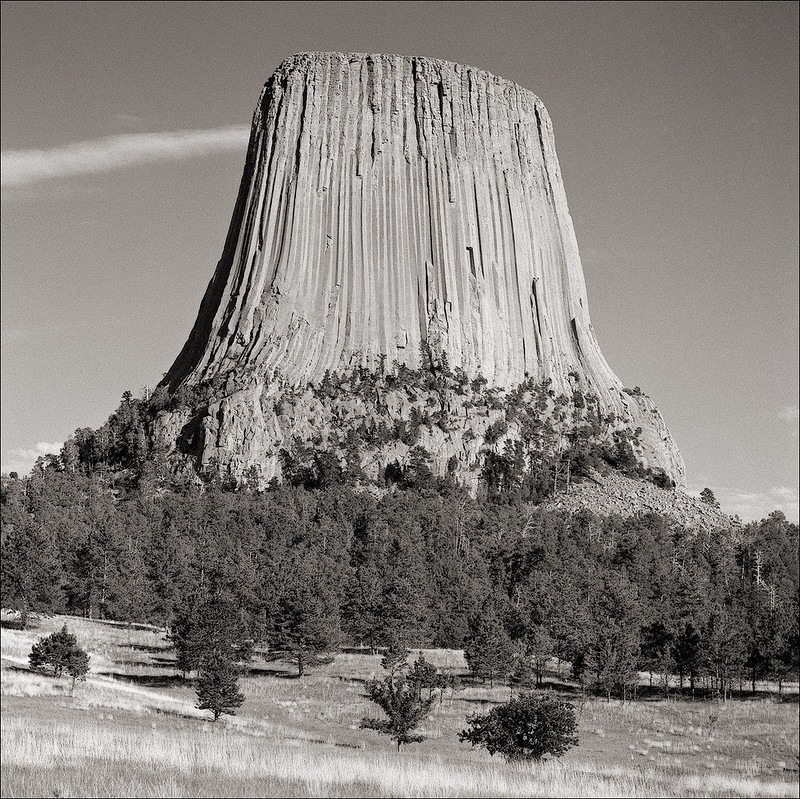
Devil's Tower
Tele-Rolleiflex
IlfordHP5+
HC-110dilH
9min 18C
by rich8155 (Richard Sintchak), on Flickr
And also shooting at 800 and using Rodinal has surprisingly given me some pleasing results too, never before liking it at 200-400 in Rodinal.
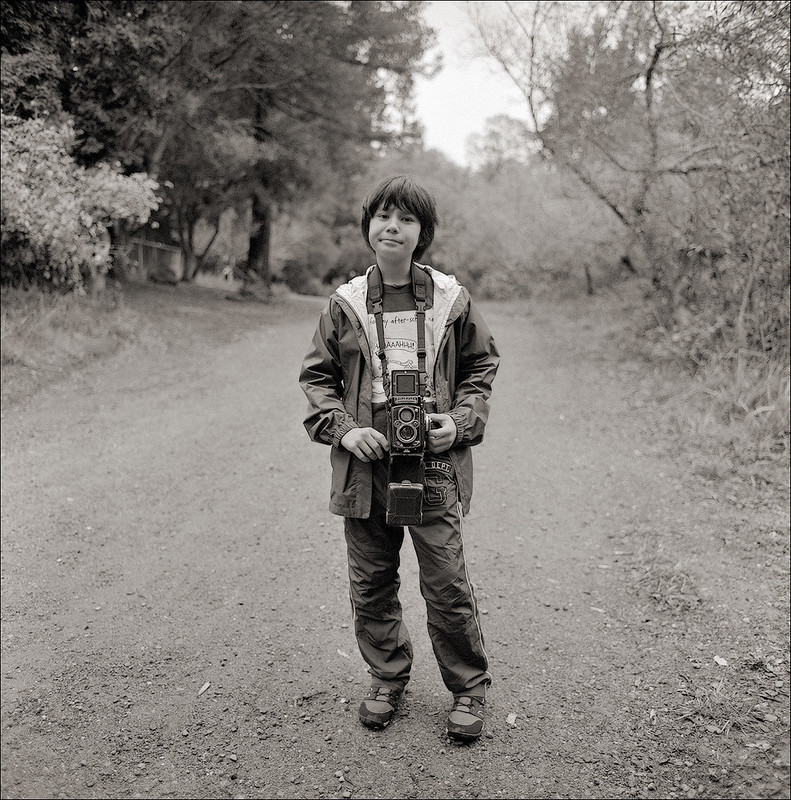
Jewel Lake with Ben
Rolleiwide
Ilford HP5+ at 800
Rodinal 1-50
13min, 20C
by rich8155 (Richard Sintchak), on Flickr
As mentioned by others do not judge on a single roll but work with it and experiment, it's a terrific film.
Devil's Tower
Tele-Rolleiflex
IlfordHP5+
HC-110dilH
9min 18C
by rich8155 (Richard Sintchak), on Flickr
And also shooting at 800 and using Rodinal has surprisingly given me some pleasing results too, never before liking it at 200-400 in Rodinal.
Jewel Lake with Ben
Rolleiwide
Ilford HP5+ at 800
Rodinal 1-50
13min, 20C
by rich8155 (Richard Sintchak), on Flickr
As mentioned by others do not judge on a single roll but work with it and experiment, it's a terrific film.

i developed HP5+ and Tri-X side by side for a dozen rolls or so last year. in DD-X 1+4. printed on MGIV or scanned on coolscan 5K. stayed with HP5+ with absolutely no regrets (i.e. there was no feature or characteristic of Tri-X i knew i would miss). i guess that makes me an iflord junkie or something... having been that for three decades now i'm not offended 
ps. i no longer notice grain i'm afraid... but then again, i've never been a grain peeper really
pps. almost all HP5+ here (just scroll past those damn benches, dunno what possessed me ) Dead Link Removed
ps. i no longer notice grain i'm afraid... but then again, i've never been a grain peeper really
pps. almost all HP5+ here (just scroll past those damn benches, dunno what possessed me
) Dead Link Removed
Nice shots Vilk.
Less contrast and more apparent grain is what I see with this combo. On the other hand the grain can enhance the perception of sharpness. In -135 I think HP5 grain is too much at 8x10. MF is different; sharpness may appear higher while the film size avoids grain issues. At the end of the day I standardized on Tri-X.
Jewel Lake with Ben photo has that TLR Rollei look; rounded and 3D. Who knew HP5 at 800 in Rodinal could look like this!
Jewel Lake with Ben photo has that TLR Rollei look; rounded and 3D. Who knew HP5 at 800 in Rodinal could look like this!
Last edited by a moderator:
darkosaric
Member
One more thing to add: I don't like Rodinal with HP5+, but I have no problem with Fomapan 400 or TriX in Rodinal. It is just personal taste - not grain issue.

My experience is that HP5+ grain is very dependant on the particular developer used. I've had very good results exposing at 250 and processing in Microdol-X 1:3, grain is there but not ugly. The 1:3 tames the blocked-up highlights.

If you don't want grain, then switch to a pyro developer like, pyrocat-hd.
- removed account8
- Deleted
Thomas Bertilsson
Member
Agree that HP5+ is a very capable film, but what I meant with my comment is that HP5+ doesn't expand as well as Tri-X and TMax 400. It doesn't continue to develop contrast like the other with seemingly no end in sight, which is why HP5+ may not be exactly what the user want, especially if the lighting is flat. Used in the right circumstance, HP5+ certainly is an amazing film that works really well for near everything and anything.
While I agree that there is a lot about work flow that is simply down to working hard and understanding our materials, there are limitations to what they can do for us. With HP5+ the bar is set very high, but it doesn't do everything faultlessly.
While I agree that there is a lot about work flow that is simply down to working hard and understanding our materials, there are limitations to what they can do for us. With HP5+ the bar is set very high, but it doesn't do everything faultlessly.
I've made 16x20 prints from 6x6 HP5 negatives that had some grain (not a ton) and some that were virtually grainless. Endless possibilities. It's the Indian, not the arrow.
I get frustrated with both myself and others because all of the developers, lenses, films, etc. that we have today are superior in almost every aspect to what was available for Paul Strand, Edward Weston, Ansel Adams, Walker Evans and all of the greats of American Photography. We all tend to fall into the habit of questioning and/or blaming the materials when things don't work out to our satisfaction, but we should all remember that some of the most talented and hard-working engineering minds have dedicated decades of their lives in the development of these products. (Countdown to someone replying "Oh, but the PAPERS were SO MUCH BETTER back then!" 10, 9, 8, 7....)
You ever notice how golf clubs get better every year, yet the average handicap of the American golfer hasn't changed in almost 40 years? It's because people would rather read about how to get better at golf or spend money on new clubs than do the hard work of actually getting better at golf.
We are all guilty of this! Moral of the story: one camera, one lens, one or two films and one developer.
Paul Strand is a great example. He shot with the same 8x10 and 5x7 cameras for almost 40 years, and used the same 300mm Georz Dagor lens on both cameras! Strand's portrait of Mr. Bennett, one of the greatest portraits in the entire history of photography, was made with that lens on a Graflex. You think our multicoated, computer designed optics aren't better than a freaking Georz Dagor POS? Obsessing over these trivialities is just high tech procrastination. Stop worrying about it and get to work!
Thomas Bertilsson
Member
No. Pyrocat is an acutance developer. The "grain masking" effect of the dye mask with staining developers can make the negatives print slightly less grainy than with a non-staining acutance developer, but you don't get fine grain. For fine grain you stick with a solvent developer like D-76, XTOL etc etc. Even Sandy King has said this.
True.
| Photrio.com contains affiliate links to products. We may receive a commission for purchases made through these links. To read our full affiliate disclosure statement please click Here. |
PHOTRIO PARTNERS EQUALLY FUNDING OUR COMMUNITY:  |