• Welcome to Photrio!
    Registration is fast and free. Join today to unlock search, see fewer ads, and access all forum features.
    Click here to sign up

How wide is feasible?

Barber

A
Barber

  • 0
  • 0
  • 20

Recent Classifieds

Forum statistics

Threads
203,481
Messages
2,855,401
Members
101,866
Latest member
Afadjato
Recent bookmarks
0
6 inches (about 150 mm) is only slightly "widish" on 4x5 format (I call 180mm "normal" for 4x5), so I would not expect any serious falloff.

It is not too hard to make a "center filter" dodging mask for printing pinhole pix. Expose a piece of film in the camera to an evenly-toned subject (sky, grey card, etc.). Then make a contact positive from that negative, exposed and developed to the proper density to mask ("dodge') the corners of the frame.

Clever. I like the elegance of it, especially when thinking about funky curved film planes. I've always just made a dodging tool and done it by hand.
 
Here are the specifications on the widest 4x5 pinhole cameras (film width = 127 mm) I have made:

Cardboard Box (flat film plane)
0.0126 = pinhole diameter in inches
0.320 = pinhole diameter in mm
2.2 = Pinhole to Film Distance in inches
55 = Pinhole to Film Distance in mm
132 = angle of view

Mailing Tube (curved film plane)
0.0126 = pinhole diameter in inches
0.320 = pinhole diameter in mm
2.0 = Pinhole to Film Distance in inches
52 = Pinhole to Film Distance in mm
140 = angle of view

Mailing Tube (curved film plane)
0.0102 = pinhole diameter in inches
0.259 = pinhole diameter in mm
2.0 = Pinhole to Film Distance in inches
52 = Pinhole to Film Distance in mm
140 = angle of view

All pinholes were Laser cut in .001 inch stainless steel.
 
How are you making your pinholes and measuring them? I've used the soda can method in the past but I can't get over the nagging feeling that I'm leaving image quality on the table. I may spring for one of the $25 .3mm pinholes sold on the auction site, but I wish one could buy cheaper pinhole assortments.
 
Might have been me, Vaughn. I'm no longer interested in actively selling them because I don't really enjoy working for $5/hour, especially because my eyesight isn't what it used to be, but I do make one now and then for somebody.

However, somewhere on APUG is a detailed description of my current method, which is the best yet, if anyone is crazy enough to try it.
Here: (there was a url link here which no longer exists)
 
Ultra-wide with a Zero

Hmmm? If the film was forced into a spherical shape rather than a semi-circular shape. The film would all be the same distance from the pinhole and you could make the focal length as short as was practical with the equipment you had. It would also give you a fisheye view, I think? I imagine the challenge is getting the film into this shape.
I agree with Vaughn: I have a Zero Image 4x5 camera and at the shortest "focal length" of approximately 25mm (from pinhole to film) the light drop off at the corners is significant. Vignetting on a B&W image is a nice effect but it doesn't look as good with colour film... IMHO...

Hmmm ... I have used the Zero Image 4x5 @ 25mm and find the images quite pleasing with Velvia. Although there is some light fall-off, I suspect one just has to understand how the camera makes the wide-angle exposure and plan accordingly. Not easy, but this is the wonderful thought provoking challenge of pinhole imaging, i.e., the joys of anticipation via experimentation.
All the best, and I've really enjoyed the discussion here with you guys :smile:
 
Another example

Hello all,

Here is an example of a image I posted some month ago onto the gallery :

(there was a url link here which no longer exists)

It's 4x5" transparency film exposed with 23mm focal length !

I have used too a 16mm FL pinhole camera, with B&W large format film, if someone interested I can post an image of the result here (I have yet to scan it).

Regards,

Raphael
 
Look up www.zeroimage.com and find the link on the left to Zero 45. There is a specifications sheet that lists the pinhole sizes and dimensions at 25mm, 50mm and 75mm equivalents. It may not be exactly what you are looking for but it will give you a start...

What I figure, is that I know Tmax can take many stops of overexposure without changing tonality too much, because it has so much straight-line. So I figure that if I expose enough that the corners get enough exposure, I will hopefully be able to dodge back the center and have it look at least somewhat normal tonality from the center outwards, if I can get the dodging right.

Have a look at my Zero Image 4x5 pinhole images in 25 mm configuration (probably a 110-120 degree super wide angle). Instead of dodging, you need to burn in the center, or dodge the edges :wink:.

http://www.boeringa.demon.nl/amsterdam_by_night/index.html
http://www.boeringa.demon.nl/amsterdam_by_day/index.html

My procedure for printing:

- First an overall hard grade short exposure, e.g. grade 3.5-4(5) for maybe 2.5-4 seconds max. This will ensure proper contrast in the corners / edges of the print, where the negative is extremely "thin"

- Than burn in the centre of the print using a grade 2-2.5 for maybe 15-25 seconds (exact centre may need more), using a paper with a hole cut in it of about 5 cm diameter, and continuously move it up/down vertically above the paper, hence giving the real center the most exposure, and to the edges gradually less. I do go as far as giving the edges an occasional small exposure in this step as well, when the paper with hole is the utmost highest position, but keep exposing the edges to a minimum.

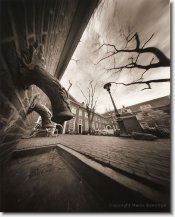
Here is one image:

DN3_287.jpg

As you can see, a 25 mm pinhole with a 4x5 negative is perfectly feasible...
 
I have a 25mm 4x5 pinhole camera. It covers to the edges, but the vignetting is very noticable. Not a bad thing for a lot of stuff. I don't remember the diameter of pinhole I'm using, but it is on very thin stock. I think it might have been around 0.15mm. Very small.

I have a couple of shots from it:
http://visualfiction.org/zenphoto/albums/4x5new/small-img001.jpg
http://visualfiction.org/zenphoto/albums/4x5new/sml-img019.jpg
http://visualfiction.org/zenphoto/albums/4x5new/sml-img021.jpg

The waterfall (first one) was taken right at the base of this waterfall. I mean pretty much right at the base. A more normal perspective shows how dramatic the wide angle is.
http://visualfiction.org/zenphoto/albums/4x5new/small-img004.jpg

(I actually scanned this with the film upside down so it is mirrored; I didn't notice before and didn't flip it):

It is ridiculously wide. When you think about it, 25mm is a pretty wide angle lens on a 35mm camera.. nevermind 4x5!

It's so wide that I still haven't come to terms with it and figured out how to frame things in an expected way. Even using diagonal lines I drew on the box top I still underestimate how wide my images will be.
 
It's so wide that I still haven't come to terms with it and figured out how to frame things in an expected way. Even using diagonal lines I drew on the box top I still underestimate how wide my images will be.

I know the feeling. You really need to force yourself to go right up to the subject with a 25mm 4x5 LF pinhole. And with that I mean sometimes in the range of 10-25cm max.

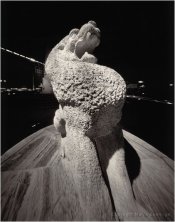
Here is another extreme example of making maximum use of the extreme wide angle. I don't think I have to explain to you how close I set up the camera to the pump... it literally rested against the stone masonry:

DN3_293.jpg
 
Anybody ever try to make a non image neg from the pinhole camera aimed at an evenly lit blank wall and developed to just the right contrast and density then sandwich that with a neg for printing to automatically dodge the print? It would be a custom job for each camera and focal length used.
 
I know the feeling. You really need to force yourself to go right up to the subject with a 25mm 4x5 LF pinhole. And with that I mean sometimes in the range of 10-25cm max.

Here is another extreme example of making maximum use of the extreme wide angle. I don't think I have to explain to you how close I set up the camera to the pump... it literally rested against the stone masonry:

That's a great image. Sometimes I think I must have placed my camera ridiculously far away from something, and then I catch a detail like the bricks in your image... that spout is like a brick's width away from the camera. Maybe two.
 
Anybody ever try to make a non image neg from the pinhole camera aimed at an evenly lit blank wall and developed to just the right contrast and density then sandwich that with a neg for printing to automatically dodge the print? It would be a custom job for each camera and focal length used.

I just read about that yesterday. I think you have to make a contact positive for it to work first; or shoot transparency film.
 
Right, thats they way it works. A contact positive would be best. The neg would work better placed in front of the neg somehow to act as a center ND filter.
 
If you really want the widest angle, you could curve the film 360 inside a can and have the pinhole in the end. More than a touch of distortion and light fall off, though...:smile: Or take a round flat tin (cookie tin) and put a smaller cylinder inside and use multiple pinholes. I've never done either of these, but they are on my to-do list!
 
If you really want the widest angle, you could curve the film 360 inside a can and have the pinhole in the end. More than a touch of distortion and light fall off, though...:smile:

William Mokrynski's "Endroit de vie" series is a nice example of the bizarre results such a pinhole camera creates:

Dead Link Removed

Marco
 
William Mokrynski's "Endroit de vie" series is a nice example of the bizarre results such a pinhole camera creates:

Dead Link Removed

Marco


What a weird kind of projection.
 
What a weird kind of projection.

I think it's because the film plane, or in this case the film cylinder, wasn't vertical.

Of course, had it been vertical, then the image wouldn't have included the arches, but would instead have been a bunch of pews. Perhaps there were scenes of both, and the pews turned out to be very uninteresting. Hard to know without asking.
 
My own wide angle (anamorphic) pinhole cams

Me too, am a fan of this kind of pinhole cams !

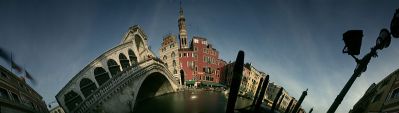
Here, I published a paper about the three cams that I designed and built myself,

and here, (click on the picture) you may access a galerie with a few examples of photos I took with them :


My POLKa cams have an horizontal taking angle of about 300° (4 6x18 views per 120 roll), and on the displayed picture of the rialto bridge in Venise, you can notice on both ends the same windows from a building which was actually behind me.

At the end of the paper, I show also how to watch these weird perspectives so that they look normal.


Paul
 
Photrio.com contains affiliate links to products. We may receive a commission for purchases made through these links.
To read our full affiliate disclosure statement please click Here.

PHOTRIO PARTNERS EQUALLY FUNDING OUR COMMUNITY:


Ilford ADOX Freestyle Photographic Stearman Press Weldon Color Lab Blue Moon Camera & Machine
Top Bottom