They were all made with skill. The same ethos of skill as a cabinet maker or an artist. Skill built up over a matter of years and not gleaned from a manual or trial and error which with the other 'photography' is in some cases sadly lacking.

I wish I had a shot of our studio setup at the place I worked in high school. I certainly printed my share of photos like that one
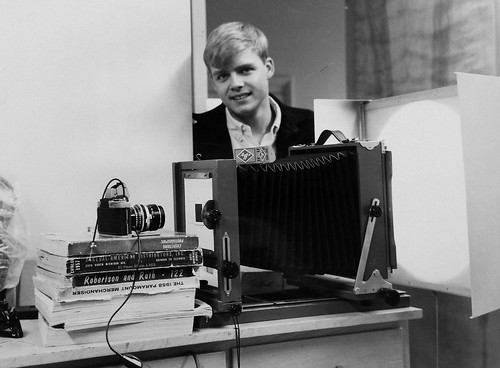
The posing chair would have been a stool with an arm--just a little platform--that could be locked in any position as an arm rest or back rest. Usually the photographer had the subject lean a bit into the arm, and the picture might then be printed tilted, too, for a dynamic look. The lights probably something like Kodatron electronic flash shown on the right, below, used less than 4 feet away (not that powerful, but that close it's almost like an umbrella used farther away) with some fill, background, and hair lights. The camera in the middle of the picture shot images on split 5x7--3/-1/2 x 5 negs with a 215mm f/4.5 Paragon lens, since there was really no need for the excessive sharpness of larger film, but the photographer understood the need to impress the customers with the large camera, anyway. (For the same reason, he also used a Super Graphic with a 90mm lens and a roll back for weddings, switching to 4x5 only for the altar group shots.)
![]()
Jim Making Slide Dupes, 1966 by Michael Darnton, on Flickr
The print could have been on Ektalure G Opal G paper (usually Opal for this---I don't remember why), printing through a Lewco Variable Vignetter . One closed it down all the way, then spun a finger around the inside of the hole to push it out to the exact shape needed. It wouldn't make a precise hole that could jump around projections well, explaining the ghost ear in the photo. On top of the vignetter I'd use an embroidery hoop with a stocking stretched across it for about 50% of the time, for diffusion. Prints were made light and flat, by any normal standard (that's easy to see in the photo) then sepia toned. We sent them off to the colorist who added a dash of oil color to the lips and the eye color, and that was enough to make the point. I can't explain the slash of color across the back--some local affectation?
I have a lot of photos of myself shot on Sundays in that studio, but I guess the photographer hated the normal look of the OP's example shot, because mine are all low key with heavy shadows, printed dark and dramatic.![]()
Well, I'm now the proud owner of this piece. It arrived in what appears to be the same condition as the studio delivered it -- framed and matted with rear dust jacket more or less intact. There is some moisture damage on the mat (left side in the second picture). Given that, I guess there's nothing lost in taking it apart and recovering the photograph? If so, I can take a high resolution scan of it.I'm beginning to think that the painting of the right ear isn't sloppy but deliberate. There is also a thin line of blue on the edge of the face from the painted ear down to almost where the neck starts. I don't use PS but if someone could convert the ear and edge of the face to the skin tone used, it might not be as good a portrait.
There is a thin line of grey on the left edge of the face. Lighting or paint? If paint, they got it perfect. if lighting, why no highlights on the left ear?
At the very bottom, just left of middle, you can see a button that has been painted over so maybe no vignetting was used.
Thanks for the insight here. I'd be very interested in seeing one or more of these photographs.I have a lot of photos of myself shot on Sundays in that studio, but I guess the photographer hated the normal look of the OP's example shot, because mine are all low key with heavy shadows, printed dark and dramatic.
The slide duplication equipment used seriously in 1969: http://www.glennview.com/copy.htm

Yes. About seven years or so after the picture above was shot I was working producing slide shows and film strips, using a rig very similar to this one--motor-driven copy stand, integrated color head for color correction, all of the bells and whistles. https://www.ebay.com/itm/Forox-Series-II-Slide-Animation-Camera-and-Copy-Stand-/183067280907?nma=true&si=mVQ%2BuCV3g%2FiwrSRTBp5d94d3Ck0%3D&orig_cvip=true&rt=nc&_trksid=p2047675.l2557
But I quickly discovered that for slide duping my Olympus OM1 - 50/3.5 macro gave superior sharpness to the lens in the system, and docked the camera part of the whole thing in a drawer.![]()
I worked 24hrs straight too many times, but had a ball otherwise.| Photrio.com contains affiliate links to products. We may receive a commission for purchases made through these links. To read our full affiliate disclosure statement please click Here. |
PHOTRIO PARTNERS EQUALLY FUNDING OUR COMMUNITY: ![]() |