

I would expect that a copy of the print would need to be taken (as opposed to the negative) as it has the dodging/burning etc, but how did they copy the print and what did they copy it to? Also how would they copy the layout of the pages. These days I assume they just scan and do the rest like any other thing digitally.
-
Welcome to Photrio!Registration is fast and free. Join today to unlock search, see fewer ads, and access all forum features.Click here to sign up
You are using an out of date browser. It may not display this or other websites correctly.
You should upgrade or use an alternative browser.
You should upgrade or use an alternative browser.
How were photos printed in books/magazines?
-
A
- Thread starter Carriage
- Start date
Recent Classifieds
-
For Sale Rolleiflex Original (Germany, 1929)
- Started by Manual Camera
-
For Sale Original Rolleiflex Lens Cap (bayonet 1)
- Started by Manual Camera
-
For Sale Rolleiflex Adapter for Cut Film and Plates
- Started by Manual Camera
-
For Sale Eight (8) 620 film spools w/ Etone film case
- Started by Disconnekt
-
Under Offer FREE for Shipping Cost: Expired 16mm Film, Tri-X and Ektachrome
- Started by AnselMortensen
Forum statistics

Theo Sulphate
Member
In less expensive books, magazines, and in newspapers, the halftone process was used.
https://en.wikipedia.org/wiki/Halftone
https://en.wikipedia.org/wiki/Halftone
- APUGuser19
- Deleted
- APUGuser19
- Deleted

sdotkling
Member
Actually, halftoning is pretty easy. You place a negative, at the size of reproduction, on top of a halftone screen, which is just a sheet of film covered with a zillion dots. The size of the dot is what determines the name of the screen, i.e. a "60-line screen" has 60 dots per inch. The "sandwich" of neg and screen is placed on a plate, and exposed to ultraviolet light. The light passes through the negative and then through the halftone screen. The lighter areas of the photo are, in effect, overexposed, and this burns away some of the dot, reducing it in size. The darker areas are, in effect, underexposed, and so the dot grows. Look through a loupe at a newspaper photo and you'll see what I mean.
- APUGuser19
- Deleted
Thanks for the help guys. Makes sense. Another source mentioned early methods used a wire screen that gives an intensity to area relationship due to diffraction. I assume some form of chemical photoetching would be used to transfer this to the metal plate/roller?
- APUGuser19
- Deleted

summicron1
Subscriber
some high quality magazines -- including newspaper supplements and photography magazines -- also used a rotogravure process when they wanted the highest quality reproduction. Instead of a screen the image was etched into a plate into which ink was pressed that was darker as it got thicker. The resulting images had depth and really good reproduction, for newspapers that used the old hot type (lead plates) of the day.
Don't recall any mention of metal screens when i was getting into newspapering in the early 70s.
Don't recall any mention of metal screens when i was getting into newspapering in the early 70s.
- APUGuser19
- Deleted
The images were normally made using letterpress techniques, then offset lithography techniques using half tone screens. That's not a short story describing how the images got to that stage either. It's more about traditional fine art printing, mixed w/ photography, mixed w/ high speed industrial processes. The photoengravers are highly skilled craftsmen/artists, and that has just about died out except for very high end photograph and fine art reproduction.
Last edited by a moderator:
From here http://www-personal.umich.edu/~jpboyd/eng403_chap10_halftones.pdf No idea what this actually is from.
"The earliest screens were lattices of thin, criss-crossing wires, little different from ordinary window screens except that the mesh was finer." I assume wire implies metal.
"The earliest screens were lattices of thin, criss-crossing wires, little different from ordinary window screens except that the mesh was finer." I assume wire implies metal.
pbromaghin
Subscriber
And pardon me if you will of not wanting to talk about it. After a career in the printing biz, I'd rather discuss root canals or the 24 hour virus.
Nobody will ever find me answering questions on the printer's sites like PE does photography here.
That's too bad. It sounds like you have a lot of valuable knowledge in that area. If you don't put it out there where future generations can see it, who will?

Bill Burk
Subscriber
- Joined
- Feb 9, 2010
- Messages
- 9,618
- Format
- 4x5 Format
From here http://www-personal.umich.edu/~jpboyd/eng403_chap10_halftones.pdf No idea what this actually is from.
"The earliest screens were lattices of thin, criss-crossing wires, little different from ordinary window screens except that the mesh was finer." I assume wire implies metal.
I think that reference was casually-written and is incorrect on that detail. APUGuser19 is more correct on this. Maybe Umut will join in, as we all have experience with Printing.
The earliest screens were two sheets of glass etched with lines and those lines were filled with something opaque like India ink. They were crossed face to face and held at a specific distance from the high-contrast "litho" film. You can imagine every spot of light that made it through such as screen will be like a little fuzzy gray scale, a bright part of the original would hit the threshold of a larger area under that opening, while the darker parts of the picture would only make a tiny pinpoint of exposure. I never used glass screens but saw instructions on their use in some old reference books I have since given away.
The "contact screens" are like "pictures" of the glass screens taken on low contrast film (they were manufactured in a special way but that's the general idea), so the contact screens are like sheets of fuzzy dots. They got held down to the film by vacuum.
Computers changed things because the laser imagesetters would put high contrast dots down, the first one I used would put down 1000 dots per inch, and halftones were done in patterns of dots. The system could do 140 lines per inch of screen patterns, but more often we drove it at 118 lines.
- APUGuser19
- Deleted

Jim Jones
Member
APUGuser19 really simplifies it. When I worked in prepress, a huge banner reminded the hundreds of workers, "Quality Begins With You!" I suggested a more realistic, "Quality Is Irretrievably Lost By The First Worker Who Screws Up," but they never changed it. Nor did some departments ever really get it right. Some half-tone negatives could be identified at arms length as customer supplied because they were that much better than any the in-house camera room ever produced.
For examples of good mass produced press work, consider the Ansel Adams books produced by the New York Graphic Society. Adams was a critical participant in the production. For great press work, try to find a first edition of Yousuf Karsh's Portraits of Greatness, printed by sheet-fed gravure by Enshede of Haarlem, Netherlands. Karsh demanded and got superb printing which did not replicate the photographs, but interpreted the photographer's intent with the potential of that exacting printing process.
For examples of good mass produced press work, consider the Ansel Adams books produced by the New York Graphic Society. Adams was a critical participant in the production. For great press work, try to find a first edition of Yousuf Karsh's Portraits of Greatness, printed by sheet-fed gravure by Enshede of Haarlem, Netherlands. Karsh demanded and got superb printing which did not replicate the photographs, but interpreted the photographer's intent with the potential of that exacting printing process.
How do you fit a 20-20,000hz piece of music within the bandwidth allowed to an AM radio station?
You don't, am radio is only about 500-1500hz or so.. The rest misteriously disappears.
Now your getting into my world, and I do t want to talk about it either...

gzinsel
Member
- Joined
- Mar 20, 2011
- Messages
- 402
- Format
- Med. Format RF
Remember, ALL prints are reproductions! some people use continuous tone, while others use half-tone. To get a understanding of late 19th and early 20th cen. processes, read, THE KEEPERS OF LIGHT> from cover to cover its a good read, also if you would like there is a bibliography to do more in-depth research. As to the Half tone world of screens, aluminum plate, zinc plate, copper plate, line per inch,inking, ink modifiers, fountain solutions, runs, editions. . . etc. . . . And don't even get me started on PAPER!!!!! it is just as complicated as making a light sensitive emulsion and putting on film, packaging it, and having happy customers who use it. for those who are non believers, try it!!! and tell me what you think. you will come back with your tail between your legs and cryin' to your Mama for mercy!!!!!!!!!!!

Europan
Subscriber
Carriage is right, its grid rastering. The subject belongs to reprography and therefore not here.
Still, the best is a true photograph inserted in the book, glued in or whatever. Next best is gravure printing, then come the raster images. Whether relief printing or the offset process is better can be discussed. Least is serigraphy although that has been improved dramatically until today. I recommend reading books.
Still, the best is a true photograph inserted in the book, glued in or whatever. Next best is gravure printing, then come the raster images. Whether relief printing or the offset process is better can be discussed. Least is serigraphy although that has been improved dramatically until today. I recommend reading books.
Bill Burk
Subscriber
- Joined
- Feb 9, 2010
- Messages
- 9,618
- Format
- 4x5 Format
APUGuser19 really simplifies it. When I worked in prepress, a huge banner reminded the hundreds of workers, "Quality Begins With You!" I suggested a more realistic, "Quality Is Irretrievably Lost By The First Worker Who Screws Up," but they never changed it. Nor did some departments ever really get it right. .
Haaaaa, Jim Jones, I didn't know you were also a pre-press person...
In my prepress world at Burroughs Business Forms, City of Industry, CA... a stripper (a real job description in pre-press, which paid well and requires approximately the same skill set as dye transfer and unsharp masking) had a slogan on his light table "The customer is always right, not necessarily always bright".
I'm forever grateful to him for telling me to look at the work of Toyo Miyatake.
David Lingham
Member
a stripper (a real job description in pre-press,
Interesting the different words used to describe the same job. I’ve just retired having spent 47yrs in pre press. Here in the UK a stripper is called a film planner. I started as an apprentice retoucher/film planner, worked as a planner then became a scanner operator, pre press mac operator and a system manager. Best time though was working with film on the light bench working by hand.
Interesting the different words used to describe the same job. I’ve just retired having spent 47yrs in pre press. Here in the UK a stripper is called a film planner. I started as an apprentice retoucher/film planner, worked as a planner then became a scanner operator, pre press mac operator and a system manager. Best time though was working with film on the light bench working by hand.
The subject belongs to reprography and therefore not here.
I consider it a fine topic for this "Presentation" Forum. At least when analogue means are involved and that is what the OP inquires about.

RalphLambrecht
Subscriber
What do you mean by screened? How did they convert from film to dots? Also how did they do the expensive arty books?
Thanks for the help
the better the publication the finer the screen.newspapers are screened at about 70lines per inch whereas glossy magazines are screened at 130lines/inch.It's the same processI use to make digital negatives for contact printing

Bill Burk
Subscriber
- Joined
- Feb 9, 2010
- Messages
- 9,618
- Format
- 4x5 Format
An old photo almanac led me to the March 4, 1880 halftone "Shantytown, New York" which led me to Stephen Horgan's half-tone...
It appears from the narrative, that the first halftone screen was made out of cardboard by Stephen Horgan...
And the next ones were two line screens of glass cemented together... square apertures pierced... one-third the area of the opaque plane surface.
https://archive.org/stream/horganshalftonep00horg#page/n109/mode/2up
It appears from the narrative, that the first halftone screen was made out of cardboard by Stephen Horgan...
And the next ones were two line screens of glass cemented together... square apertures pierced... one-third the area of the opaque plane surface.
https://archive.org/stream/horganshalftonep00horg#page/n109/mode/2up
Bill Burk
Subscriber
- Joined
- Feb 9, 2010
- Messages
- 9,618
- Format
- 4x5 Format
I was intrigued by the story of the first printed halftone so I started looking for it...
I found an academic slide of this on eBay and ordered it.
The resolution of the slide is high enough to reveal all the detail that was printed.
Its a line screen, so at this stage Stephen Horgan hadn't introduced the dot screen...
Often times a halftone pattern will interfere with a subject.
But not in this case. The subject matter fits a line screen very nicely.
Boards on the buildings cross the screen and make the buildings "look" more detailed.
The tire against the wall of a shack "looks" like it has spokes.
Here is what it looks like, a little more detail than elsewhere on the internet...
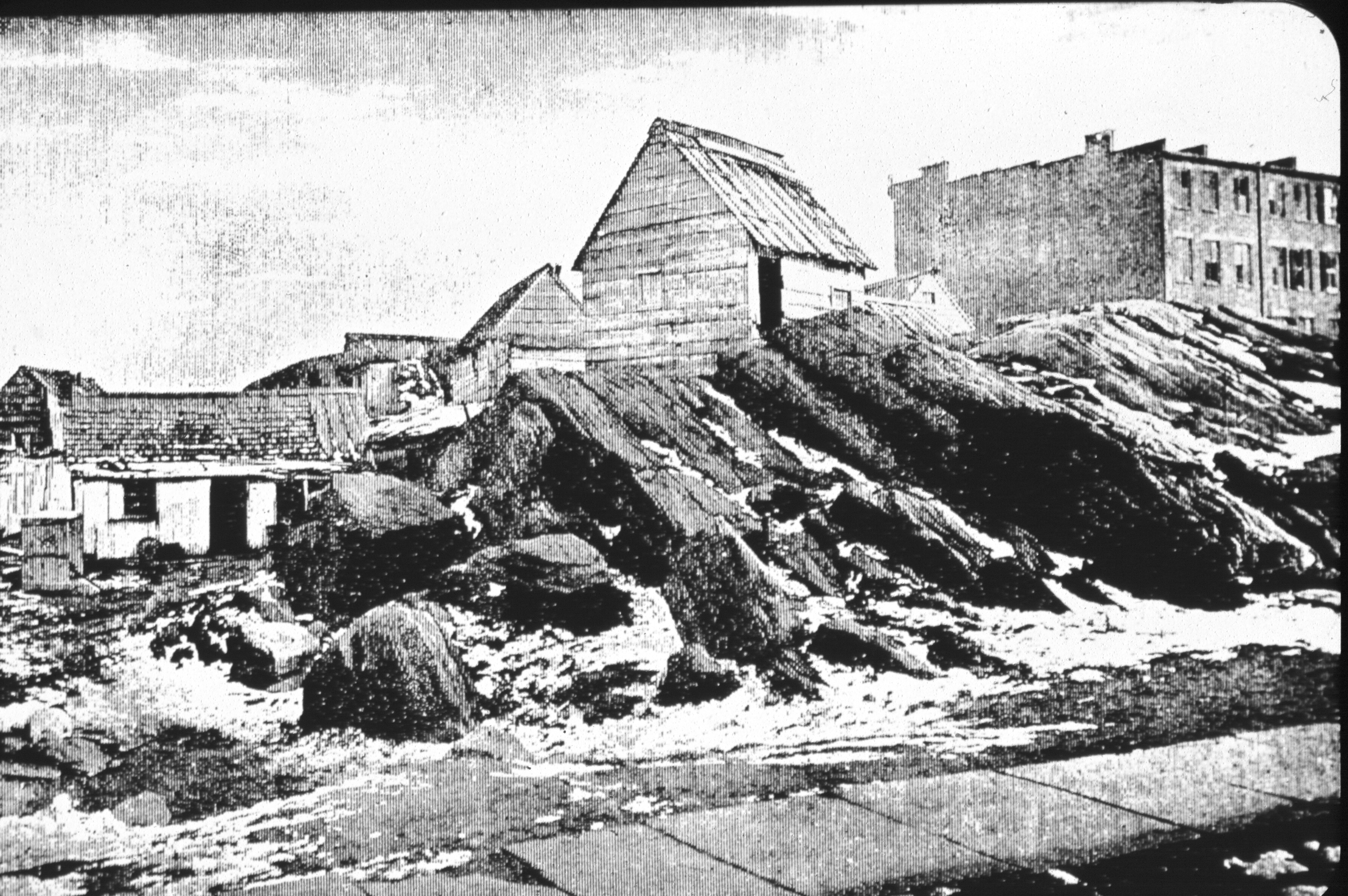
March 4, 1880 halftone "Shantytown, New York"
I found an academic slide of this on eBay and ordered it.
The resolution of the slide is high enough to reveal all the detail that was printed.
Its a line screen, so at this stage Stephen Horgan hadn't introduced the dot screen...
Often times a halftone pattern will interfere with a subject.
But not in this case. The subject matter fits a line screen very nicely.
Boards on the buildings cross the screen and make the buildings "look" more detailed.
The tire against the wall of a shack "looks" like it has spokes.
Here is what it looks like, a little more detail than elsewhere on the internet...
March 4, 1880 halftone "Shantytown, New York"
RalphLambrecht
Subscriber
halftoningI would expect that a copy of the print would need to be taken (as opposed to the negative) as it has the dodging/burning etc, but how did they copy the print and what did they copy it to? Also how would they copy the layout of the pages. These days I assume they just scan and do the rest like any other thing digitally.

Mick Fagan
Subscriber
I would expect that a copy of the print would need to be taken (as opposed to the negative) as it has the dodging/burning etc, but how did they copy the print and what did they copy it to? Also how would they copy the layout of the pages. These days I assume they just scan and do the rest like any other thing digitally.
Continuous tone B&W photographs for newspaper or magazine reproduction using film, was an interesting lesson in failure at some important point in the production process, usually when you were already behind the deadline.
To answer your question directly, the copy was made with a film negative using a process camera, usually a gallery type of camera using either cut sheet film or roll film. The largest camera we had was a Klimsch Gallery Kamera from Germany which was capable of doing a 1m square negative. The film was held on the back of the film plane with a vacuum back. The screen ruled glass plate was some distance away in front of the film, I believe from memory around 30-40mm, in front of that was the screen dot aperture and in front of that was the lens with its own f/stop aperture like what you are familiar with on your camera.
One of the first things to realise is the screen ruling, which literally refers to a rule or line gauge, of so many lines, or rules per inch. There are of course metric rules for line gauges, but we’ll stick to inches. Rules per inch in normal wet ink printing parlance, is referred to as Lines Per Inch, (LPI).
For magazine work on quality paper stock, the minimum would usually be 150 LPI, finer stuff with better inks or processes, would often be 300 LPI. LPI can be higher, but by and large 300 LPI is usually adequate for most fine reproduction work using an analogue film process.
Essentially on the horizontal lines you would have around 150 LPI from the top to the bottom, with the vertical lines running from left to right at 150 LPI. On the best screens we had, all of these lines were on single sheets of glass and were manufactured in Germany. All other screen rulings we had, were on two glass sheets sandwiched together. Cheaper acrylic/polymer seemed to be a really good way to get the same quality as glass, but as far as our production house was concerned, those screens really didn’t cut the mustard.
The distance the screen rulings on the glass plates were away from the sheet of film also has an effect to the overall outcome; another variable.
The shape of the apertures can and did make a huge difference to the outcome and dependent upon the material being reproduced and the printing process down the track, the camera operator would select the most appropriate aperture shape. Generally though, most trade houses I was familiar with in the seventies, eighties and into the early nineties, would pretty much use the same type of aperture for everything.
Dead Link Removed
Duotone is what lifted many ink press reproductions above the ordinary and is normally used in B&W reproduction to expand the tonal scale. This is done by printing in two passes, usually using a black and grey ink. The light grey ink was laid down first, then overprinted using a dark black ink.
With this method, the difference between a single printing using a black ink and a duotone print, was often very noticeable. Usually the highlights retained exceptional detail, mid-tones were pretty much as they would have been with a single black printing, with the shadows also showing better detail.
Then to top it all off, one had to decide whether to print your duotone with a wet on dry print run, or a wet on wet print run. Meaning you print your first grey run, dry the ink (usually with a spray of a substance similar to talcum powder), then print your second run. Or, you print the first grey run, then print the second run with the ink from the first run still wet. For the record, I prefer wet on wet, but printers (in Australia anyway) always said wet on dry was better. Printers using German Heidelberg two colour machines, mostly it seemed, printed wet on wet with outstanding results.
The apertures are self explanetery. The Gallery camera showing the front you can see the lenses, the lights (ours usually were 3000W each side). Showing the rear of a different Klimsch you can see the film being held by the operator. It looks about A2 sized, or about broadsheet size.
Looking into the camera you should see a space where (on the left on all of our cameras) the screen glass was selected and rolled out to be in front of the film negative. The round dials would be for exposure, measured in seconds and minutes if required.
We had around 20 of these cameras in various places around Melbourne, not to mention the various vertical repro cameras which were all over our various departments.
Mick.
We must not forget that the films used for these processes were the first to suffer from alternative electronic means. Here the decline of the halide part of the industry started.
Partly it was covered by new plate-technology.
Partly it was covered by new plate-technology.
Prof_Pixel
Member
We must not forget that the films used for these processes were the first to suffer from alternative electronic means. Here the decline of the halide part of the industry started.
Partly it was covered by new plate-technology.
Ah yes. Color Electronic Prepress Systems (CEPS) from Crosfield and Scitex. They got their start back in the pre-digital days.
| Photrio.com contains affiliate links to products. We may receive a commission for purchases made through these links. To read our full affiliate disclosure statement please click Here. |
PHOTRIO PARTNERS EQUALLY FUNDING OUR COMMUNITY:  |