
• Welcome to Photrio!
    Registration is fast and free. Join today to unlock search, see fewer ads, and access all forum features.
    Click here to sign up

How well should zone system calibrations translate from roll to sheet film?

Emi on Fomapan 400

A
Emi on Fomapan 400

  • 0
  • 0
  • 8
Venice

A
Venice

  • 0
  • 0
  • 55

Recent Classifieds

Forum statistics

Threads
201,795
Messages
2,830,256
Members
100,952
Latest member
pcwelch
Recent bookmarks
0

BHuij

Member
Allowing Ads
Joined
Oct 12, 2016
Messages
961
Location
Utah
Format
Multi Format
I've been shooting 35mm and 120 film "seriously" for several years. I have Zone System development calibrations dialed in for HP5+/HC-110 as well as FP4+/Rodinal, which work fantastic for roll film in my steel daylight tank and reel.

Recently I made the jump to 4x5. I was curious how well the times would translate as agitation is by nature different in daylight tank vs tray development.

So I tested FP4+/Rodinal with a sheet exposed for N development first. Interestingly, when I put the single sheet into the tray in my darkroom, stuck to the same agitation timing as the tank (merely agitating by lifting the corner rapidly for 5 seconds every minute instead of inverting for 5 seconds every minute), the sheet appears to have come out exactly right (no densitometer readings to confirm that the results are exactly the same, but it looks, scans, and contact prints just like my roll film).

However, when I tried developing multiple sheets, agitating by "shuffling" the bottom sheet onto the top X+1 times (where X is the number of sheets in the tray), my results were terribly underdeveloped.

I don't think I'm running into exhausted developer. For a roll of 120, I use Rodinal at 1:50, with 400ml of water and 8ml of syrup. My understanding is that a roll of 120 is roughly equivalent in surface area to a sheet of 8x10 or 4 sheets of 4x5. In the tray, I used the same 400ml of water and 8ml of syrup, and never more than 3 sheets at once, (usually only 2, I shoot pretty low volume).

I also don't think it's a temperature issue, or wouldn't I be seeing the same muddy underdeveloped look in my single-sheet test?

What do you guys think? Am I missing something, or am I better off just bagging it and re-calibrating from scratch for this type of development?
 

superpos

Member
Allowing Ads
Joined
Mar 23, 2008
Messages
31
Location
Berlin, Germany
Format
Multi Format
Hi BHuij,

I actually do my FP4+ / Adonal/Rodinal in a combiplan, usually having 4 sheets in the 1050 ml.

As far as I can see the first “single sheet development” could have been a lucky shot. While it is FP+ both of the time, from what I read 120 and 4x5 are not exactly the same. Each format is a little bit different. Partly different material etc. I usually just use the development time from the other format as a starting point.

Also 400ml for 3 sheets sounds a little bit “stingy”.

Just to make sure, what Rodinal are you talking about.

I use the Adox Adonal/Rodinal.

I check my notes and come back to you.
 
OP
OP
BHuij

BHuij

Member
Allowing Ads
Joined
Oct 12, 2016
Messages
961
Location
Utah
Format
Multi Format
I am using the Adox Adonal as well.

400ml for 3 sheets should be enough if my math is right. I'm developing in a 5x7 tray and it's very easy to make sure everything stays submerged, so I don't think I'm using too little developer.
 

jeffreyg

Subscriber
Allowing Ads
Joined
Jun 12, 2008
Messages
2,767
Location
florida
Format
Medium Format
Possibly while each sheet was on top the same amount of time the rest of the time they may have been stuck together with the emulsion against the base of the one above it so the time of adequate development didn't occur. I develop my 4x5's in film hangers in old Kodak rubber tanks and get even development. If you are only developing two in a tray try having the emulsion sides opposite each other and see if that helps. I don't use Rodinal so I can't comment on that. I use Ilford ID11 or PMKPyro.
Just a guess.

http://www.jeffreyglasser.com/
 
OP
OP
BHuij

BHuij

Member
Allowing Ads
Joined
Oct 12, 2016
Messages
961
Location
Utah
Format
Multi Format
The thought had occurred to me that stacking them both emulsion side up could be starving the sheet on the bottom for developer. I'll try doing them with emulsion sides both facing out and see what I get. Thanks!
 

Sirius Glass

Subscriber
Joined
Jan 18, 2007
Messages
50,814
Location
Southern California
Format
Multi Format
The Zone system works well for 35mm and MF as long as one sticks to N development. N-1 or N+1 el al requires that a complete roll be taken and developed that way. That is inconvenient for MF but a real pain for 135-36. Since modern films have such a wide exposure latitude, I can comfortable get every thing in sticking to N development for all formats.
 

Leigh B

Member
Allowing Ads
Joined
Jan 17, 2011
Messages
2,059
Location
Maryland, USA
Format
Multi Format
The fact that a single sheet came out OK indicates that you basic procedure is correct.
The fact that three sheets failed indicates you have too little developer.

The total volume of developer is irrelevant, except as regards calculating the dilution.

The critical factor is the amount of Rodinal concentrate in the tank. You need 10ml per roll.

One "roll" in this context means one 35mm-36 or 120 roll or one 8x10 sheet or equivalent.
The simple test is anything that can be proofed on one 8x10 sheet of paper is a "roll".

- Leigh
 
Last edited:

juan

Member
Allowing Ads
Joined
May 7, 2003
Messages
2,709
Location
St. Simons I
Format
Multi Format
You don't mention presoaking. When developing multiple sheet films by shuffling, I always presoak in plain water to be sure the sheets don't stick together in the developer. I don't necessarily presoak 35/120. That said, I never found the different sizes of film to develop the same. Another consideration is that the different sized films are printed differently - different enlargements, probably different lenses, etc. Scanning makes its own adjustments.
 

Alan9940

Member
Allowing Ads
Joined
Jun 17, 2006
Messages
2,492
Location
Arizona
Format
Multi Format
Back when I tray developed 4x5 and 8x10, like juan, I did a presoak (5 mins for me) to ensure that the film wouldn't stick together when I placed the stack into the developer. I always shuffled emulsion-side up and never had a scratch; others recommend emulsion-side down. You will have to experiment to see which you prefer. Timing was such that one rotation through the stack = 30 secs. After two rotations, I'd rotate the entire stack clockwise to the right. I used 8x10 trays for 4x5 and 12x15 trays for 8x10.

Nowadays, though, I process LF either on my Jobo CPP-2, B&W King stainless tank, BTZS tubes, or in custom tubes I built. Generally, what method I use depends on what I'm doing. For example, if using Pyrocat-HD along with extreme minimal agitation I'll use my custom tubes. If you want to mimic the tanks you've used to process small format, I'd look into the CombiPlan, B&W King, etc.

I've only ever used Rodinal to process 120 film, but I know you have to be careful with those higher dilutions.

Good luck!
 

silveror0

Member
Allowing Ads
Joined
Dec 3, 2007
Messages
364
Location
Seattle area, WA
Format
Large Format
I only shoot sheet film, so I can’t comment on matching development with roll film calibrations. I also tray shuffle up to 6 sheets at a time (and presoak at least 2 minutes to avoid sheets sticking together in the developer). Agitation shuffling technique is described in AA’s The Negative very clearly, if you have a copy, and provides some examples of proper shuffling. For 6 sheets, move the bottom sheet to the top of the stack every 5 seconds throughout the development time, thus each sheet is moved every 30 seconds. For 3 sheets, move the bottom sheet to the top every 10 seconds, which similarly moves each sheet every 30 seconds. Total dev time should not fall below 4 minutes, as inaccuracy would result (also a caution by Ilford). It’s best to use a 5x7 tray for 4x5 film. For 6 sheets in HC-110 Dilution B I use 568ml of working solution (which makes about 0.7” depth in the 5x7 tray) to comply with the capacity requirements for this developer.
 

Bill Burk

Subscriber
Allowing Ads
Joined
Feb 9, 2010
Messages
9,463
Format
4x5 Format
My gut instinct tells me you did something really wrong. Cold temperature, wrong dilution, contamination or something.

I once developed a single sheet and got wildly more activity than a stack of sheets.

Then I found it was Dektol instead of D-76 that I reached for.

I don't think you will find a dramatic difference 1 sheet vs stacked. I have seen local starvation of developer in stacks when I placed sheets emulsion to emulsion by mistake (then two sheets competed for the same layer of developer). The step wedge in the batch appeared as a ghost on my photographic negative.
 

Gerald C Koch

Member
Allowing Ads
Joined
Jul 12, 2010
Messages
8,131
Location
Southern USA
Format
Multi Format
I am curious as to how the Zone System can be used with roll film unless the entire roll consists of very similar subjects taken under very similar lighting conditions? When using the system you are attempting to adjust the tonal scale of the subject to ultimately fit that of the paper. The Zone System really doesn't work well with multiple negatives and was designed for single exposure LF. Sounds like the OP must begin anew.
 
Last edited:

juan

Member
Allowing Ads
Joined
May 7, 2003
Messages
2,709
Location
St. Simons I
Format
Multi Format
I used it for 120, so only 12-shots to the roll. I almost always shot the entire roll in roughly the same place, so conditions were similar. I developed for the majority of the shots - generally N or N+1 - then used the data as a starting point for which paper grade to use in printing. I found the Zone System used in this manner to give me somewhat more printable results than using the manufacturer's suggested speed and times. It was not a great difference, but I liked having the systematic discipline.
 

Ian Grant

Subscriber
Allowing Ads
Joined
Aug 2, 2004
Messages
23,409
Location
West Midland
Format
Multi Format
It's much harder to control the temperature with dish processing. I'd get yourself a processing tank. I've used a Jobo 2000 tank, takes two reels each holding 6 sheets of film, for just over 40 years, and now have second as well as a Yankee tank. One advantage is the Jobo's are inversion tanks (pre-rotary) so it's easy to test with 35mm film and know it's the same with 120 or 5x4 as times and agitation are the same for a given film. I'll often develop a 120 film or two in the same tank as the 5x4.

Ian
 
Joined
Sep 10, 2002
Messages
3,675
Location
Eugene, Oregon
Format
4x5 Format
I shuffle anywhere from one to eight sheets at a time with the rule that I go once through the stack every 30 seconds. With two sheets, it would be one shuffle every 15 seconds, with six sheets, once every five seconds, etc. The only departure for this is when I develop just one sheet. I figure that since the film gets "agitated" when you lift it out and replace it and then again when you push another sheet down on top of it, that for one sheet I also need to agitate once every 15 seconds. I get very consistent results this way with the same development times for any given development.

What you can't do is compare development times tray rocking agitation for one sheet to times for shuffling through a stack. Pick an agitation method and stick with it. Then, determine your time for N. Once you have that, you can extrapolate your other development times (N+ and N-) by using percentage differences from N for the roll films you have already calibrated. This should get you way into the ballpark. Keep good field notes and refine your times as needed.

If I were you, I'd start over with finding my time for N for sheet film using an agitation method that works for all batches you plan on developing. If you want to tray-develop multiple sheets, the shuffle method is really the only one.

When shuffling, you don't need to worry about sheets sitting stacked on top of each other between shuffles; just make sure the development time is long enough.

For consistency, it is really important that sheets in smaller batches get the same agitation frequency as sheets in larger batches. That's why going through the stack at a regular interval is best. That means slower shuffle frequency for small batches and faster for larger, but each sheet of film gets moved from bottom to top once every 30 seconds.

Despite what many say, I believe that tray development, done correctly, is still one of the the best (cheapest, most even and most flexible) ways to develop sheet film. My developing tray goes into a larger tray of water; this holds temperature just fine over the developing time. Careful handling is needed to avoid scratches. This seems to be a problem for some; I haven't scratched a neg for as long as I can remember.

Best,

Doremus
 

Ian Grant

Subscriber
Allowing Ads
Joined
Aug 2, 2004
Messages
23,409
Location
West Midland
Format
Multi Format
I am curious as to how the Zone System can be used with roll film unless the entire roll consists of very similar subjects taken under very similar lighting conditions? When using the system you are attempting to adjust the tonal scale of the subject to ultimately fit that of the paper. The Zone System really doesn't work well with multiple negatives and was designed for single exposure LF. Sounds like the OP must begin anew.

Actually the Zone system works fine with Roll film or 35mm it's not all about expansion and contraction it's also about calibrating your effective EI and development times to get the optimum results that suit your output whether darkroom prints or for scanning. Ansel Adams covers using the Zone System for 35mm/120 in "The Negative".

It's also about careful metering, extremes of contrast are a problem when you don't check highlights and shadows readings that can be with done with most meters, you don't need a Spotmeter although that's quicker and more accurate, then you have a choice of how you expose that film (frame). and whether you adjust development. I started using the Zone system with Weston Euromaster and my Mamiya 1000S (6x4.5 RF).

In practice because I expose, process and develop to print on Grade 2 paper with quite a long tonal range I have some latitude latitude to cope with lower.higher contrasts which we'd call N-1 and N+1, I'd only adjust EI/Dev time for N+2 or N+3 situations which are quite rare with the type of images (landscapes) I shooot. Putting that in context when I was first using the Zone system I spent a year photographing a small bridge in widely differing lighting/weather conditions as a tes with my Mamiya. I was able to print and frame a Diptych of prints, one shot early evening sunlight mid summer, the other a foggy day in the winter and the two images looked great together with similar tonality in the prints.

Ian
 

Craig75

Member
Allowing Ads
Joined
May 9, 2016
Messages
1,234
Location
Uk
Format
35mm
I do it as - calculate EI & n-1 development to print a normal scene on grade 3 for 35mm and it works well with semi or automatic cameras as it gives you as much info captured as possible and headroom to go up or down with VC papers. I dont really like 35mm on grade 2 as a starting point. There are a few different ways to do it depending on personal taste and film size (eg subminiature works "better" with a very thin negative) but I cant see how a typical simplified zone system for miniature cameras (no matter what system you use) would translate to contact printing or small enlargements of large format as you have changed the nature of the printing method radically from large enlargements of small negatives to contact printing (or small enlargements) of large negatives and the development controls open to you
 
OP
OP
BHuij

BHuij

Member
Allowing Ads
Joined
Oct 12, 2016
Messages
961
Location
Utah
Format
Multi Format
Thanks all for the great info. Sounds like my best bet at this point is to re-calibrate, probably starting with a slightly longer dev time for N than I get with roll film and inversion agitation. Shuffling through the entire stack one time every minute, whether that's 2, 3, or 6 sheets makes sense so that every sheet sees new developer on the top of the stack with the same frequency.

Calibrating isn't my favorite part of the zone system, but I suppose I can spare 5 or 6 sheets to really dial things in. Maybe I can compare my completed "N" development time for sheet film shuffled in a tray vs roll film inverted in a tank and multiply the dev time from roll film N+1, N+2, etc. by the same percentage. Should at least get me in the ballpark.
 

silveror0

Member
Allowing Ads
Joined
Dec 3, 2007
Messages
364
Location
Seattle area, WA
Format
Large Format
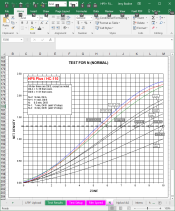
If it's any help, here's a screenshot of my resulting 31-step wedge tray-dev shuffle (6-sheets once through the stack every 30s) for HP5+ in HC-110, 68F/20C. I also have done this with FP4+ in HC-110 if you're interested. Net Density Zero is film-base plus fog. Also note the loss/gain in film speed.

2017-04-25.png
 

RalphLambrecht

Subscriber
Allowing Ads
Joined
Sep 19, 2003
Messages
14,922
Location
K,Germany
Format
Medium Format
I've been shooting 35mm and 120 film "seriously" for several years. I have Zone System development calibrations dialed in for HP5+/HC-110 as well as FP4+/Rodinal, which work fantastic for roll film in my steel daylight tank and reel.

Recently I made the jump to 4x5. I was curious how well the times would translate as agitation is by nature different in daylight tank vs tray development.

So I tested FP4+/Rodinal with a sheet exposed for N development first. Interestingly, when I put the single sheet into the tray in my darkroom, stuck to the same agitation timing as the tank (merely agitating by lifting the corner rapidly for 5 seconds every minute instead of inverting for 5 seconds every minute), the sheet appears to have come out exactly right (no densitometer readings to confirm that the results are exactly the same, but it looks, scans, and contact prints just like my roll film).

However, when I tried developing multiple sheets, agitating by "shuffling" the bottom sheet onto the top X+1 times (where X is the number of sheets in the tray), my results were terribly underdeveloped.
as long as you don't run into developer exhaustion and develop all in a Jobo rotation(that's what I do)there should be little difference. I did nor recalibrate from 120 to 4x5 and it is just fine.
I don't think I'm running into exhausted developer. For a roll of 120, I use Rodinal at 1:50, with 400ml of water and 8ml of syrup. My understanding is that a roll of 120 is roughly equivalent in surface area to a sheet of 8x10 or 4 sheets of 4x5. In the tray, I used the same 400ml of water and 8ml of syrup, and never more than 3 sheets at once, (usually only 2, I shoot pretty low volume).

I also don't think it's a temperature issue, or wouldn't I be seeing the same muddy underdeveloped look in my single-sheet test?

What do you guys think? Am I missing something, or am I better off just bagging it and re-calibrating from scratch for this type of development?
 

Gerald C Koch

Member
Allowing Ads
Joined
Jul 12, 2010
Messages
8,131
Location
Southern USA
Format
Multi Format
Yes I can see where applying the Zone System to roll film might be considered applicable. In as much as the priest names the infant as Quasimodo observing wryly that he was found on Low Sunday (Quasimodo Sunday) and is only an approximation of a man. Quasimodo Sunday so named for the opening words of the Antiphon for that day Quasi modo geniti infants, "As newborn babies.."
 
Last edited:

Craig75

Member
Allowing Ads
Joined
May 9, 2016
Messages
1,234
Location
Uk
Format
35mm
Not really. You just trying to capture as much info as possible in negative, especially with semi and auto compacts, by giving an extra stop exposure and n-1 development (or what other style you prefer) and using vari contrast paper to replace development control. If zone system's aim is to get all negatives to print on grade 2 or whatever preference one has, using development modifications to get there, then roll film's goal is to get a standard scene on grade 2 or 3 (depending on your preference) and use variable contrast paper to be able to print negatives that deviate from that. You still need to have everything set up to get a standard scene to print at the grade of your choice,plus enough room on negative to account for differing contrast scenes and the cameras own exposure meter. Wringing the life out of a compact is not straight forward affair.
 

Gerald C Koch

Member
Allowing Ads
Joined
Jul 12, 2010
Messages
8,131
Location
Southern USA
Format
Multi Format
Not really. You just trying to capture as much info as possible in negative, especially with semi and auto compacts, by giving an extra stop exposure and n-1 development (or what other style you prefer) and using vari contrast paper to replace development control. If zone system's aim is to get all negatives to print on grade 2 or whatever preference one has, using development modifications to get there, then roll film's goal is to get a standard scene on grade 2 or 3 (depending on your preference) and use variable contrast paper to be able to print negatives that deviate from that. You still need to have everything set up to get a standard scene to print at the grade of your choice,plus enough room on negative to account for differing contrast scenes and the cameras own exposure meter. Wringing the life out of a compact is not straight forward affair.

My point was that what is being described isn't necessarily the Zone System but what any experienced photographer desires to do. But if the tonal scale of the negative doesn't fit the scale of the paper then you are not going to get the best print. One is leaving some tonality on the table so to speak. Of course there are exceptions like high key images.
 
Last edited:

Craig75

Member
Allowing Ads
Joined
May 9, 2016
Messages
1,234
Location
Uk
Format
35mm
Thats true but you still need some zone system style calibrations of your workflow to get your standard scene on your preferred grade.

Even if you reach that conclusion another way it can still be expressed in terminology of zone system and worked out using a modified zone system methodology.
 
Photrio.com contains affiliate links to products. We may receive a commission for purchases made through these links.
To read our full affiliate disclosure statement please click Here.

PHOTRIO PARTNERS EQUALLY FUNDING OUR COMMUNITY:


Ilford ADOX Freestyle Photographic Stearman Press Weldon Color Lab Blue Moon Camera & Machine
Top Bottom