• Welcome to Photrio!
    Registration is fast and free. Join today to unlock search, see fewer ads, and access all forum features.
    Click here to sign up

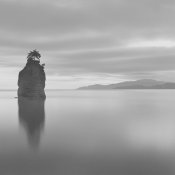
How was this image shot?

Forum statistics

Threads
203,438
Messages
2,854,710
Members
101,842
Latest member
Madmac
Recent bookmarks
0

peter2022

Member
Allowing Ads
Joined
Apr 12, 2022
Messages
50
Location
Italy
Format
Med. Format RF
This image:


I am thinking:
- high sharpness lens and format (hasselblad/zeiss, that much I know from the tags)
- b/w super high dynamic range film (plus-x, also from the tags)
- ND filter to smooth out the water
- focus on the rock to the left (or closer than that) and (very)small aperture to get basically the whole scene in focus
- no polarizer (light is low anyway, non-reflective)

and now the difficult part:
- exposure: spot-metered on the large hill at the far end, which seems to be middle-greyish (maybe this is too simplistic and the image needs zone-system metering, which I am not yet capable of)

Sounds right?
 
Looks as if picture taken in early morning with mist hovering over water.
 
It could just as easily have been metered off rock in the foreground and printed down, skies burnt in to taste, foreground burnt in etc.

It might have needed a lot of darkroom work to get that print
 
There is no way to tell about the metering. There is nothing special about zone technique or spot metering that would make these more or, less feasible. Ambient metering could be used as well.
Any film could be used too, it's interesting that it may be Plus-X.
 
Due to the sharpness of the foreground rock and the mountains in the distance and the softness of the water and clouds, I vote for a long exposure and a small aperture. The softness is the result of movement of the clouds and the surface of the water--an old tried and true method.
 
Due to the sharpness of the foreground rock and the mountains in the distance and the softness of the water and clouds, I vote for a long exposure and a small aperture. The softness is the result of movement of the clouds and the surface of the water--an old tried and true method.

I agree. I do not think that we can conclusively figure out the metering method, which for all we know or do not know could have been from an overall reading from a PME prism or external light meter.
 
Just guesses here. Looks like a moderate to low scale image (overcast) with a time exposure, maybe 20 seconds. The tree looks like it has not moved much, but the grass on the left of the rock has moved in the wind some during the exposure. Can't tell if it is sharp or not due to low resolution scan, but as mentioned maybe f32 or (f45 if a Rollei lens), contributing to some loss of sharpness
 
Are you sure it's from a film camera? It could easily be digital. No grain, very little detail, smooth look.
 
maybe this is too simplistic and the image needs zone-system metering, which I am not yet capable of

Two things. As others have mentioned, no image "needs" zone-system metering. How you meter a scene is a question of personal choice, and experience — i.e., learning to "read" the light.

Secondly, yes, you are capable of so-called zone-system metering. It's the simplest part of the zone system, and all you need to get the basics of it is a good spot meter. After that, where you place your middle grey, how much shadow detail you want, how sensitive you are to be careful not to have blown highlights, yes, that becomes a question of experience.

Regarding the photo you posted, I'd be careful not to deduce too much. Seems to me there's a lot of burning that went into to final aspect of it (print or digital, impossible to tell).
 
  • jvo
  • jvo
  • Deleted
jason henthorne, a photographer, does similar stuff. he originally started in film, don't know if he ever switched to digital. his method was longgggggg exposures, nd filters, small aperture, and lots of research.
 
jason henthorne, a photographer, does similar stuff. he originally started in film, don't know if he ever switched to digital. his method was longgggggg exposures, nd filters, small aperture, and lots of research.

What do you mean by research?
 
jason henthorne, a photographer, does similar stuff. he originally started in film, don't know if he ever switched to digital. his method was longgggggg exposures, nd filters, small aperture, and lots of research.

I checked out his website, he's definitely switched to digital, you can see the super high-res, plasticky look to his photos, remind me of the photos you see hanging behind CEOs or in meeting rooms in rented offices. Still he's technically excellent, I would like like to see his analog work.
 
I lightened it in PS. Plenty of detail in the rock. Probably a "realistic" interpretation was boring. Printing it down gives it more impact, and the our eyes go directly to the rock first. The shutter speed was probably about a second, perhaps a tad longer, depending on how fast the clouds were moving.
 

Attachments

  • 3797578118_3b0a399515_b.jpg
    3797578118_3b0a399515_b.jpg
    165.1 KB · Views: 117
I lightened it in PS. Plenty of detail in the rock. Probably a "realistic" interpretation was boring. Printing it down gives it more impact, and the our eyes go directly to the rock first. The shutter speed was probably about a second, perhaps a tad longer, depending on how fast the clouds were moving.

wow cool! dodging and burning galore, and exposure must have been on the detail of the rock...
 
wow cool! dodging and burning galore, and exposure must have been on the detail of the rock...

Yes, I believe so. If it were me, I would have based the exposure on the rock.
 
Jason was originally from Tampa Bay... he reported he spent many hours doing research, specifically using google earth, as well as other resources, on specific locales around the world he was interested in.

Very important, I think that Ansel Adams was also a tireless explorer
 
Photrio.com contains affiliate links to products. We may receive a commission for purchases made through these links.
To read our full affiliate disclosure statement please click Here.

PHOTRIO PARTNERS EQUALLY FUNDING OUR COMMUNITY:


Ilford ADOX Freestyle Photographic Stearman Press Weldon Color Lab Blue Moon Camera & Machine
Top Bottom