• Welcome to Photrio!
    Registration is fast and free. Join today to unlock search, see fewer ads, and access all forum features.
    Click here to sign up

How to meter properly.

Recent Classifieds

Forum statistics

Threads
202,985
Messages
2,848,409
Members
101,577
Latest member
Ostrevino
Recent bookmarks
0

baachitraka

Member
Joined
Apr 6, 2011
Messages
3,651
Location
Bremen, Germany.
Format
Multi Format
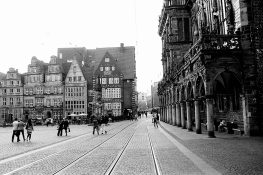
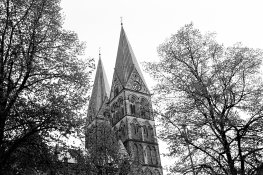
Pictures came blow-out. I do not know how to use centre-weight meter properly.

Camera: Olympus OM-1n
Lens: OM Zuiko f=35mm.
 

Attachments

  • TownHall.png
    TownHall.png
    1.1 MB · Views: 333
  • Dom.jpg
    Dom.jpg
    603.3 KB · Views: 293
You're meter is probably seeing that bright sky and trying to set it to medium grey. Meters are dumb, that's the first lesson, and from there you can learn how to get the right exposure. If it is center weighted, it is averaging the scene towards the center of the frame. If there is a white car in the center, it will under expose (making the car 18% grey) if there is a black car, it will over-expose (making it %18 grey).

So, with this in mind, looking at your shots--turn your camera towards the buildings without the bright sky and take the meter reading. This will put the buildings in the medium range. Use that reading even though when you go to shoot the actual scene it will have sky. It will take some experimenting to get used to, but eventually you will learn to meter something that you want in the middle, then keep that exposure although you're meter is telling otherwise.
 
You're meter is probably seeing that bright sky and trying to set it to medium grey. Meters are dumb, that's the first lesson, and from there you can learn how to get the right exposure. If it is center weighted, it is averaging the scene towards the center of the frame. If there is a white car in the center, it will under expose (making the car 18% grey) if there is a black car, it will over-expose (making it %18 grey).

So, with this in mind, looking at your shots--turn your camera towards the buildings without the bright sky and take the meter reading. This will put the buildings in the medium range. Use that reading even though when you go to shoot the actual scene it will have sky. It will take some experimenting to get used to, but eventually you will learn to meter something that you want in the middle, then keep that exposure although you're meter is telling otherwise.

Pointing the camera to the highlights first and then to the lowlights and set the exposure some where in between should give proper exposure. But, this may not be the universal for all types of shots.
 
If these are representative of prints on your standard average paper grade (about grade 2), then you need to reduce your effective film speed and your development time. This is too contrasty, which means the negative was overdeveloped, and there is little to no shadow detail, which means it was underexposed. Try cutting the film speed you used in half and reducing your development time by about 20% for traditional films, or about 10% for T-grain, Delta, sigma, or whatever other designation the film maker gives their 'engineered' grain film.

Lee
 
Apart from huge amounts of overcast(?) sky, there's also an enormous contrast range in these shots, especially the first streetscape. What's a dumb centre-weighted meter to do? Meter off a midtone next time.
 
Find a good photographic book which explains why it's usually best to take mid-tone readings using a centre weighted meter for 35mm B&W film.

Understanding why is more useful than following a rule of thumb.

Regards
Jerry
 
How does your negative look? Looking at your scan, it looks like some shadow details are there so that your camera's reading was probably affected by the bright overcast sky. That means it was under exposed a bit. If you metered correctly, meaning increase exposure a bit, the sky will be even more exposed.

If you had an overcast sky, there weren't much detail there to begin with.

You *could* have increased exposure a bit and get more shadow detail. You *could* have reduced development time to get the contrast range reduced. But, you still have a blown out sky with no details.

You might just have scenes that are impossible to "do it right."
 
You have a lot more control over these things if your own processing and printing. If you're sending it out and scanning negatives then that's a whole other thing. If you're doing your own processing, exposing for the shadows and developing for your highlights is a general rule of thumb. Of course this can't be applied to every scene. Also if you're doing your own printing then you might try burning in your sky if there is information there.
 
I use a quick-and-dirty method with a center-weighted meter. I use grass or street pavement as a convenient mid-tone, then I hold the exposure and re-frame. This works very well for me.
 
There is also the blue sensitivity of the film - add a yellow filter to whack most of that out. I never shoot without one anymore - surprising how much it helps really.
 
There is also the blue sensitivity of the film - add a yellow filter to whack most of that out. I never shoot without one anymore - surprising how much it helps really.

Costs you a stop, but well worth it in many cases! Not sure it would helped a lot with these shots.
 
That's where I'm headed too, but I'm not sure that the OP is doing his or her own processing.

I gave to the lab. But, now I think to develop by myself. I am not really happy about what I got.

It was pretty clear sky on that day, I shot those in the evening and in-fact there was no direct sun...
 
I gave to the lab. But, now I think to develop by myself. I am not really happy about what I got. ...

Good idea. Talk to us when you're ready for that. You will get much better negatives developing them yourself.
 
Get an incident meter, or use a grey card.
 
Good idea. Talk to us when you're ready for that. You will get much better negatives developing them yourself.

It seems they just follow one method no matter how fast or slow the film is. Since in the previous instance I get the same results with ILFord Delta 3200(noisy).

It is another things, but I would like to concentrate on meter and get better exposure. Now, I have little knowledge in relation between film speed and exposures.
 
I am going to disagree from most everyone here about your two examples.

It appears to me that the stonework is more or less properly exposed. If you do as may others suggest and meter off the ground or grass or gray area of the buildings, the sky will still be blown out.

If your camera's meter was off due to the sky, the sky would be closer to a grey tone and the foreground would be way way darker.


I think I have a similar shot here:
crop0112.jpg


I think instead you just need to control the contrast by either using a yellow or orange filter or developing for less contrast. I would probably try the yellow filter first.
 
Given the examples, I don't think that exposure is actually the issue.

I say this because the main subject matter actually looks nice and the sky in the scene was described by baachitraka as pretty clear.

baachitraka I'm going to guess that you expected a darker sky, not more detail.

I'd also bet that if color film had been used here the sky would be a nice blue not the blank white area it shows here.

If my assumptions are right using a say a red filter to get a darker sky might actually be the fix.
 
Given the examples, I don't think that exposure is actually the issue.

I say this because the main subject matter actually looks nice and the sky in the scene was described by baachitraka as pretty clear.

baachitraka I'm going to guess that you expected a darker sky, not more detail.

I'd also bet that if color film had been used here the sky would be a nice blue not the blank white area it shows here.

If my assumptions are right using a say a red filter to get a darker sky might actually be the fix.

Now, I learned that films esp., high-speeds are far more sensitive when compared to digital part. Right now, I cannot prove with an example but this is my feeling.

Yes, I was expecting at-least a gray sky. :-(
 
baachitraka,

The response of B&W film is not more sensitive, but it is distinctly different than color work. It requires some experience and for you to think, work, and see differently.

Without color; composition, subject choice, and texture become much more important.

Without color you also have new tools to manipulate the scene. For example in a color shot of that same scene the sky may still have been too light.

With B&W you can use say a deep red filter to skew the amount of color the film can see. In this case you are not letting the film see as much blue and since the sky is blue the film doesn't get as much exposure in the sky areas.
 
Last edited by a moderator:
baachitraka,

The response of B&W film is not more sensitive, but it is a distinctly different than color work. It requires some experience and for you to think, work, and see differently.

Without color; composition, subject choice, and texture become much more important.

Without color you also have new tools to manipulate the scene. For example in a color shot of that same scene the sky may still have been too light.

With B&W you can use say a deep red filter to skew the amount of color the film can see. In this case you are not letting the film see as much blue and since the sky is blue the film doesn't get as much exposure in the sky areas.

Yes, I am still at the origin of the learning curve.

I am still wondering what other color filters are necessary for landscape photography when shooting black-and-white.
 
Pointing the camera to the highlights first and then to the lowlights and set the exposure some where in between should give proper exposure. But, this may not be the universal for all types of shots.
Not " lowlights", they are called shadows.
 
Photrio.com contains affiliate links to products. We may receive a commission for purchases made through these links.
To read our full affiliate disclosure statement please click Here.

PHOTRIO PARTNERS EQUALLY FUNDING OUR COMMUNITY:



Ilford ADOX Freestyle Photographic Stearman Press Weldon Color Lab Blue Moon Camera & Machine
Top Bottom