
• Welcome to Photrio!
    Registration is fast and free. Join today to unlock search, see fewer ads, and access all forum features.
    Click here to sign up

How to imitate the look of a charcoal drawing

Procession

A
Procession

  • 1
  • 0
  • 35
Millers Lane

A
Millers Lane

  • 4
  • 2
  • 64

Forum statistics

Threads
202,899
Messages
2,847,211
Members
101,531
Latest member
F2_User
Recent bookmarks
2

blacksquare

Member
Joined
Sep 8, 2015
Messages
90
Location
Czech Republic
Format
Large Format
Hello,

I need some technique to get closer to the look of a charcoal drawing.
A friend of mine will be exhibiting his realistic charcoal drawings and we would like to complement it with some of my prints and ideally match the look a bit.

My negatives are mostly 5x7 Fomapan 100, there is also something about the format. The ones from VF are logically very "clean" and smooth. So I would mainly like to add some texture to larger areas, such as the sky, water surface etc .

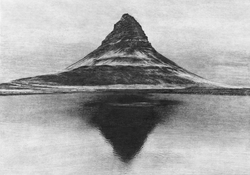
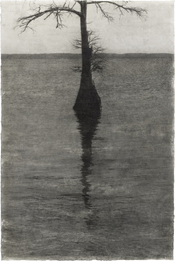
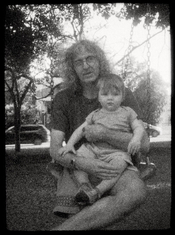
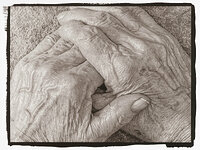
As a reference, I am attaching 3 photos from photographer Jungjin Lee:
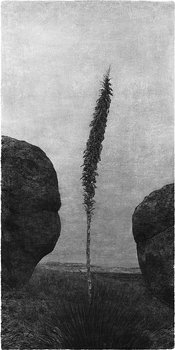
63.jpg62.jpg64.jpg


What I know is that she used rice paper, onto which she applied photographic emulsion with a brush, so the texture of the paper and the brush strokes are visible.
I don't know how difficult it is to work with liquid emulsion. Both technically and financially (how much emulsion is needed for one 30x40cm (12x16 inch) paper). I'm from the Czech Republic, so I would reach for the Foma emulsion.
Before I try something like that, can you think of an alternative? Maybe some kind of contact process like toned cyanotype? 5x7 contacts would probably be feasible, for medium format I would have to go the route of some kind of internegative/interpositive. I have tried Kallitype a few times in the past, I don't have much experience here.

Thank you very much for your ideas.
Jan
 
bromoil print


gary003.jpg
 
What's about Bromoil printing?
I found it relatively easy to start with, and I love to continue stubbing the ink to the prepared paper next time.
All in all it isn't a cheep process. The emulsion, the developer and the bleach is expensive thisadays.
But I'm sure you would match your pictorialistic ideas with Bromoil.

Edith: As Gary said in short :smile:
 
Back in the day, texture screens were available in various sizes.
Large ones were contacted with the paper under the enlarger, small ones were sandwiched with the negative in the enlarger.
 
bromoil print

What's about Bromoil printing?
I found it relatively easy to start with, and I love to continue stubbing the ink to the prepared paper next time.
All in all it isn't a cheep process. The emulsion, the developer and the bleach is expensive thisadays.
But I'm sure you would match your pictorialistic ideas with Bromoil.

Edith: As Gary said in short :smile:

Thanks. I did a little research, I only knew roughly theory about the Rawlins Oil Print.
Bromoil looks interesting, Wolfgang Moersch also has a developer for this process. The problem will be with the bleach, dichromates are already quite difficult to find in the EU.
 
Back in the day, texture screens were available in various sizes.
Large ones were contacted with the paper under the enlarger, small ones were sandwiched with the negative in the enlarger.

Ohh, that's interesting, I'll look into that. Maybe something could be created, on film negative.
 
Yes, many people made their own by photographing canvas, fabric, sand, window screen material, etc.
 
bromoil print

Definitely the first thing that comes to mind.

You can also get results that have a painterly style with direct pigment processes like (not exclusively) gum bichromate. It's a different style than bromoil.

The emulsion, the developer and the bleach is expensive thisadays.
What specifically is expensive? I must be overlooking; the materials as far as I'm aware are fairly cheap, in fact. There are problems obtaining them, however.

The main problem with bromoil these days is getting a suitable paper. I don't think any of the papers in current manufacture work for this process. The advantage of bromoil is/was that you can enlarge regular negatives onto the paper.

A regular oil print can be made with relatively cheap materials (gelatin, dichromate etc.), although officially you can't purchase the required dichromate anymore in the EU. Unofficially, loads of the stuff are still around and could probably be obtained from private individuals looking to get rid of it. The main drawback is that this limits you to contact printing, so for big prints you need to work with big (inkjet) negatives.

The more technically feasible route would be therefore the regular oil print, which also brings some advantages w.r.t. freedom of choice in the base material/support. However, it'll be a learning curve to get acceptable results.

Back in the day, texture screens were available in various sizes.
That would be one of the easier routes and it would sort of work, visually, as long as the viewer remains at a distance of the print, and depending on lighting conditions. It all too easily breaks down once any of these factors changes.
 
The main problem with bromoil these days is getting a suitable paper. I don't think any of the papers in current manufacture work for this process. The advantage of bromoil is/was that you can enlarge regular negatives onto the paper.
The last paper that used to work was Ilford Multigrade FB MGFB 5k But maybe that has changed.
 
You could try printing really dark, and then bleach back the highlights and midtones with a large brush. That could work with silver gelatin, cyanotype and several other processes.
 
Not stepping into any alt processes, I'd make a normal- to high-contrast enlargement and photograph that print with high contrast copy film or any normal film (overdeveloped to boost contrast) then enlarge that onto matt paper. But the right image would be required.

Alternatively, for a greater sooty look, take the initial print, photocopy it (on an actual photocopier), touch it up with pencil or ink, photograph that, then enlarge onto matt paper.
 
Not stepping into any alt processes, I'd make a normal- to high-contrast enlargement and photograph that print with high contrast copy film or any normal film (overdeveloped to boost contrast) then enlarge that onto matt paper. But the right image would be required.

Alternatively, for a greater sooty look, take the initial print, photocopy it (on an actual photocopier), touch it up with pencil or ink, photograph that, then enlarge onto matt paper.

I see I'm not as creative as you, interesting ideas. Especially the idea of "editing" a
photo with a pencil and then photograph it.

I used to get a nice pencil drawing effect with the (now defunct) Kodak 2475 Recording Film. It had a prominent grain and a soft tonal range. It was nominally 1000 to 1250 ASA.

Maybe push Tri-X and avoid a high sulphite developer?

I need to work with existing negatives :/
 
I need to work with existing negatives
Find some of your higher speed film that is pushed or under exposed, and find an interesting new tight crop.
Attached is a 8x11 frame Minox B with Kodak 2484 missile testing film.
 

Attachments

  • Minox-2484-043aa.jpg
    Minox-2484-043aa.jpg
    118.5 KB · Views: 134
Back in the day, texture screens were available in various sizes.
Large ones were contacted with the paper under the enlarger, small ones were sandwiched with the negative in the enlarger.

Best thin stocking of girlfriend or wife used to be used..
 
I would like to preserve the details, some alternative processes or extreme manipulations are too pictorialistic.
 
Or make a mask with charcoal on vellum or similar, then put it on top of your negative when you contact print.
 
Bromoil: - "Say it with Flowers"

18) 'Say it with flowers' - Alton - England.jpg
 
What specifically is expensive?

Foma Emulsion 80 Euro/ 1Kg,
Bromöl Developer (Moersch) 29 Euro/Liter,
Bleach (Moersch) 40 Euro / Liter,
Fix (Moersch) 40 Euro / 2,5l
Black ink 20 to 30 Euro
Paper of course, plus some tools like brushes, rollers, Terpentin etc.
 
Foma Emulsion 80 Euro/ 1Kg,
Bromöl Developer (Moersch) 29 Euro/Liter,
Bleach (Moersch) 40 Euro / Liter,
Fix (Moersch) 40 Euro / 2,5l
Black ink 20 to 30 Euro
Emulsion: you can DIY one for a fraction of the cost, or use an oil print instead of bromoil print process that uses a much simpler 'emulsion' of just gelatin.
Developer, bleach & fix: you can DIY these as well. For the fixer, any old fixer is OK. Costs will be a fraction of the Moersch products.
Black ink: last time I checked a 60ml tube of Charbonnel etching ink was €12.

You can make this as expensive as you want of course.
 
Thanks for your hints concerning costs, I will have some questions some day.

I didn't know about the very small quantities of ink which I needed up to now, so I bought a what, 200ml kanister? Which will save money during within the next 10 years :smile:

I'm just in the beginner's round and have thought about buying stable products first.
Regarding my first little successes without struggling with unknown accidents and wasted marerials I think I made it as cheep as possible to me.
Later having some practice I will try to reduce my costs. But first I have to learn some things.
 
At one stage Paterson used to make texture screens, at least in 35mm, which were sandwiched with the negative before exposure in the enlarger.

Probably just as easy to photograph textured surfaces per @AnselMortensen's advice above.
 
I haven't done it but I've seen it done. I bet there is a fair bit of skill and practice involved.

In the darkroom use an enlarger to project a negative on to paper. Then use graphite pencils to fill in the lighter parts of the projected image so that the entire image area becomes a uniform dark tone.
Switch on the lights to see a positive pencil drawing! I suppose a similar thing could be attempted with actual charcoal sticks. Theory, theory.
 
Photrio.com contains affiliate links to products. We may receive a commission for purchases made through these links.
To read our full affiliate disclosure statement please click Here.

PHOTRIO PARTNERS EQUALLY FUNDING OUR COMMUNITY:


Ilford ADOX Freestyle Photographic Stearman Press Weldon Color Lab Blue Moon Camera & Machine
Top Bottom