

Andreas Thaler
Subscriber
Over the past few months, I’ve been active online with the goal of making DIY service/repairs for electromechanical SLRs accessible to a wider audience.
The aim is to help preserve these beautiful and ingeniously designed SLRs from Japan dating from the 1970s and 1980s. This is because repair options for many of these cameras are becoming increasingly limited.
My six months on Reddit, in particular, were very productive; one result of that effort is this how-to guide for getting started with the topic. Since there wasn’t anything specific on this subject before, I’ve compiled my more than four years of experience in the field.
The guide consists of eight parts, which I’m presenting in the same format as on Reddit.
My goal was to keep the topic as simply as possible, even for laypeople who are interested but have no repair experience.
I’m no longer active on Reddit, but during that time I published several projects on servicing and repairing electromechanical SLRs as on photo.net, which I’ll be sharing with you here soon. For my previous repair projects, see here on PHOTRIO.
I have a lot planned for the near future and am excited to be active here on PHOTRIO again!
Best regards from Vienna,
Andreas
Original series on Reddit published in 2026, adjusted in details.
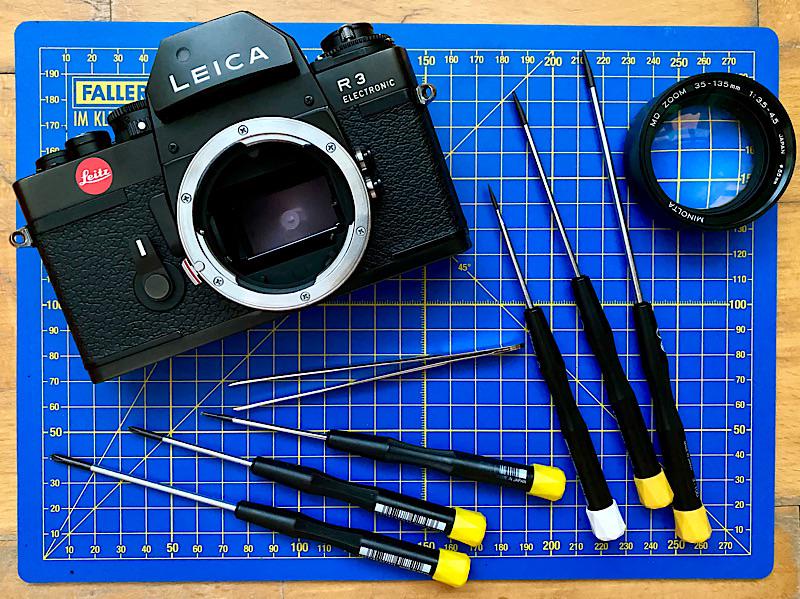
As the first topic for our how-to guide DIY service/repair for electromechanical SLRs we want to look at how to get started with service and repairs.
There are as many ways to do this as there are interested parties, so I will describe my own here.
Questions, contributions, and requests for topics are welcome at any time!
Before we start, here is an overview of the planned topics, each of which will have its own post:
1. How do I get started with DIY?
2. What knowledge do I need?
3. What tools are required?
4. What can I repair myself, and what can't I?
5. Where can I find information on repairing specific cameras?
6. How do I work with technical documentation?
7. How do I go about troubleshooting?
8. Summary
Concerns of a user and collector
As a user and collector of several 35mm systems, there is always a need for service and repair.
For a while, I took my SLRs and lenses to a repair shop in Vienna. That cost me a lot of money, and one day I was no longer satisfied with the service. So I looked for a repair shop I could trust and that wouldn't break the bank.
But It turned out that no one was willing to take on most of my cameras. "No spare parts" was the standard response when I inquired. At the time, I believed that, and my concern for my collection grew and grew. Should I sell everything while it still worked?
Turning point and reorientation
Then there was a major turning point in my life: severe burnout forced me to change course.
As I recovered, I thought about what to do with my time, because I could no longer do my job in communications at an international company.
I was interested in electronics, because I knew nothing about it. So I got some books and started reading. I took two courses.
Then I remembered the two classic repair books by Thomas Tomosy that I had bought once. Repairing SLRs and lenses myself - I couldn't imagine doing that. But I was interested, and I started reading those books too.
I took apart a Minolta X-700, successfully replaced the small mirror for the aperture display in a Minolta XD viewfinder, dismantled a Nikon Motor Drive MD-4, and tinkered with the battery indicator …
That was just the beginning
And when I later managed to replace the defective LCD on my mint-condition Nikon F3/T, it was clear to me: this was just the beginning!
This beautiful camera sat in my closet for a long time, and I couldn't find a repair shop for this job.
Now I had helped myself!
And I saw a future for my collection and also for myself. Because now I had a task that fascinated and fulfilled me: to know more, to learn more, to become better at repairing.
What is the message of this story?
To get started with DIY, you need to be motivated.
Without motivation, you won't get anywhere because there's no one there to push you. And you will have to overcome some hurdles that will require all your motivation.
So search for your motivation.
There is no training for camera technicians specializing in electromechanical SLRs from the 1970s and 1980s. That was once the case, but now it has to be replaced by personal initiative.
Suggestions
How about you?
Are you motivated to start doing DIY?
Report on it!
+++
 A word of caution
Please keep in mind that you’ll be using highly flammable solvents for service work, and their fumes are harmful to your health. Soldering also produces fumes that should not be inhaled. Dangerous high voltages can be present when handling electronics, especially in conjunction with electronic flash units and mains. Therefore, familiarize yourself with the safety regulations beforehand and ensure your safety. Depending on the activity, protective gear may be advisable.
All information provided without guarantee and use at your own risk.
The aim is to help preserve these beautiful and ingeniously designed SLRs from Japan dating from the 1970s and 1980s. This is because repair options for many of these cameras are becoming increasingly limited.
My six months on Reddit, in particular, were very productive; one result of that effort is this how-to guide for getting started with the topic. Since there wasn’t anything specific on this subject before, I’ve compiled my more than four years of experience in the field.
The guide consists of eight parts, which I’m presenting in the same format as on Reddit.
My goal was to keep the topic as simply as possible, even for laypeople who are interested but have no repair experience.
I’m no longer active on Reddit, but during that time I published several projects on servicing and repairing electromechanical SLRs as on photo.net, which I’ll be sharing with you here soon. For my previous repair projects, see here on PHOTRIO.
I have a lot planned for the near future and am excited to be active here on PHOTRIO again!
Best regards from Vienna,
Andreas
Original series on Reddit published in 2026, adjusted in details.
As the first topic for our how-to guide DIY service/repair for electromechanical SLRs we want to look at how to get started with service and repairs.
There are as many ways to do this as there are interested parties, so I will describe my own here.
Questions, contributions, and requests for topics are welcome at any time!
Before we start, here is an overview of the planned topics, each of which will have its own post:
1. How do I get started with DIY?
2. What knowledge do I need?
3. What tools are required?
4. What can I repair myself, and what can't I?
5. Where can I find information on repairing specific cameras?
6. How do I work with technical documentation?
7. How do I go about troubleshooting?
8. Summary
Concerns of a user and collector
As a user and collector of several 35mm systems, there is always a need for service and repair.
For a while, I took my SLRs and lenses to a repair shop in Vienna. That cost me a lot of money, and one day I was no longer satisfied with the service. So I looked for a repair shop I could trust and that wouldn't break the bank.
But It turned out that no one was willing to take on most of my cameras. "No spare parts" was the standard response when I inquired. At the time, I believed that, and my concern for my collection grew and grew. Should I sell everything while it still worked?
Turning point and reorientation
Then there was a major turning point in my life: severe burnout forced me to change course.
As I recovered, I thought about what to do with my time, because I could no longer do my job in communications at an international company.
I was interested in electronics, because I knew nothing about it. So I got some books and started reading. I took two courses.
Then I remembered the two classic repair books by Thomas Tomosy that I had bought once. Repairing SLRs and lenses myself - I couldn't imagine doing that. But I was interested, and I started reading those books too.
I took apart a Minolta X-700, successfully replaced the small mirror for the aperture display in a Minolta XD viewfinder, dismantled a Nikon Motor Drive MD-4, and tinkered with the battery indicator …
That was just the beginning
And when I later managed to replace the defective LCD on my mint-condition Nikon F3/T, it was clear to me: this was just the beginning!
This beautiful camera sat in my closet for a long time, and I couldn't find a repair shop for this job.
Now I had helped myself!
And I saw a future for my collection and also for myself. Because now I had a task that fascinated and fulfilled me: to know more, to learn more, to become better at repairing.
What is the message of this story?
To get started with DIY, you need to be motivated.
Without motivation, you won't get anywhere because there's no one there to push you. And you will have to overcome some hurdles that will require all your motivation.
So search for your motivation.
There is no training for camera technicians specializing in electromechanical SLRs from the 1970s and 1980s. That was once the case, but now it has to be replaced by personal initiative.
Suggestions
- Get yourself a broken SLR that really interests you.
- Get the available technical documentation, whether you understand it or not.
- Read books about camera repair and learn the basics.
- Get the basic tools mentioned in the books. And start taking the SLR apart, screw by screw.
- Learn how to solder, how to work with tweezers and screwdrivers, make mistakes, keep going.
- Then comes the point where you either give up or keep going. That can be within a day or a year.
- And with that, you are on your own personal journey.
How about you?
Are you motivated to start doing DIY?
Report on it!
+++
A word of cautionPlease keep in mind that you’ll be using highly flammable solvents for service work, and their fumes are harmful to your health. Soldering also produces fumes that should not be inhaled. Dangerous high voltages can be present when handling electronics, especially in conjunction with electronic flash units and mains. Therefore, familiarize yourself with the safety regulations beforehand and ensure your safety. Depending on the activity, protective gear may be advisable.
All information provided without guarantee and use at your own risk.
Last edited: