

• Welcome to Photrio!
    Registration is fast and free. Join today to unlock search, see fewer ads, and access all forum features.
    Click here to sign up

How to get real red out of selenium toning?

Recent Classifieds

Forum statistics

Threads
203,204
Messages
2,851,334
Members
101,721
Latest member
rptn
Recent bookmarks
0

hpulley

Member
Allowing Ads
Joined
Oct 6, 2010
Messages
2,207
Location
Guelph, Onta
Format
Multi Format
Is there any way to get a real red out of Berg Selenium toner? I have MGWT paper which I love alone and I do like the selenium tones for some pictures but for others I prefer the real red of Berg Copper but it isn't archival of course. Berg Selenium 1+3 seems to go more light brown eggplant than red with MGWT, darker and deeper black purple with MGIV even after a full 10:00. Split toning Selenium followed by Copper doesn't do what I want, it reddens the highlights, not the shadows and mid tones.

Is Ilford Galerie paper redder in selenium? Is KRST or Ilford Selenium redder or is selenium always the same redness? Any other warm tone papers go to actual red in selenium or am I stuck with non-archival copper which gives me the tone I want?

Ilford MGWT untoned:
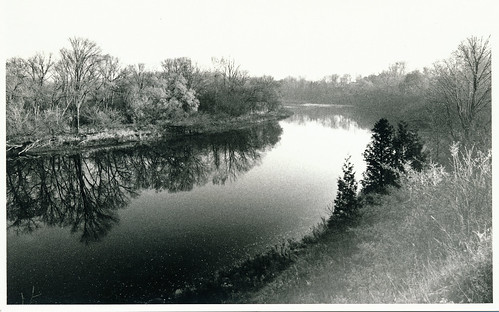
Misty morning river in MGWTFB by Harry Pulley, on Flickr

Ilford MGWT Berg Selenium 1+3 10:00:

Selenium toned Misty River by Harry Pulley, on Flickr

Ilford MGIV Berg Copper 1+3:

Misty Morning River Copper Toned by Harry Pulley, on Flickr
 
The colour is partially due to grain size, so a warmer tone film/developer combination is better.

I can get a redder colour from Forte Plyearmtone, in ID-78 and KRST. The toners differ slightly but prior development etc are important.

Ian
 
I have an ID-78 formula in a book and Digital Truth has one as well. Is that warmer than Bromophen, Multigrade, PQ Universal, Dektol? Those ones I can get locally, for anything else I'll have to order it in.

Polywarmtone is going to be tough, guess I can add my name to the pre-order list...

Would Selenium 1+9 or 1+19 give me redder results than 1+3? Seems counterintuitive.
 
Last edited by a moderator:
How about Sepia toning before the selenium? Seems to me that produces a redder image with some papers.

Both toners are "archival".
 
A warm tone paper in warm tone developer (ID78) longer exposure/shorter dev time will give quite red tones. However there's so many variables you'll need to fine tune.

A selenium-Sulphide flemish toner works well with colder tone papers.

Ian
 
If you tone in sepia first and then in gold you can get salmon red tones. You should get Rudman's "Toning book". It tells you ALL you will ever need to know about toning.

r

Mats
 
I echo Mats statement and have just looked through Tim's book. There is one print in it which comes close to what you seem to want with gold after polysulphide and this would be archival. However if you want a replica of print 3 you have shown then it looks like only copper will do that but hey you might look at Tim's book and choose some print as being what you need that I would never have thought met your requirements in a million years.

Simple tea toning with a South African tea which from its Afrikaans name translates as redbush tea might get close. It really is much redder than normal "black" tea but in the land of coffee may be difficult or impossible to get.

I suspect it may work well. If you are a tea drinker like me it tastes nice as well. Not likely to be archival though.

pentaxuser
 
Fotospeed Palette Red. Yes it is a copper toner but Selenium is only so so archival anyway
Mark
 
I've never used Berg selenium and am rather surprised by the 10:00 toning result. When I use Kodak RST at the 1:9 dilution and tone for 10-15 minutes my results are much redder than that, not red-red, but more reddish brownish, certainly not picture #3. These results are with MGWT in combonation with LPD.

Picture #3 reminds me of fully bleaching then sepia toning MGWT, or fully bleaching then toning with Viradon.
 
At best, selenium toner produces a purplish brown tone. Copper toner is more red, as you found out, but it is not considered to be archival. Different copper toner formulas and different toning times give different shades. The traditional way to get red tones is to use a sulfide-sepia toner followed by gold toner. I don't know what effect gold toner would have after selenium, but it might be interesting and in the direction you're looking for.
 
Thanks for all the suggestions! More toners and Tim's book sounds like a good direction and of course a lot more experimentation. Just too bad the copper gives me exactly what I want visually without any fuss.
 
Harry:

Well the Berg copper "toner" does not, in itself, ensure that your photograph is archival, I don't know that it actually reduces the archival properties of a photograph that has already been processed to an archival standard.

So you may want to consider toning for archival results, and then adjusting the colour of the image using the dye based Berg copper product.
 
I was worried that copper was worse than silver but you might be right, it might be no worse.

I think dye would be different than metallic replacement but I can get a Berg color dye kit locally to try. Thanks for the suggestion.
 
Tim Rudman says in his book that even though copper is not an archival treatment it only means that it does not help to increase the longevity of the print. A properly fixed, washed and copper toned picture should last as long as any other silver gelatin print. And that is not bad. If you are not selling your prints to a museum then go ahead, copper tone, tea tone, coffee tone.... do whatever floats your boat. If the print starts to degrade in 10-20 years, so what. It just gives you an excuse to redo the print. And it will be so much better since you will have 20 more years experience printing :wink:

r

Mats
 
Copper toner comes in many flavours of red.
Gold after polysulphide is archival if the print is worth current AuCl prices.
I generally prefer the copper colour
Mark
 
If you want salmon-colored, try Berg Copper/Brown toner on a print that has been fixed with a hardening fixer. It'll REALLY go pink. Another option for getting the color you want is alt-process printing - either a salt print or an albumen print will get you in the tonal range, with the salt print being the redder of the two, and the albumen more brown/sepia.
 
You simply need the right paper. I've toned Slavich graded papers and the new Adox Nuance papers to very red (only as an experiment, though, since I personally don't find the tone that pleasing). I use KRST and about a 1+10 or greater dilution.

Some papers don't tone very much, even when left in rather strong toner a long time, others tone very rapidly and change tone dramatically.

I use graded paper mostly; VC papers may not tone as radically as the graded papers due to the emulsion formulation.

Best,

Doremus Scudder
www.DoremusScudder.com
 
Harry:

Well the Berg copper "toner" does not, in itself, ensure that your photograph is archival, I don't know that it actually reduces the archival properties of a photograph that has already been processed to an archival standard.

So you may want to consider toning for archival results, and then adjusting the colour of the image using the dye based Berg copper product.

Copper toning converts the image to copper ferricyanide, which is less stable than the original silver metal image. But it is still quite stable, and it should last for many years.
 
Ilford Galerie tones to a warm brown in selenium.
 
I don't have my Tim Rudman book handy, but there is a process called, iirc, Chinese toning where selenium toning is done first and then the silver is bleached out leaving a red-brown image. I've seen one at a Tim Rudman course and it's striking.

I'll look it up later.
 
About Chinese toning: First, strong selenium toning (e.g. 1+2 for 15 minutes) then bleach print in iodine+methylated spirit, which removes silver but not selenium. It will be stained orange and is then cleared in fixer. It's more orange that the OP's copper example, but the process can be done partially without bleaching all the silver. Refer to Tim Rudman's toning book for details.
 
You may be able to influence results by changing developer. Try Geaveart 262.

From Tom Hoskin's post of 11-14-2006:

Gevaert G-262 Warm Tone Developer
Water (125 F)-----------------------750 ml
Sodium Sulfite (anhy)---------------70.0 grams
Hydroquninone----------------------25.0 grams
Sodium Carbonate (mono)-----------90.0 grams
Potassium Bromide-------------------2.0 grams
Water to make----------------------1.0 liter

Try it diluted 10x - you really need to expose the #$*&^%#$ out of the paper and develop for 10 minutes or so. Results are decidedly redish even with no toning, but low contrast was a problem when I tried it.
 
Developers like this used highly dilute worked better with the older warmtone papers with cadmium in their emulsions, the last paper taht would responds reasonably well to give red tones purely with development was Record Rapid pre-1990 (approx).

Forte Polywarmtone processed in Ilford Warmtone, Agfa WA or ID-78 will give a strong reddish brown with selenium toning to completion.

Ian
 
Photrio.com contains affiliate links to products. We may receive a commission for purchases made through these links.
To read our full affiliate disclosure statement please click Here.

PHOTRIO PARTNERS EQUALLY FUNDING OUR COMMUNITY:


Ilford ADOX Freestyle Photographic Stearman Press Weldon Color Lab Blue Moon Camera & Machine
Top Bottom
