• Welcome to Photrio!
    Registration is fast and free. Join today to unlock search, see fewer ads, and access all forum features.
    Click here to sign up

How to expose with Infrared 850mn filter

Recent Classifieds

Forum statistics

Threads
203,396
Messages
2,853,996
Members
101,817
Latest member
goodman1999
Recent bookmarks
0

spl

Member
Allowing Ads
Joined
Aug 12, 2021
Messages
57
Location
Dublin, Ireland
Format
Analog
Hey folks,

I have found an old 850nm infrared filter. I know this blocks out all visible light and looks black. I want to play with it and achieve the black and white effect in landscapes. I only shoot black and white so I have two choices of film in the fridge: Ilford SPX200 and Rollei Infrared 400.

This page has a brilliant example of the same scene with different filters: https://kolarivision.com/articles/choosing-a-filter/
and the image they show for the 850nm filter is very nice.

Problem I have is this: SPX200 claims to be responsive to 740 nm, and Rollei, I have found two sources but none deeper than 820nm.

On the graph I found it seems that Rollei 400 has 20% responsiveness to IR at 850nm, the value of the filter, so does that mean I need to open another 2 stops?

How do 850nm filters produce anything on IR films if they don't respond down that low?

How do I guess how many stops I need to close to use the 850nm?

Thanks for your help and ideas!
 
The 850nm filter would have given you some results with the no longer manufactured Kodak HIE film. I'm not sure, but there might have been marginal results from the no longer manufactured Efke and Konica IR films.
That filter will not give you anything useful with any currently produced films.
There may be other types of sensors that do respond to infrared over 850nm - you could use the filter with them.
 
So this is one to keep for the digital world?
I'm not sure even there, but I don't really know. I was thinking more of specifically designed scientific sensors.
 
Look at the spectral sensitivity chart of the respective Agfa film. And at the spectral transmission curve of your filter. (Let aside the spectral composition of your lighting). You shall see that such filter leaves hardly any effective sensitivity to the film.
Keep also in mind that Agfa some years ago discontinued this film, thus you only will get stock out of storage, which may have effected that resting IR sensitivity too.
 
The 850 will not work on SFX or Rollei IR. Keep it for your digital camera...even though the 720 is more than enough. I use the 720 regularly when exposing Rollei IR and SFX. I still have several sheets of the old Efke IR, and Kodak HIE that perform well with the 850, or Kodak Wratten 87C.
 
Yes, I can see a few digital cameras that have been converted to 850nm, implying that there are sensors there that will work at that.

I see that Rollei ends at 820nm according to many sources. I'm not certain the actual transmittance curve of the filter ... however when I shoot the Rollei with a newly acquired 720nm, I will probably just for fun throw on the 850 and do a bracketed 30 second bulb to see if anything at all happens, just for fun.

I don't even have a digital at the moment :smile:
 
Yes, I can see a few digital cameras that have been converted to 850nm, implying that there are sensors there that will work at that.

I see that Rollei ends at 820nm according to many sources. I'm not certain the actual transmittance curve of the filter ... however when I shoot the Rollei with a newly acquired 720nm, I will probably just for fun throw on the 850 and do a bracketed 30 second bulb to see if anything at all happens, just for fun.

I don't even have a digital at the moment :smile:
30 seconds will most certainly not be enough.
You will need minutes and maybe even an hour, to see any kind of result.
You are up against not only the tiny response of the film at that wave length, also the dwindling and unpredictable amount of mid IR in daylight, and lastly of course reciprocity failure.
 
So, to answer the original question I conducted an experiment with Rollei 400 IR film and a 680 nm and an 850 nm IR filter. The results show that it is possible to get the Rollei IR 400 to respond even through the 850 nm filter, though results leave something to be desired.

The entire experiment consumed the whole roll and exposures were upto 32 minutes at f/1.8, but I am limiting this post to just the few frames that correctly exposed. EVs were taken with a light meter but some judgement and estimation is involved. I didn't dust the negatives and didn't adjust any levels, these are direct off the film scanner. Developed in R09 for 12 minutes at 1+50, 20 degrees. Ilford rapid fixer. Camera is an OM1.

680 nm filter:

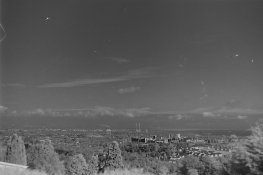
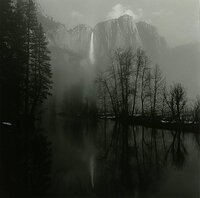
4 stops up (f/2.8, 1/1000, EV15) 10.jpeg 10.JPG
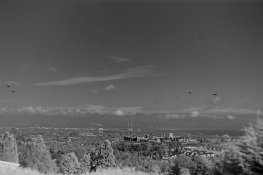
5 stops up (f/2.8, 1/500, EV15) 11.jpg11.JPG
6 stops up (f/2.8, 1/200, EV15) 12.jpg12.JPG

And just to confirm, here is a normal shot at 6 stops up, clearly this works great!PICT0251.JPG

But now for the interesting part, the 850 nm filter:

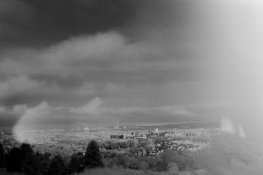
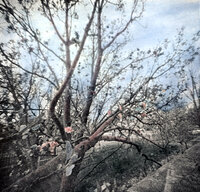
25 stops up (f/1.8, 16 minutes, EV15) 32.jpeg32.JPG
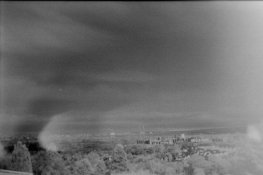
26 stops up (f/1.8, 32 minutes, EV15) 33.jpeg33.JPG

So, it certainly suggests that if you had a very bright scene and were willing to push process by a stop or two you could easily expose Rollei IR 400 through an 850 nm filter with a bulb exposure at 2 or 4 minutes. It is true to say though that results would be ... artistic.

Looking at the two 850 nm photos, there is a bright bank of IR coming in from the right of frame. There is a sea over there, if that means anything.

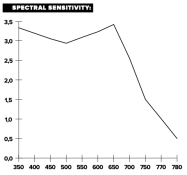
While results are inenviable, it is interesting that the image has potential at all given the spectral sensitivity graph from the Rollei IR datasheet (I'd be lying to say I know what that y axis is.)Screen Shot 2021-09-15 at 20.39.12.png
 
You shall see that such filter leaves hardly any effective sensitivity to the film.
As I said.

The problem wit such long exposure times is, that you not only have the problem of moving persons or vehicles, but also that of moving clouds and even of the sun with moving shadows.
 
So, to answer the original question I conducted an experiment with Rollei 400 IR film and a 680 nm and an 850 nm IR filter. The results show that it is possible to get the Rollei IR 400 to respond even through the 850 nm filter, though results leave something to be desired.

The entire experiment consumed the whole roll and exposures were upto 32 minutes at f/1.8, but I am limiting this post to just the few frames that correctly exposed. EVs were taken with a light meter but some judgement and estimation is involved. I didn't dust the negatives and didn't adjust any levels, these are direct off the film scanner. Developed in R09 for 12 minutes at 1+50, 20 degrees. Ilford rapid fixer. Camera is an OM1.

680 nm filter:

4 stops up (f/2.8, 1/1000, EV15) 10.jpeg View attachment 285470
5 stops up (f/2.8, 1/500, EV15) 11.jpgView attachment 285471
6 stops up (f/2.8, 1/200, EV15) 12.jpgView attachment 285472

And just to confirm, here is a normal shot at 6 stops up, clearly this works great!View attachment 285475

But now for the interesting part, the 850 nm filter:

25 stops up (f/1.8, 16 minutes, EV15) 32.jpegView attachment 285473
26 stops up (f/1.8, 32 minutes, EV15) 33.jpegView attachment 285474

So, it certainly suggests that if you had a very bright scene and were willing to push process by a stop or two you could easily expose Rollei IR 400 through an 850 nm filter with a bulb exposure at 2 or 4 minutes. It is true to say though that results would be ... artistic.

Looking at the two 850 nm photos, there is a bright bank of IR coming in from the right of frame. There is a sea over there, if that means anything.

While results are inenviable, it is interesting that the image has potential at all given the spectral sensitivity graph from the Rollei IR datasheet (I'd be lying to say I know what that y axis is.)View attachment 285476
Use a polarizer if you want more dark skies.
Even use a grad filter to add an even more dramatic effect.
Zomei filters are fine and cheap.
I have both Hoya and Zomei filters. If there is a difference, it’s too small to detect.
 
I've been told that the 25 is the best filter for SFX, without going over the top.
 
I've been told that the 25 is the best filter for SFX, without going over the top.
Is this the Wratten 25 to which you refer? If so then in my experience it does give you very dark skies and dark water such as a seascape scene on a very sunny day but the white effect on foliage is largely lost. For that a R72 is needed

pentaxuser
 
Is this the Wratten 25 to which you refer? If so then in my experience it does give you very dark skies and dark water such as a seascape scene on a very sunny day but the white effect on foliage is largely lost. For that a R72 is needed

pentaxuser


Yes, that's what I want to loose. Seems totally false to me.
 
Photrio.com contains affiliate links to products. We may receive a commission for purchases made through these links.
To read our full affiliate disclosure statement please click Here.

PHOTRIO PARTNERS EQUALLY FUNDING OUR COMMUNITY:


Ilford ADOX Freestyle Photographic Stearman Press Weldon Color Lab Blue Moon Camera & Machine
Top Bottom