• Welcome to Photrio!
    Registration is fast and free. Join today to unlock search, see fewer ads, and access all forum features.
    Click here to sign up

How to calculate mixture of different-temp water?

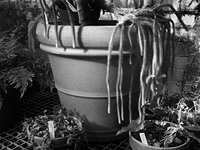
Ferns

H
Ferns

  • 0
  • 0
  • 24
between takes

H
between takes

  • Tel
  • Mar 21, 2026
  • 3
  • 0
  • 43

Recent Classifieds

Forum statistics

Threads
202,868
Messages
2,846,776
Members
101,578
Latest member
Reaton
Recent bookmarks
1

markaudacity

Subscriber
Allowing Ads
Joined
Jun 20, 2013
Messages
184
Location
Houston TX USA
Format
Med. Format RF
Google doesn’t work for anything but selling you things anymore, so I’m asking here:

What is the formula for determining how much water at temp A to mix with water of temp B to achieve temp C?
 
If both fluids are the same:

T = [ mass(A)xT(A) + mass(B)xT(B)] / [mass(A) + mass(B)]

Also works with volume instead of mass.
 
If I understand correctly:
1 litre @18°c + 1 litre @22°c = 2 litres @20°c

Temp.A+Temp.B÷2=Temp.C

So the outcome is always the average of the other two as long as the volumes are the same.

And I believe that by knowing any 2 of the variables, A,B,C, the 3rd can always be calculated.
 
As an engineer enough with math. If I want 16 oz of developer and it's at 80' degrees I pour 8 oz in a measuring cup and then add cooler water (~70 deg) to bring it up. I just play around until I hit it. Maybe a little ice water bath to increase the temp a couple of deg or a hot water bath to lower it. I'm talking my measuring cup in a slightly bigger container hold the cold or hot water.

Or use diafine - any temp between 70 and 80 is good.
 
. If I want 16 oz of developer and it's at 80' degrees I pour 8 oz in a measuring cup and then add cooler water (~70 deg) to bring it up.

Yeah, likewise. Although I generally start with more than I need, bring to temperature and then measure out the volume I actually need.

The math is useful insofar as it gets you in the ballpark when adding let's say near-boiling water to tap water. But the answer usually ends up something like "ah, not much, this dash will do fine" and that's it. I've never found it very practical to calculate this.
 
Apart from the mentioned formulae which can be of help of course, my experience is that bringing down the temperature of a solution is much more difficult than warming it up. When my darkroom is at 22C I must use a waterbath of 20 C to keep the developer at 20C, whereas I don't need such a bath when it's 18C in my darkroom. So I'd rather not mix different temperatures and bring the water and developer at the same temperature before mixing; with a waterbath.
 
There is an easy way to compute unequal mixtures with a cross diagram. But I could not find examples in English. So see below, originally with wine (of course, obvious French-bashing cliché, with this out of the way let's proceed). Let's say the numbers are °F. You have water at 75°F and 60°F. In what proportions should you mix them to obtain water at 70°F?
Follow the graphical steps (should be obvious). Answer 10 parts of 75F water mixer with 5 parts of 60°F water. Also works with concentrations, etc.

1721812428451.png
 
If both fluids are the same:

T = [ mass(A)xT(A) + mass(B)xT(B)] / [mass(A) + mass(B)]

Also works with volume instead of mass.

Temperature is an arbitrary numbering system. Fahrenheit differs from Centigrade. 32-212 vs 0-100 (freezing-boiling). I don't see a relationship between volume and temperature where the formula would be the same for each measurement type. Even the conversion is a special formula. Fahrenheit = (Celsius * 1.8) + 32
 
Temperature is an arbitrary numbering system. Fahrenheit differs from Centigrade. 32-212 vs 0-100 (freezing-boiling). I don't see a relationship between volume and temperature where the formula would be the same for each measurement type. Even the conversion is a special formula. Fahrenheit = (Celsius * 1.8) + 32

Both the Fahrenheit and Celsius systems are linear. The different zero points don't matter for this as we're not multiplying absolute temperatures or anything thing like that. As long as you don't mix them, it works in either.
 
Temperature is an arbitrary numbering system.

Not really. Celsius 0 = freezing point of water. 100C = boiling point of water under normal (sea level) pressure. 100F = typical human body core temperature.
And since the unit is eliminated in the calculation, it doesn't matter anyway as @grain elevator pointed out.
 
Temperature is an arbitrary numbering system. Fahrenheit differs from Centigrade. 32-212 vs 0-100 (freezing-boiling). I don't see a relationship between volume and temperature where the formula would be the same for each measurement type. Even the conversion is a special formula. Fahrenheit = (Celsius * 1.8) + 32
There is nothing in the formula that belongs to this or that unit system, as long as they are related by a linear transform (to be precise, this equation assumes that the specific heat is --reasonably-- constant). As pointed out by @grain elevator.
And as noted in my post just above yours, it also applies to concentrations. How come?
Temperature is in effect energy per unit mass
Concentration is mass (of active substance) per unit mass (of solvent).
So, same problem under different clothes.
 
The question of proportions of two solutions also will vary with 'specific heat' of each solution, and final temperature is influenced by the temperature of the vessel in which the solutions are being mixed!
 
If you're just adding water to water then it's fine to do it by trial. But if one of the solutions is a stock, and you don't want to mix more working solution than you need, it is useful to know how to compute that. Let's say you have developer stock solution at room temp 80 F, and want to make 16 oz of 1+1 working solution at 70 F. Obviously you need 8 oz of stock solution, and 8 oz of water, and here because it's 1+1, it's simple: the water needs to be 60 F. If it were 16 oz of 1+2, you would need 5.3 oz of stock, 10.6 oz of water, and the water should be 65 F.

As others have said, because temperature scales are linear, this works in any common temperature scale - the zeropoint cancels out. Otherwise you would have to do the calculation in degrees Kelvin.

For photochemistry where nearly all the solutions are fairly dilute solutions in water, you can just use the specific heat of water and not worry much about the differences.

 
So let's say you add one liter of water at 50C to one liter of water at 70C (20 degrees different) and the resultant temperature of the 2 liters is 58C. (8 degrees higher than the lower liter's temperature)?(what would it be actually?) ( don;t include the vessel temperatures).

So now you do the experiment again and add one liter at 30C to one liter at 50C (also 20 degrees different) , and you get what? 38C (8 degrees higher than the lower liter's temperature the same as the first experiment)? Something else?
 
So let's say you add one liter of water at 50C to one liter of water at 70C (20 degrees different) and the resultant temperature of the 2 liters is 58C. (8 degrees higher than the lower liter's temperature)?(what would it be actually?) ( don;t include the vessel temperatures).

So now you do the experiment again and add one liter at 30C to one liter at 50C (also 20 degrees different) , and you get what? 38C (8 degrees higher than the lower liter's temperature the same as the first experiment)? Something else?

Change my experiments and use Fahrenheit. Will the ratio of changes be the same as centigrade experiment? Or will the resultant temperature be different?
 
So let's say you add one liter of water at 50C to one liter of water at 70C (20 degrees different) and the resultant temperature of the 2 liters is 58C. (8 degrees higher than the lower liter's temperature)?(what would it be actually?) ( don;t include the vessel temperatures).

So now you do the experiment again and add one liter at 30C to one liter at 50C (also 20 degrees different) , and you get what? 38C (8 degrees higher than the lower liter's temperature the same as the first experiment)? Something else?

No...add a liter of 50C water to a liter of 70C water and you get 60C water -- not 58C. How did you get 58C?

If you add equal amts of water at 122F (50C) and 158F (70C), you get halfway between at 140F...(122F+158F)/2 = 140F...Which equals 60C. Using C or F does not matter in the method.

The second experiment you would get 40C. -- again. why 38C?

Assuming no influence by the temp of the container.
 
Last edited:
So let's say you add one liter of water at 50C to one liter of water at 70C (20 degrees different) and the resultant temperature of the 2 liters is 58C.

You'd end up smack in the middle, so at 60C.

So now you do the experiment again and add one liter at 30C to one liter at 50C (also 20 degrees different)

Same. 40C.

Basic arithmetic is still applicable even if there's a C or an F in the units somewhere. It doesn't matter.
 
No...add a liter of 50C water to a liter of 70C water and you get 60C water -- not 58C. How did you get 58C?

If you add equal amts of water at 122F (50C) and 158F (70C), you get halfway between at 140F...(122F+158F)/2 = 140F...Which equals 60C. Using C or F does not matter in the method.

The second experiment you would get 40C. -- again. why 38C?

Assuming no influence by the temp of the container.

You'd end up smack in the middle, so at 60C.


Same. 40C.

Basic arithmetic is still applicable even if there's a C or an F in the units somewhere. It doesn't matter.
Ok got it. The final temperature is the average of the two temperatures regardless of C or F or Kelvin excluding losses due to the container.
 
Yes, exactly, that's it! And it's a weighted average, so the regular math for those applies here, too. The remark about the vessel is also spot on and in fact this is one of the reasons I only use this approach to temperature control for an initial coarse adjustment. Further finetuning works better IMO by either using a tempering bath, or by incrementally adding hot or cold water until the target is reached.
 
Thanks for all the responses, y’all. Lots of good info here, and my question was more than answered. :smile:
 
How to Develop a 35mm Black & White Film With a developing solution of 1:1 with water


Developing solution – You will need 150ml of water mixed with 150ml of developer = 300ml for one film. The mixture of developer and water should ideally be at a temperature of about 68oF/20oC.


Pour 150ml of developer into a measuring jug and measure temperature. If it is under or over 68oF/20oC, make a separate jug of water to compensate for the difference. Example – if the developer temperature is 18oC, make the water to 22oC, before adding 150ml of water to the developer.
 
Example – if the developer temperature is 18oC, make the water to 22oC, before adding 150ml of water to the developer.

This doesn’t actually address the issue at hand. The problem is I have two fixed temperatures of water, and I need to know the mixture necessary to get to a given temperature. I have no way to make the water to a temperature (or, more accurately, I can heat it, which is unhelpful, but I cannot cool it in a reasonable timeframe).

Perhaps a piece of information y’all who live in cooler climes are missing is that my tap water is currently running at 30°C. The cold water available to me is from a jug in the fridge, which is obviously too cold. :tongue:
 
Say you have water at 30C and 5C, and you need 500ml at 20C. Use formula in post no.2 plus some arithmetic, you'll get 300ml of 30C and 200ml of 5C.

Vmix * (Tmix - Tcold) = Vhot * (Thot - Tcold)
Vmix = Vhot + Vcold
 
Last edited:
Photrio.com contains affiliate links to products. We may receive a commission for purchases made through these links.
To read our full affiliate disclosure statement please click Here.

PHOTRIO PARTNERS EQUALLY FUNDING OUR COMMUNITY:


Ilford ADOX Freestyle Photographic Stearman Press Weldon Color Lab Blue Moon Camera & Machine
Top Bottom