• Welcome to Photrio!
    Registration is fast and free. Join today to unlock search, see fewer ads, and access all forum features.
    Click here to sign up

How sharp can you get a pinhole image?

Recent Classifieds

Forum statistics

Threads
203,475
Messages
2,855,359
Members
101,862
Latest member
Justagram
Recent bookmarks
0

m1tch

Member
Allowing Ads
Joined
Nov 26, 2012
Messages
172
Format
Multi Format
Hi all,

I will be getting into large format photography at some point next year but I am gradually purchasing the parts over time to spread the costs, anyway I have some 5x4 double slides coming in the post for the camera (I don't have yet) and I thought in the interim I might look into pinhole photography. I see that there is a nice guide for an 8x10 pinhole on this forum which looks like you just simply strap the film holder to a recess in the back with some rubber bands lol so I might look at making one of those as it seems pretty simple to make considering its a box with an opening at one end :D

Anyway, I was just wondering about how sharp you can get a pinhole image, I know that with normal lenses there is a 'sweet spot' with regards to image sharpness and resolution, I am not after anything tack sharp as I don't really want the image to be clinical as it is with some digital images, but not massively blurred.

Is anyone able to post up a pinhole image from a 5x4 camera and let me know what the calculated F stop is for the 'lens'? It would be cool to compare and see what the different effects on the image a small change to the F stop might bring.
 
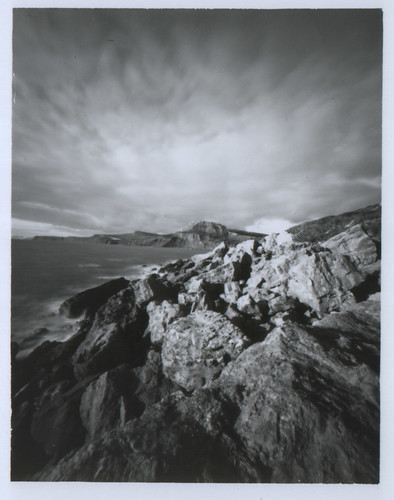
low res scan of a contact
f/176

 
Keep in mind that there are two optimal pinhole diameters,one for resolution and one for sharpness. i suggest optimizing for contrstnd sharpnessas that gets the most apparend sharpness, which the eye appreciates more than resolution. a high-resolution mage canstill look'unsharp'. a low-resolutionbut high-contrast image, on the other hand, looks sharper.
 
Thanks for the comments, I might just go with a pre-made laser cut sort, or indeed use a pin/needle of a certain size, for a sheet of 5x4 the optimal specs are apparently:

Focal length = 6.4"
Pinhole diameter = 0.54mm giving F302
Angle of view would be 53 degrees

I'm going to get some materials together and have a look at some designs, I need to get development equipment together as well so I have a bit of time before I will be taking any shots with it!

Playing around with some numbers I have found this to be perhaps something to aim for:

5.5" focal
0.5mm pinhole
f279
60 degree FOV
3 second exposure on a sunny day with ISO 100 film

Looks like if I aim for a pinhole at around 0.5mm and a focal length of around 5.5-6" it should be good for a 5x4.
 
Last edited by a moderator:
just start playing withit.pinholes are so much fun and surprisingly good at imaging.

I will have a go, my 5x4 double dark slides have arrived so I just need to build a camera now lol :D
 
Foamboard works a treat for the cam body, much easier and quicker than plywood etc. though also weaker.
 
If I wanted a sharp pinhole image I'd shoot on 8x10" film and reduce it to 4x5" when printing, that would double the resolution. Though, I'm not sure why I would want to do that, because if I wanted a sharp image I'd just use a lens.
 
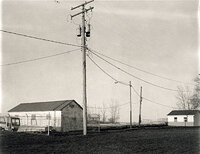
Here's a 4x5 negative scan:

_WPPD2011_Film_02_1B_SteamLocoCloseup.jpg

A 0.305 mm pinhole @ 63 mm from the film plane, a relatively wide angle of view.
Arista ULTRA 100 exposed 8 sec with the f/210 pinhole.

The camera was a relatively fancy project using plywood.
 
Here's a 4x5 negative scan:

View attachment 60521

A 0.305 mm pinhole @ 63 mm from the film plane, a relatively wide angle of view.
Arista ULTRA 100 exposed 8 sec with the f/210 pinhole.

The camera was a relatively fancy project using plywood.

Thanks for posting that up, that's a nice image made from a nice looking camera, it almost looks like a large format field camera in its collapsed form, how did you make your pinhole?
 
Thanks for posting that up, that's a nice image made from a nice looking camera, it almost looks like a large format field camera in its collapsed form, how did you make your pinhole?

The pinhole was made by the traditional dimple-and-sand method, using 0.001 inch brass shim stock and #400 wet-or-dry sandpaper wet. You create a dimple with the tip of the needle, flip the sheet over and sand gently with a circular motion. It is not necessary to actually pierce with the needle, nor does the needle have to be as small as the desired hole diameter. I use a scrap of mat board as backup when "operating." In the ideal case, the hole is left with a knife edge and perfectly round. It's an iterative process, slowly working up to the desired diameter (in my case, checked with a direct reading microscope in my possession for about 45 years!)

The finished pinhole plate was blackened with BlackenIt, a mysterious liquid found in model railroad oriented hobby shops.

1 mil shim stock is pretty flimsy to handle -- I might suggest 2 or 3 mil for a first try. There are assortments of several thicknesses found in some hobby shops, auto parts stores and hardware stores. Often a K&S brand found with other brass strips and shapes for model making.
 
Last edited by a moderator:
Ah I see, so you dimple it rather than pierce it and then when you sand the back of it the dimple gets sanded through before the rest of the material? I think some of the acid etched pinholes are dimpled around the actual pinhole rather than just a 90 degree hole as is with the laser etched ones which apparently gives a clearer image.
 
Ah I see, so you dimple it rather than pierce it and then when you sand the back of it the dimple gets sanded through before the rest of the material? I think some of the acid etched pinholes are dimpled around the actual pinhole rather than just a 90 degree hole as is with the laser etched ones which apparently gives a clearer image.

Yes, think of running a razor over a zit -- uh -- on second thought, maybe we'd rather not! :blink:

From my ancient days in etched parts, circuit boards, etc. it's almost inevitable that there is a slope to the etched edge, so that could produce a bit of a knife edge, even in a flat sheet.
 
Note: there is a page full of links to assorted and sundry pinhole information on the Worldwide Pinhole Photography Day website. Click on the 'Resources' link at the top. There are galleries there showing pinhole shots from all over the world on pinhole days back to 2001 or so.

By the way, WPPD is something to line up for in 2013, it's usually the last Sunday in April. I've been going out for that each year now since 2005. usually I try to record some sort of unique/historic spot in my area.
 
When I get some time I will post some shots from the pinhole made from a PBR can, sand paper, needle, and a black sharpie. I come from the school of KISS.
 
Jon, that shot does look really good, especially considering that there isn't actually an optical lens on the camera :D it would be cool to KISS but then again its probably not as easy with a DDS.

Here is a video on a beercan pinhole which is simple, but I can't really fit a 5x4 DDS in a beercan!

http://www.youtube.com/watch?v=Hp-JMGQUAMA
 
Jon, that shot does look really good, especially considering that there isn't actually an optical lens on the camera :D it would be cool to KISS but then again its probably not as easy with a DDS.

Here is a video on a beercan pinhole which is simple, but I can't really fit a 5x4 DDS in a beercan!

http://www.youtube.com/watch?v=Hp-JMGQUAMA

I have been really happy with the 4x5 pinhole camera I made....
 
For determining pinhole designer, I prefer PinholeDesigner from http://www.pinhole.cz/en/pinholedesigner/. A user constant of 1.4 seems to work better than the default 1.9 Lord Rayleigh constant. Lord Rayleigh may have calculated pinholes on a basis of scientific theory, not photographic results. Contrary to some photographers, the accuracy required for optimum performance is fairly critical. It seems counter-intuitive, but an optimum sized pinhole can actually resolve line pairs on a resolution chart with a spacing finer than the pinhole diameter. When comparing lens resolution charts photographed through pinholes, a deviation from optimum diameter by maybe 10% starts to become noticable. However, lens resolution charts don't make the most pleasing subject for pinhole photography. If detailed pinhole images are the goal, large film with short focal lengths gives the best results in the center of the image. Resolution and illumination fall off towards the corners. For a comprehensive book on pinhole photography, get Pinhole Photography by Eric Renner. For much online information, google for Jon Grepstad
 
I've used a user constant of 1.562 I don't remember exactly where I found this number but I do remember someone had done a pretty convincing analysis about it.

7003065524_9b1638122a_c.jpg
 
I built one out of foam core with my son. That was fun and pretty easy to do. Recently, I bought a Ilford Harmon Titan pinhole camera from Badger Graphic. I highly recommend the Harmon Titan.
 
Photrio.com contains affiliate links to products. We may receive a commission for purchases made through these links.
To read our full affiliate disclosure statement please click Here.

PHOTRIO PARTNERS EQUALLY FUNDING OUR COMMUNITY:


Ilford ADOX Freestyle Photographic Stearman Press Weldon Color Lab Blue Moon Camera & Machine
Top Bottom