• Welcome to Photrio!
    Registration is fast and free. Join today to unlock search, see fewer ads, and access all forum features.
    Click here to sign up

How much better is RF image quality over SLR?

Forum statistics

Threads
203,441
Messages
2,854,727
Members
101,842
Latest member
Madmac
Recent bookmarks
0
The only real difference is a SLR with a /3.5 28mm in overcast day is like 'the black hole of Calcutta', this does not trouble me cause I can still use both eyes, (I'm 'ambi-clumsy'), a 1:1 rangefinder like a M3 or Canon P is still dazzling bright, you don't need to use both eyes, to see the scene.

A cellar gig with candle illumination is no problem apart from slow shutter speed. If you have an auto focus lens on the SLR the focus will/may be ok but can you see the subject?

The IQ is an irrelevance if you cant see the subject.
 
Try to focus an off-centered subject with a Range Finder... :munch:

Bon appetite. :cool:

The only unlimited off-center free focusing method I'm aware of is with ground glass.
Manual focus SLRs, SLRS with AF points also kind of limited to the center or not so far from it.
 
It's not the arrow, its the Indian.

It's not the photo gear, it's the photographer.

Just find and use the gear that feels right to you, in your hands.

If image quality is very important to you, try medium format.
 
I've learned that there's no practical difference between SLR and RF image quality, except that RF image quality is incomparably superior to SLR.

I've also learned that there's no real difference in their hand-held performance, aside from RF's ability to shoot at 1/8 and still get sharp photos.

I would dispute that claim. My Canon New F-1 has a viewfinder quality that is better than any rangefinder i've owned or used. Although i've never owned or used a Leica M3. But it is really big, really bright, and you can focus in any light with it.

As for the ability to shoot at 1/8 and get good photos, you can also do that with some SLRs, depending on how good is the shutter+mirror damping.
 
This is one of those cases that some cannot fathom that they can or may be wrong, or that many of us don't care. JMHO
 
I think one or two have also had a major sense of humour bypass.
 
Honestly, heespharm, no one is getting 'ornery'. We are simply solving the dichotomy of the relationship of shooting a gun and shooting a photo. In a way, both are similar in that we aim both 'vehicles' and have to hold steady.

My question was concerning the change in aim due to the firing of a gun: was that bullet's trajectory determined before or after the bullet left the barrel? E von Hoegh seems to posit that the bullet's angle is determined by the recoil and it would be difficult to disagree with that common sense. Thus, I guess that we have to assume that that recoil is present before the bullet leaves the barrel. And I wondered, as, seemingly he did, how that meshes with pressing a camera's shutter. I say that pressing that shutter can release vibration that can readily influence the wanted aim, before the film is exposed, by the mirror's hitting the fresnel area and by the curtains hitting their end-posts, much like the recoil of a pistol can influence that bullet's aimed target.

No one is getting too esoteric here. No one is getting flummoxed. We are all learning about similarities and no one is getting shot. Pax et concordia. - David Lyga

My statement was in regard to pistols only, and I posited nothing - what I described is a well known fact. The bullet's trajectory is determined by it's initial direction, it's initial velocity, it's ballistic coefficient, the density of the air, and gravity. If your target is far enough away you need to allow for the coriolis effect too.

Bill, your tripod test is interesting. The way my camera was mounted, it became in effect a dumbbell with the lens glass at one end and the camera body at the other, supported about 2/5 the way out from the lens flange.
 
Don't forget the wind and any gavitational waves that may be passing by.

Oh, and if you believe your equipment is terribly superior (without knowing whether it really is or isn't) then you will believe that your images are superior too. So you get the confidence from your ignorance and brand name you have in your hamds.
 
Last edited by a moderator:
Don't forget the wind and any gavitational waves that may be passing by.

Oh, and if you believe your equipment is terribly superior (without knowing whether it really is or isn't) then you will believe that your images are superior too. So you get the confidence from your ignorance and brand name you have in your hamds.

Actually I ended up with the Nikon F system by mere chance. I'd have been perfectly happy with the Canon F1, but a Nikon F crossed my path first. I used that camera semi professionally until 1999 at which time it was 31 years old. I didn't get an F2 until a few months ago.:smile:

As for the ballistics, I also forgot to mention that the projectile will drift slightly right or left according to the hand of the rifling. Left hand twist is good for a right handed shooter of elephant guns with very heavy bullets, the torque reaction from accelerating the projectile doesn't rotate the comb of the stock into your cheekbone as the gun rises in recoil. Most if not all heavy British double rifles have left hand rifling for just this reason, although the only thing worse than firing a .577 Nitro Express of whatever hand rifling would be being trampled by an elephant - precisely the event the gun was made to prevent.
 
As for the ballistics, I also forgot to mention that the projectile will drift slightly right or left according to the hand of the rifling. Left hand twist is good for a right handed shooter of elephant guns with very heavy bullets, the torque reaction from accelerating the projectile doesn't rotate the comb of the stock into your cheekbone as the gun rises in recoil. Most if not all heavy British double rifles have left hand rifling for just this reason, although the only thing worse than firing a .577 Nitro Express of whatever hand rifling would be being trampled by an elephant - precisely the event the gun was made to prevent.

This is good to know if I ever choose to buy a hand gun or a rifle.

Also being trampled by an elephant, rhinoceros, or sperm whale are not presently on my bucket list. Furthermore I might add I do not have plans to add them in the future.

By the way, is the rifling affected by the Coriolis effect? Especially vis-a-vis backwards flushing toilets in the Southern Hemisphere?
 
This is good to know if I ever choose to buy a hand gun or a rifle.

Also being trampled by an elephant, rhinoceros, or sperm whale are not presently on my bucket list. Furthermore I might add I do not have plans to add them in the future.

By the way, is the rifling affected by the Coriolis effect? Especially vis-a-vis backwards flushing toilets in the Southern Hemisphere?

Yes, it's important to use counter-clockwise rifling when in the southern hemisphere. Counter-clockwise gyroscopic precession counteracts the southern hemisphere's coriolis effect. It can be a pain getting counter-clockwise barrels in Australia, because most manufacturers are from the Northern hemisphere and rifle their barrels clockwise.


Of course, this only really matters for shots over 400m...
 
Yes, it's important to use counter-clockwise rifling when in the southern hemisphere. Counter-clockwise gyroscopic precession counteracts the southern hemisphere's coriolis effect. It can be a pain getting counter-clockwise barrels in Australia, because most manufacturers are from the Northern hemisphere and rifle their barrels clockwise.


Of course, this only really matters for shots over 400m...

Get you an Enfield, the No. 4 Mk1 should still be fairly common. Or make all your shots due east or due west.:wink:
 
Get you an Enfield, the No. 4 Mk1 should still be fairly common. Or make all your shots due east or due west.:wink:

If your are in/in Antarctica, hold the Enfield horizontal does the bullet curve to the left, right?
 
Bon appetite. :cool:

The only unlimited off-center free focusing method I'm aware of is with ground glass.
Manual focus SLRs, SLRS with AF points also kind of limited to the center or not so far from it.

All of my SLRs have the central focus aid surrounded by ground glass. It's not as quick or precise as the central focus aids but it's certainly possible to focus accurately on any part of the ground glass if you take your time and are careful.


Sent from my iPhone using Tapatalk and 100% recycled electrons - because I care.
 

Attachments

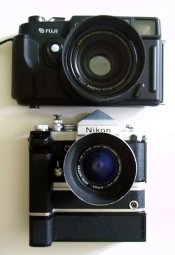
  • Pro Cameras 002_filtered b sml.jpg
    Pro Cameras 002_filtered b sml.jpg
    48.9 KB · Views: 145
Photrio.com contains affiliate links to products. We may receive a commission for purchases made through these links.
To read our full affiliate disclosure statement please click Here.

PHOTRIO PARTNERS EQUALLY FUNDING OUR COMMUNITY:



Ilford ADOX Freestyle Photographic Stearman Press Weldon Color Lab Blue Moon Camera & Machine
Top Bottom