• Welcome to Photrio!
    Registration is fast and free. Join today to unlock search, see fewer ads, and access all forum features.
    Click here to sign up

how long to leave paper in developer?

Recent Classifieds

Forum statistics

Threads
203,204
Messages
2,851,319
Members
101,721
Latest member
rptn
Recent bookmarks
0

jfoote

Member
Allowing Ads
Joined
Dec 28, 2010
Messages
27
Location
Raleigh, NC
Format
35mm
I am relearning after several years out. One of the many things I can't remember doing well is how long to leave paper in the developer. What is a good starting time? 60 seconds? Most likely Dektol on polycontrast III. (It's old but I got a ton of it for free!)


thansk
 
Using Dektol at standard dilution and RC paper, I develop mine for 60 seconds. If you look at the bag Dektol comes in, it tells you what Kodak recommends. If your developer is really old, it MAY have been stale. If it still works, you should see shadow start to develop in 10 to 15 seconds and continue to develop for about 20 to 30 seconds.
 
Last edited by a moderator:
Rc paper is usually 90 sec. fiber various from 2 -3 minutes. Pick a time and stick to it. Ilford's Cooltone recommends 2minutes rather than 90 sec.
 
It's my humble experience that time in developer varies. It depends on dilution, temperature and exhaustion (how many papers have gone through). A paper should always be developed to completion. The time is different for every combination of paper/developer. Leaving the paper too long in the developer is also bad as this will fog the paper.
There are several ways to find out the correct developing time. One rule of thumb is that you should develop 6 times longer than it takes for the first picture to emerge. Say you see the first picture after 10 secs (typical time for Ilford Multigrade RC in Ilford developer 1+10) then you should develop for a total of 60 secs.
You can also make yourself a test strip to get an even more exact time. Cut a strip of paper and make 8-10 marks on the back. They should be about even sized but this is not critical. Expose the paper strip to white light, use ceiling light or bring it outside.
Then under normal safelight conditions develope the paper strip for 10 or 15 secs for each area on the back. At 0 secs dip the strip in developer up to the first mark. Keep it there for 10 or 15 sec. Then dip one more mark for every 10 or 15 sec. The last part of the strip will only be 15 sec in the developer. Stop, fix and wash as per normal. Dry the strip with a hair blower, micro or something and then examine it in normal light. You will have bands of absolute black on one end to light grey on one. The first band that you can not tell apart from the next that is your target time. For this paper/developer dilution/temperature.

It is much easier done than explained. Try it, it's fun.

r

Mats
 
My method is to wait it until it doesn't appear to be getting any darker then leave it in for that amount of time again.


Steve.
 
Is it really hard to over develop though? If you read the literature for Ilford Multigrade developer, it suggests:

On correctly exposed FB prints, the image will
begin to appear after 35 seconds with these
developers. Development may be extended to 6
minutes without any noticeable change in contrast
or fog.

The recommended time for FB prints at 1:9 is 2mins. With this in mind, is it really quite fool proof? Or is this a bit of a long bow?
 
I am relearning after several years out. One of the many things I can't remember doing well is how long to leave paper in the developer. What is a good starting time? 60 seconds? Most likely Dektol on polycontrast III. (It's old but I got a ton of it for free!)


thansk

No guarantees on Polycontrast III. Free (old) paper may cost you a lot of time and hassle. Not recommended for serious work.

Nonetheless:

Assuming room temperature and Dektol (or alike) 1+2, you can start with 90s for RC and 3 minutes for FB (including a 15s drip-off time). Actual time depends on paper. I recommend a Dmax test to be sure to get the best out of the paper.

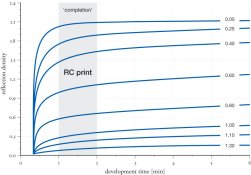
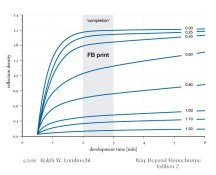
There is no such thing as developing to completion. Development continues until the paper fogs (see attached graphs).

Factorial development is great but works a lot better with FB than it does with RC, because rapid initial development with RC makes it difficult to estimate final development time.
 

Attachments

  • FactorialDev1.jpg
    FactorialDev1.jpg
    61.8 KB · Views: 533
  • FactorialDev2.jpg
    FactorialDev2.jpg
    56.5 KB · Views: 414
By "completion", people probably mean that the DMAX doesn't get (noticeably) higher. I agree it's about double the time when the print "looks" ready (non-changing) in the dim safelight.
 
By "completion", people probably mean that the DMAX doesn't get (noticeably) higher. ...

Yes, that's probably what they mean, but it implies that nothing more happens afterwards and that it is safe to leave the print in the developer until the paper fogs, and that is not the case. Once the darkest shadows have reached Dmax, all other tones slowly continue to increase density, which does the image no good. Consequently, there is an optimum development time, at which point development should be stopped. That's how I understood the OP's questions.
 
You will get a noticibly different image if you develope for 2 minutes or 3 minutes. I find the longer you develope the lower your maximum contrast range get. The some goes for developing for the same amount of time in a higher temperature. One degree difference in developer temperature makes a fair bit of difference....

Jaap Jan
 
I develop my prints for three minutes. Always.

Ethol LPD developer, fiber paper (Fomabrom Variant 112 or Ilford Warmtone semimatte).

Works great for me. Rich deep blacks with full density and weight.
 
Long enough. The development time varies with the developer. The recommended times from the manufacturer are usually close to the minimum that will give you a decent print. With a developer like Dektol, I generally give the print 1 minute 50 seconds. That is about 20 percent longer than the manufacturer's recommendation. The 90 second recommendation doesn't quite give me the results I want. At one time, with older papers, you had to worry about development fog if you developed too long, and the idea was to develop the print as long as possible before fog started to appear. You made tests to determine what that time was. Fog is not much of a concern with current papers, and you choose a time that gives full development. With warm tone papers, you can also trade off exposure and development time to some extent to vary the image tone a bit.
 
Maximum Black precedes Maximum Contrast

I am relearning after several years out.
One of the many things I can't remember doing well is how long
to leave paper in the developer. What is a good starting time?
60 seconds? Most likely Dektol on polycontrast III. thansk

A little less exposure and somewhat extended development may
at times deliver a needed additional contrast. With correct
exposure Maximum blacks may be maintained.

By the reverse token a little more exposure with pull processing
will deliver lower contrast with Maximum blacks.

I'd say a 1/2 grade of control possible. Papers will likely vary
in their response. Dan
 
Photrio.com contains affiliate links to products. We may receive a commission for purchases made through these links.
To read our full affiliate disclosure statement please click Here.

PHOTRIO PARTNERS EQUALLY FUNDING OUR COMMUNITY:


Ilford ADOX Freestyle Photographic Stearman Press Weldon Color Lab Blue Moon Camera & Machine
Top Bottom