
• Welcome to Photrio!
    Registration is fast and free. Join today to unlock search, see fewer ads, and access all forum features.
    Click here to sign up

How important is black?

Forum statistics

Threads
203,120
Messages
2,850,091
Members
101,680
Latest member
QGolden
Recent bookmarks
1
Joined
Jan 21, 2003
Messages
15,716
Location
Switzerland
Format
Multi Format
I have recently found myself in a situation where I've been confused about my printing style, and came up with a question I couldn't answer myself.

In a b&w print, how important is black? Not maximum black, but a strong black. I have previously been of the opinion that a strong black was a choice, and I've seen some work completely lacking that, and the print was still beautiful.
A while back I made prints that I thought were all about mid-tones. So I heavily emphasized on mid-tones to get them just right. Then the black is what it is when I'm done.

I would appreciate your thoughts on the matter.

Thanks!
 
Your method would work very well for a photo showing the texture and ripples in wind blown snow, as an example.

There is a place for every method. No one method works for everything.

Steve
 
On the one hand, one might be tempted to say: pah, black is just another tone. Nothing special.

But max black and bright white are at the limits of the tone scale and thus calibrate the eye for the other tones. So I suppose that the tones are all quite relative unless you have a black and white limiting tones to "set the scale," so to speak.

Of course, you can have an effective print which has no max black or bright white.... it just depends on the subject matter. But nevertheless, the presence of limiting/calibrating tones seems to be quite common: if max black and a crisp white aren't present in a black and white print then, lo and behold, I noticed that a lot of time people will supply them with a white surround (mat) and a black frame! That's not required, of course, it's just something I've noticed. It is as if people need for the tone scale to be anchored/calibrated.
 
Good prints do not always go to max black. For me (and presumably others, based on my museum visits) its not a requirement for a good print. In fact I find the lack of direct control over middle tonality is the major problem I have with the 'standard' split grade technique.
 
When I was at college my teacher said that to check if the print is properly printed, the blacks should be black and the whites white. Then I looked at some of John Blakemore's work and realised that for most 'average' subjects this may be true, but not every image will or should show a full tonal range. It does depend on the subject matter and the mood you wish to convey.
 
I have recently found myself in a situation where I've been confused about my printing style, and came up with a question I couldn't answer myself.

In a b&w print, how important is black? Not maximum black, but a strong black. I have previously been of the opinion that a strong black was a choice, and I've seen some work completely lacking that, and the print was still beautiful.
A while back I made prints that I thought were all about mid-tones. So I heavily emphasized on mid-tones to get them just right. Then the black is what it is when I'm done.

I would appreciate your thoughts on the matter.

Thanks!

I think it was Ansel Adams who said that asking for all tones in a good photograph is as unrealistic as asking for all notes in a good piece of music. I'm sure that a good photograph does not necessarily have to have all tones from white to black. It certainly depends on the subject, but on the other hand, all the images I really like of Ansel Adams have a rich assortment of all tones. Go figure.

One thing is for certain: It's a lot easier to make a good print if the image has brilliant highlights and deep rich blacks. Most observers like and are stunned by the vividness this contrast provides. To make a convincing print with a limited tonal scale is possible but a lot harder to do.
 
It depends on the print, but usually I like a good healthy zone 0 and I in at least a few areas. It is kind of like punctuation for the rest of the print. I generally much prefer to see maximum density in a print than minimum density.
 
Thomas

Obviously there is probably 20 to 100 printing styles with silver.

I think that if black is in the image then it is important. This does not mean that max Dmax is needed but the viewers eyes needs to percieve black as black.
The hardest prints to make IMO are ones with a very long midtone scale where white detail is achieved by being a percievable tone above paper white border, and the black is set to give the viewer a full range image where the eye is fooled to see black.
This black can be what makes the print sing and being aware of its importance is critical to a good print.
If you took a densitomiter to the black region you would find it is nowhere near dmax but we do not sell images of control strips and if the viewer is fooled to see it as black then your job is successful.

Lately I have been making some prints where the blacks are dead , dead , dead black with high contrast everywhere else and the effect is quite stunning. Not like lith but more gritty than lith can accomplish. Once again without total attention of where the blacks are being set the images would not work.

Beautiful work can be done without black tones and even white tones, all midtone , but if you find your negs have both ends then keep your attention to them.

Re : the comment about controlling the mid tones with split printing , this is why I moved to starting my multiple filter printing with a middle filter. I find that starting in the middle and working both ends is more easy for me.

Bob
 
It just depends on what is important in the actual print, could be important in one print and a detriment in another print if you had to rob significant highlights. It goes back to your negatives, if they are well exposed, developed and have a good range then you have many printing options and you should print variations and live with them on the wall for a while to make this decision. I like everything I have seen of yours online and hope to see some in person in the future..Evan Clarke
 
black can be good, as can be white, grey works sometimes but not always.
sometimes i use my shoe for a hammer.
 
I have recently found myself in a situation where I've been confused about my printing style, and came up with a question I couldn't answer myself.

In a b&w print, how important is black? Not maximum black, but a strong black. I have previously been of the opinion that a strong black was a choice, and I've seen some work completely lacking that, and the print was still beautiful.
A while back I made prints that I thought were all about mid-tones. So I heavily emphasized on mid-tones to get them just right. Then the black is what it is when I'm done.

I would appreciate your thoughts on the matter.

Thanks!
******
Well, it IS black and white photography, after all. That being said, a picture of London Bridge in the fog might be lacking in a black. Even so, it is my experience that most images need a black somewhere to anchor the photo; to pin the image to a foundation, so to speak. My two cents.
 
Thank you for your feedback. It seems like the consensus is that max black or strong black is 'nice to have', especially if the scene contains a really dark area. But it's not absolutely necessary, and that depends on the subject matter and how it's captured.

Which gets me right back to where I started... :smile:

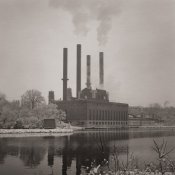
One of the reasons I asked is due to the attached print. To me it perfectly describes what it was like that morning, and reflects my vision of it, while everybody I've shown it to (except my wife, who is my most trusted critique) say they lack black. I'm not saying that either opinion is right or wrong. I'm just saying that it's the luck of the draw to have a taste in what looks good that coincides with what the audience likes.

- Thomas
 

Attachments

  • st_anthony_power_plant_001.jpg
    st_anthony_power_plant_001.jpg
    143.2 KB · Views: 225
Thomas, that looks great to me. I believe that the shadpow of the power plant on the water anchors the image quite well. I feel that as long as an image has a solidity to it, it can pass muster without a deep black. I'm speaking of images that are printed in the manner of a "full range" of tones and not those which are purposely printed in one subset of those tones, ie, high-key or the wonderful almost-pencil-like renderings of some images by people like John Sexton and Ray McSavaney.
 
There was Ansel, and Bill Brandt, and Ralph Gibson and . . . various ways of printing. Black is beautiful as we used to say back in the day.
 
I agree with your wife

a slight blast of 5 would improve this image as I see it on the screen without affecting the mood.
 
Thomas - wonderful shot and I think it illustrates the point very well. To have full-on black and whites is a good check for a typical print. They serve as a guide to a properly calibrated print. But as with the photo you displayed (and subject to my monitor/limitations) you captured the feeling and range of the photo quite properly. Your instrument (ie your instincts) is well calibrated and the image is properly conveyed to the viewer. Well done! Cheers.
 
Thank you for your feedback. It seems like the consensus is that max black or strong black is 'nice to have', especially if the scene contains a really dark area. But it's not absolutely necessary, and that depends on the subject matter and how it's captured.

Which gets me right back to where I started... :smile:

One of the reasons I asked is due to the attached print. To me it perfectly describes what it was like that morning, and reflects my vision of it, while everybody I've shown it to (except my wife, who is my most trusted critique) say they lack black. I'm not saying that either opinion is right or wrong. I'm just saying that it's the luck of the draw to have a taste in what looks good that coincides with what the audience likes.

- Thomas


Thomas

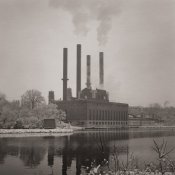
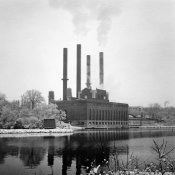
Your image (left) has mood. It is fine. A full-tonal-scale image of this print (right) lost the mood and look steril. Yours is much better!
 

Attachments

  • st_anthony_power_plant_001.jpg
    st_anthony_power_plant_001.jpg
    143.2 KB · Views: 179
  • st_anthony_power_plant_002.jpg
    st_anthony_power_plant_002.jpg
    86.2 KB · Views: 187
Thomas, that looks great to me. I believe that the shadpow of the power plant on the water anchors the image quite well.

Exactly!

Steve
 
More important than making rules for what is right is finding a way to keep your vision fresh and your response to your own work unregulated.
Dennis
 
Thank you for your feedback. It seems like the consensus is that max black or strong black is 'nice to have', especially if the scene contains a really dark area. But it's not absolutely necessary, and that depends on the subject matter and how it's captured.

Which gets me right back to where I started... :smile:

One of the reasons I asked is due to the attached print. To me it perfectly describes what it was like that morning, and reflects my vision of it, while everybody I've shown it to (except my wife, who is my most trusted critique) say they lack black. I'm not saying that either opinion is right or wrong. I'm just saying that it's the luck of the draw to have a taste in what looks good that coincides with what the audience likes.

- Thomas

For this image I think you got it right. I notice the lack of a crisp white in the snow more than the lack of a black. But I wouldn't change it. A crisp white and strong black would ruin the mood of the print.
 
My vote goes to full tonal scale print on the right. The greater contrast gives the image the vitality which the highly toned version on the left lacks.

Morry Katz - Lethbridge
 
Thomas, I know why you've asked this question -- it's something I've been thinking about as well. I had the opportunity over the past three years to visit many of the major photo exhibitions in Paris, where I paid particular interest to exactly this aspect of the pictures. I was surprised in many cases to find the photographs I knew so well had less black than I "remembered" from seeing prints in books, and in most cases the lack of really deep black was not missed. Here's a parallel question - is "contrast" just another way of saying deep blacks and bright whites, or can it be something else?
 
Photrio.com contains affiliate links to products. We may receive a commission for purchases made through these links.
To read our full affiliate disclosure statement please click Here.

PHOTRIO PARTNERS EQUALLY FUNDING OUR COMMUNITY:


Ilford ADOX Freestyle Photographic Stearman Press Weldon Color Lab Blue Moon Camera & Machine
Top Bottom