• Welcome to Photrio!
    Registration is fast and free. Join today to unlock search, see fewer ads, and access all forum features.
    Click here to sign up

How does slide film work without a mask?

Recent Classifieds

Forum statistics

Threads
203,113
Messages
2,849,955
Members
101,673
Latest member
mkamera
Recent bookmarks
0

Steven Lee

Member
Allowing Ads
Joined
Jul 10, 2022
Messages
1,441
Location
USA
Format
Medium Format
I understand that this is more of a film technology question, not a practical processing concern.
I am just curious.

Digging through the archives here and also on photo.net, I see several explanations, stating that an orange mask is needed to cancel out contamination in the emulsion layers due to impurity of dyes. The benefit is more accurate color. I get the idea, it's simple enough.

But slide film obviously doesn't use masking. How does it work then? I rarely shoot slides because I do not have a projector (although I like them projected) but I always felt they look somewhat cartoonish after scanning. Is the absence of a mask the reason for why transparencies usually look so unnatural and have such a narrow latitude?
 
Last edited:
The mask is beneficial for colour negative films because colour negatives are designed to print on to colour photographic paper. By incorporating a mask, the non-linearities in the behaviors of the dyes in the negative are compensated for, resulting in the ability to print accurately by filtering out the resulting linear red cast, and then inverting the colours. That filtering and inversion is built into the colour paper's response.
With slide film, any such dye non-linearities are compensated for by building them into the bleach, re-exposure and re-development processes inherent in the E6 process.
 
FWIW, I don't find scanned Ektachrome (or Kodachrome) to be cartoonish at all.
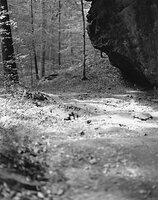
An Ektachrome example:
41a-2013-10-19c-res 800.jpg
 
Slides are easy for me to scan. I'd just as soon make a color print, in the darkroom from color negative film. Easy to scan a color print, a negative takes a lot of patience.
 
The mask is beneficial for colour negative films because colour negatives are designed to print on to colour photographic paper. By incorporating a mask, the non-linearities in the behaviors of the dyes in the negative are compensated for,...

These deficiencies are not non-linearaties, but malabsortions of the image-forming dyes.

(You erroneously tried to state a counterpart to the masking resulting in a gradationless mask density, which you erroneously regarded as linear. [The malabsobtions also result in a linear density, but this has a gradation.])

With slide film, any such dye non-linearities are compensated for by building them into the bleach, re-exposure and re-development processes inherent in the E6 process.

There is no such compensation, moreover these processes could not affect those malabsortions.
Also if they could, two of them would be incorporated in negative film too...


But one should not overlook that at a neg/pos system those malabsorbtions happen twice, not so at a reversal system (common slide film).
 
I understand that this is more of a film technology question, not a practical processing concern.
I am just curious.

Digging through the archives here and also on photo.net, I see several explanations, stating that an orange mask is needed to cancel out contamination in the emulsion layers due to impurity of dyes. The benefit is more accurate color. I get the idea, it's simple enough.

But slide film obviously doesn't use masking. How does it work then? I rarely shoot slides because I do not have a projector (although I like them projected) but I always felt they look somewhat cartoonish after scanning. Is the absence of a mask the reason for why transparencies usually look so unnatural and have such a narrow latitude?

By cartoonish, what do you mean? What subjects are you referring too?

If you shoot a highly saturated film like Velvia, you get a different look than let's say Provia which is more neutral. Also, if you shoot portraits, Portra negative color film reproduces flesh tones more naturally than most chromes.

My own personal preference is to shoot Velvia because I shoot landscapes mainly and like the "pop". Also, I found chromes are easier to scan than color negatives.
 
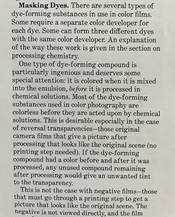
I should know this off the top of my head but I don’t. I think the answer will be in reference like Bob Shanebrook’s “Making Kodak Film”. Meanwhile a hint from publication J-3 Introduction to Color Photographic Processing…

I think I remember this is true… but won’t swear by it…

The mask is incorporated with its mask color in layers of the emulsion and gets washed out.
 

Attachments

  • AF89068B-D2D8-43E0-93F7-A5DFDC2BAF0E.jpeg
    AF89068B-D2D8-43E0-93F7-A5DFDC2BAF0E.jpeg
    167.2 KB · Views: 113
@Bill Burk I've been thinking about buying that book for a while, perhaps this will be the final push. Thank you.
 
These deficiencies are not non-linearaties, but malabsortions of the image-forming dyes.

(You erroneously tried to state a counterpart to the masking resulting in a gradationless mask density, which you erroneously regarded as linear. [The malabsobtions also result in a linear density, but this has a gradation.])

I expect malabsorption is a more accurate word.
I used linear because there was a higher chance people would understand what I was talking about! :smile:
Perhaps I should have prefaced my comments by describing them as greatly simplified - certainly that reflects my level of understanding of the process.
 
The mask is incorporated with its mask color in layers of the emulsion and gets washed out.

There is nothing washed out in the masks we have it about. But coloured dyes becomes decolorised during development, proportional to the respective imaging dyes being formed.
 
I expect malabsorption is a more accurate word.
I used linear because there was a higher chance people would understand what I was talking about! :smile:
Perhaps I should have prefaced my comments by describing them as greatly simplified - certainly that reflects my level of understanding of the process.

The thing with these masks is that a graphic may tell more then hundreds of words.

There is a textbook written by a german engineer which is completely wrong on masks as the author used a wrong word. Maybe he meant the right thing...
 
I found a post here written by Photo Engineer (which I can't find right now) where he said that trasparencies always have some color crossover because they aren't masked. That explains their appearance I guess. E100 datasheet also shows diverging characteristic curves in the shadows. Provia curves are a bit better aligned, but also show green cast in the shadows.
 
Colour cross-over is something very differentr than the malabsobtion of the dyes.
 
Color crossover, proportional decolorizing… these sound right
 
Colour cross-over is something very differentr than the malabsobtion of the dyes.

Yes, but this so-called malabsorption will make it exceedingly difficult to fix or prevent crossover. Conceptually they're different things, but there's a causal relationship between them.
 
There is not...
Crossover is due to at least one of the three sensitive layer having a different gradation, in a way that their curves cross each other midfield.
The dye-malabsorbtion is just a problem of the dyes absorbing outside their intended spectral range, which is a problem of dye-molecule design wich is hard to solve.
 
Crossover is due to at least one of the three sensitive layer having a different gradation, in a way that their curves cross each other midfield.

That's one cause. Other causes include mismatches in toe and shoulder shape. Not all crossover happens in the straight part of the curve; in fact, most of it happens at the extremes. That's where effects like malabsorption (but not exclusively) *will* play a role.
 
You are right. Actually with "gradation" I meant more than just the average gradient.

thus I now worded it better:
Colour Crossover happens when at least one of the three characteristic curves at least in parts does not run in parallel with the others, but so that one part of it runs below, the other above the others.


(But even Agfa in their training have it about a kind of curve swivelling with thus just a crossing point.)


But still I do not see how this is related to dye-malabsobtion. We got two different problems. That of course, at a non-masked film, may, by coincidence, both appear.
 
But still I do not see how this is related to dye-malabsobtion
Inappropriate absorption in one dye image will be density dependent on that layer, but its malabsorption will show up in one or both of the other images. Hence, the actual color image of any of the given layers is made up of not only its own dye, but also of that of one or more other dyes. Since the dye images are often not identical, this creates non-linearities in the color rendition. They will likely show up the most at extremes of the curves, especially if several layers are at a curve extreme but orn isn't, like in highly saturated colors. It might be interesting to make a digital mockup of this effect to play with; maybe I'll do that one day.
 
To summarize and hopefully clarify some of what has been said, and to add some...

The dyes in slide film, color negative film, and color print materials all have impurity problems.

Slides are meant to be projected or viewed directly, while color negatives are meant to be printed.

When a slide is viewed, you are only seeing dyes used once, and the impurities do not show significantly, and reasonable quality results. But with a printed color negative, dyes are effectively seen twice because the print material has dyes as well, and the dye impurity problem would compound, and degraded color would result, if not corrected. The job of the mask is to cancel the dye impurities in the negative, so they do not transfer to the print. Thus, only the print dye impurities are seen, and as in a slide, are not significant enough to be noticeable and reasonable quality results.

Optical prints from slides are in general inferior to prints from color negatives due to the lack of a mask, and also due to the high contrast of slides compared to negatives.
 
Thank you. I thought I already made this clear in post #5.

But maybe fellows did not get it and your descriptive wording does a better job.
 
You stated it, very briefly, so in case it wasn't clear to everyone, I thought I would give a more detailed explanation. The dye impurity/mask issue is often misunderstood (and there is lots more that could be said about it).
 
Last edited:
An old Kodak color reference talks about the color balance difficulty in reversal processing but makes it sound like the solution was to add a bunch of yellow to make flesh tones look best.
 
There is not...
Crossover is due to at least one of the three sensitive layer having a different gradation, in a way that their curves cross each other midfield.

This is an extremely strange and narrow definition of a common phenomena. Color crossover simply means colors casts in certain luminosity range (highlights, mids, shadows, etc). It can be caused by all sorts of things, from expired material to poor scanning equipment, and yes - the unwanted absorption of "wrong" frequency by the dyes. Arguing this is like saying "choking and preventing the flow of oxygen by applying pressure to the neck are not the same thing!" Yes indeed they are. One is what, the other is how. Absence of a mask absolutely leads to crossover.
 
Both slides and color print paper have dye impurities, but both can produce parallel characteristic curves (no crossover) with no masking.

I'm not sure what PE meant in his statement referred to earlier; perhaps he said crosstalk. As Bill Burk says, the reversal process itself appears to have problems that cause color reproduction issues but they not may be related to normal dye impurity or crossover issues.
 
Last edited:
Photrio.com contains affiliate links to products. We may receive a commission for purchases made through these links.
To read our full affiliate disclosure statement please click Here.

PHOTRIO PARTNERS EQUALLY FUNDING OUR COMMUNITY:


Ilford ADOX Freestyle Photographic Stearman Press Weldon Color Lab Blue Moon Camera & Machine
Top Bottom