

cirwin2010
Member
Moving beyond the original scope of the topic, but had something interesting to share that I didn't feel deserved it's own thread.
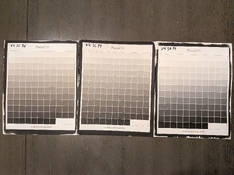
I've been making some adjustments to my process to work out some of the quirks. Mainly I switched over to using sodium citrate developer. I'm currently working on re-calibrating my printer profiles for my digital negatives and here is an image of some of them.
From left to right: sodium citrate palladium toned > sodium citrate platinum toned > sodium acetate platinum toned
Observations:
1. There is a HUGE difference in color between the two different developers, even when toned to completion. Sodium acetate + Pt is neutral and sodium citrate + Pt is a warm brown, black.
2. There is very little color difference between sodium citrate kallitypes toned in Pd or Pt. The Pd toned print is slightly more brown, but even side-by-side it is hard to tell.
3. The sodium acetate print tones WAYYYY faster than sodium citrate prints (at least when judging color change for completion). Sodium acetate took maybe less than 5 minutes, but sodium citrate took nearly 20 minutes. I have no idea why this is. Perhaps something to do with larger silver crystals or their structure?
4. Dmax between them looks visually the same.
5. (not shown) Sodium acetate prints toned in Pd are a notably different color than sodium acetate prints toned in Pt (brown black vs neutral). I wonder why sodium citrate behaves so differently.
I've been making some adjustments to my process to work out some of the quirks. Mainly I switched over to using sodium citrate developer. I'm currently working on re-calibrating my printer profiles for my digital negatives and here is an image of some of them.
From left to right: sodium citrate palladium toned > sodium citrate platinum toned > sodium acetate platinum toned
Observations:
1. There is a HUGE difference in color between the two different developers, even when toned to completion. Sodium acetate + Pt is neutral and sodium citrate + Pt is a warm brown, black.
2. There is very little color difference between sodium citrate kallitypes toned in Pd or Pt. The Pd toned print is slightly more brown, but even side-by-side it is hard to tell.
3. The sodium acetate print tones WAYYYY faster than sodium citrate prints (at least when judging color change for completion). Sodium acetate took maybe less than 5 minutes, but sodium citrate took nearly 20 minutes. I have no idea why this is. Perhaps something to do with larger silver crystals or their structure?
4. Dmax between them looks visually the same.
5. (not shown) Sodium acetate prints toned in Pd are a notably different color than sodium acetate prints toned in Pt (brown black vs neutral). I wonder why sodium citrate behaves so differently.


 Just joking.


