• Welcome to Photrio!
    Registration is fast and free. Join today to unlock search, see fewer ads, and access all forum features.
    Click here to sign up

How Do You Meter When Using 120 Roll Film

Fujino Trail

H
Fujino Trail

  • 1
  • 1
  • 27
Dead and Living.

H
Dead and Living.

  • 5
  • 4
  • 98

Recent Classifieds

Forum statistics

Threads
201,822
Messages
2,830,706
Members
100,973
Latest member
Arthur Deomi
Recent bookmarks
0

IanBarber

Member
Allowing Ads
Joined
Dec 3, 2013
Messages
126
Location
Doncaster Yorkshire UK
Format
4x5 Format
The biggest challenge I find when using the Mamiya 645 when out and about is the metering mainly because I obviously cannot see what I have just taken and also panic sometimes kicks in.

Today, I visited the coast, the weather was all over the place, fog, grey cloud, and then bright sun.

I use a Sekonic L758D handheld meter 100% of the time and this is usually what I do when using the spot.
  1. Meter off a grey card and put that in memory ( for my middle exposure )
  2. Meter the darkest area and put that in memory ( for my shadows )
  3. Meter the brightest area and put that in memory ( for my highlights )
I then look at the bottom scale on the meter which shows the brightness range, if the shadows are no lower than 2 stops below middle grey and the highlights are no more than 3 stops above middle grey the exposure I set the camera to is the Middle Grey Value.

Does this seem a long winded approach, or am I on the right track
 

BrianShaw

Member
Allowing Ads
Joined
Nov 30, 2005
Messages
16,990
Location
La-la-land
Format
Multi Format
One word to share with you: incident.

Use that to validate your averaged spot readings.
 

wiltw

Subscriber
Allowing Ads
Joined
Oct 4, 2008
Messages
6,701
Location
SF Bay area
Format
Multi Format
  1. Incident lets you know the exposure according to the light falling on the scene (assuming it is in same light as you)
  2. Your procedure step 1 should be same as above (ignoring, for convenience, the issue about reflectance reading of 18% grey vs. 12% grey)
  3. Your procedure steps 2 and 3 determine if the exposure can be captured on color transparency -- B&W film and color neg both have wider latitude
Your procedure makes sure 'it all fits' but it always assumes middle grey captured at its inherent brightness is the ultimate goal.
If you instead look at Shadow and Highlight value, and then THINK ...
  • Do I want to increase the Shadow detail content?
  • Do I want to increase the Highly detail content?
...and THEN bias your exposure a bit to better accomplish either goal, you might get more out of your shots than simply exposing to the mid-tone.

There is nothing wrong with your method, it is merely 'shoot for the midtone and see that shadow and hightlight will fit', and not optimizing exposure to suit other goals.
 
OP
OP
IanBarber

IanBarber

Member
Allowing Ads
Joined
Dec 3, 2013
Messages
126
Location
Doncaster Yorkshire UK
Format
4x5 Format
I sometime do take a shadow reading and then drop the exposure by 2 stops ( thinking Zone 3 ) but usually bottle out at the last minute and go for zone 5 as a safe option. Maybe I ought to trust my judgement a little more :smile:
 

MattKing

Moderator
Moderator
Joined
Apr 24, 2005
Messages
55,183
Location
Delta, BC Canada
Format
Medium Format
Does this seem a long winded approach
A little!

First, I assume you are using negative film. If you are using transparency (slide) film, please advise, because the advice changes slightly.

Second, you need to find peace, because with peace comes joy, and there is good news - negative film is very forgiving (which brings peace, etc., etc.).

Brian's advice above is good - take an incident meter reading. It will allow you to put the grey card away.

Then take a shadow reading - important shadows with detail you need to retain only. Compare the two. If the shadow reading is within three stops of the incident reading, go with the incident reading. If it is much lower, expose two-three stops less than the shadow reading indicates. You can take a highlight reading too, but in most cases that will just tell you about how challenging it will be to print the result. The exception is when the subject is such that all the important parts of it are in the highlight areas, and they meter at a reading that is more than three stops higher than the incident reading. In that case, adjust the exposure to favour them (at the expense of the shadows).

OR

Just use the standard reflected light mode on the meter, point it at your subject, and follow its suggestion. You will get pretty good results, and can refine your approach later when the camera becomes more familiar to you.
 

Jim Noel

Member
Allowing Ads
Joined
Mar 6, 2005
Messages
2,261
Format
Large Format
The biggest challenge I find when using the Mamiya 645 when out and about is the metering mainly because I obviously cannot see what I have just taken and also panic sometimes kicks in.

Today, I visited the coast, the weather was all over the place, fog, grey cloud, and then bright sun.

I use a Sekonic L758D handheld meter 100% of the time and this is usually what I do when using the spot.
  1. Meter off a grey card and put that in memory ( for my middle exposure )
  2. Meter the darkest area and put that in memory ( for my shadows )
  3. Meter the brightest area and put that in memory ( for my highlights )
I then look at the bottom scale on the meter which shows the brightness range, if the shadows are no lower than 2 stops below middle grey and the highlights are no more than 3 stops above middle grey the exposure I set the camera to is the Middle Grey Value.

Does this seem a long winded approach, or am I on the right track
That is a practical method, so long as you remember to make adjustments whenthe range is shorter, or longer than "normal".
 

Old-N-Feeble

Member
Allowing Ads
Joined
Feb 22, 2012
Messages
6,805
Location
South Texas
Format
Multi Format
In uneven/changing light, incident light readings are often (or usually) useless if the subject is too far away to meter there. Even if within walking distance, with changing light, by the time you return to the camera position the light has probably changed. I don't worry about the middle tones. I spotmeter and expose for the shadows while also taking a quick reading of the brightest 'textural' highlight to determine development methodology. This is quick and easy... and will always result in good printable negatives. If the light is constant then that can change procedures... but not for me because I like procedural consistency.
 

Luis-F-S

Member
Allowing Ads
Joined
Sep 19, 2013
Messages
774
Location
Madisonville
Format
8x10 Format
You could just meter the palm of your hand with a spot meter open up one stop and take a picture
 

Ai Print

Member
Allowing Ads
Joined
May 28, 2015
Messages
1,316
Location
Colorado
Format
Multi Format
I use the following metering method for all formats I shoot, 35, 120 and 4x5...

Everyone works differently and for quite some time, I swore that spot metering was the way to go. But when it came to rapidly changing, mixed or other complex light, I noticed that I was fiddling around to the point with spot readings that I was really missing key shots.

So even though I have a fancy Zone Studios modded Pentax digital spot meter, I rarely use it. I find incident metering not only to be a lot easier and faster but it has actually taught me how to meter with my eyes and instinct with virtually 100% success in not only getting printable negatives but quite often perfect ones.

Even when the area of concern is miles away and out of reach of the incident light meter, you can learn over time how to judge the difference with your eyes and if you shoot enough, it does not take all that long. The reason I think learning to become a human light meter is so much easier with an incident meter is that you are always reading the light falling on you personally. So after awhile, you become hyper aware of the slightest changes in light and perhaps best of all, when dealing with quickly passing clouds and other "moving targets" in light, are able to predict what exposure settings you will need before the light presents it self.

Incident all the way baby....
 
Last edited:

Old-N-Feeble

Member
Allowing Ads
Joined
Feb 22, 2012
Messages
6,805
Location
South Texas
Format
Multi Format
You could just meter the palm of your hand with a spot meter open up one stop and take a picture

Not if your palm is in different light than the subject. :wink:
 

Old-N-Feeble

Member
Allowing Ads
Joined
Feb 22, 2012
Messages
6,805
Location
South Texas
Format
Multi Format
I use the following metering method for all formats I shoot, 35, 120 and 4x5...

Everyone works differently and for quite some time, I swore that spot metering was the way to go. But when it came to rapidly changing, mixed or other complex light, I noticed that I was fiddling around to the point with spot readings that I was really missing key shots.

So even though I have a fancy Zone Studios modded Pentax digital spot meter, I rarely use it. I find incident metering not only to be a lot easier and faster but it has actually taught me how to meter with my eyes and instinct with virtually 100% success in not only getting printable negatives but quite often perfect ones.

Even when the area of concern is miles away and out of reach of the incident light meter, you can learn over time how to judge the difference with your eyes and if you shoot enough, it does not take all that long. The reason I think learning to become a human light meter is so much easier with an incident meter is that you are always reading the light falling on you personally. So after awhile, you become hyper aware of the slightest changes in light and perhaps best of all, when dealing with quickly passing clouds and other "moving targets" in light, are able to predict what exposure settings you will need before the light presents it self.

Incident all the way baby....

While this is largely true, you're still estimating/guessing.
 
OP
OP
IanBarber

IanBarber

Member
Allowing Ads
Joined
Dec 3, 2013
Messages
126
Location
Doncaster Yorkshire UK
Format
4x5 Format
I spotmeter and expose for the shadows while also taking a quick reading of the brightest 'textural' highlight to determine development methodology.

Doesn't determine development methodology only apply to sheet film when a roll film may have been shot under different lighting conditions ?
 

Sirius Glass

Subscriber
Joined
Jan 18, 2007
Messages
50,814
Location
Southern California
Format
Multi Format
I use the meter in the RME prism, however I meter the subject without any sky in the viewfinder.
 

Old-N-Feeble

Member
Allowing Ads
Joined
Feb 22, 2012
Messages
6,805
Location
South Texas
Format
Multi Format
Doesn't determine development methodology only apply to sheet film when a roll film may have been shot under different lighting conditions ?

Not for me. I don't take an image unless I'm completely certain I want it. If I do want it then it's worth taking an entire roll of it or just wasting half a roll. A million years ago I carried three RFHs and would keep track of how much development each roll needed. These days I'll just waste the film.
 

Poisson Du Jour

Member
Allowing Ads
Joined
Jul 1, 2008
Messages
5,462
Location
.
Format
Digital
The biggest challenge I find when using the Mamiya 645 when out and about is the metering mainly because I obviously cannot see what I have just taken and also panic sometimes kicks in.

Today, I visited the coast, the weather was all over the place, fog, grey cloud, and then bright sun.

I use a Sekonic L758D handheld meter 100% of the time and this is usually what I do when using the spot.
  1. Meter off a grey card and put that in memory ( for my middle exposure )
  2. Meter the darkest area and put that in memory ( for my shadows )
  3. Meter the brightest area and put that in memory ( for my highlights )
I then look at the bottom scale on the meter which shows the brightness range, if the shadows are no lower than 2 stops below middle grey and the highlights are no more than 3 stops above middle grey the exposure I set the camera to is the Middle Grey Value.

Does this seem a long winded approach, or am I on the right track

Panic? Well, the L758D has a panic button too. It's called a full reset, but don't touch that unless something is really, really wrong.

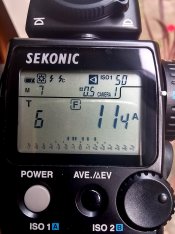
Anyway, that's the correct process (with the L758D) and is by no means long-winded, though the use of a grey card is optional. Your methodology can be as brief or as detailed as you wish. To some extent, the scene you are prepping will determine your approach and depth. Your method though is one of several that can be employed. The L758D meter by default either sets the mid-tone on the first or last metered value (refer to custom function as to what is presently set). Values are more critical if you are shooting in very contrasty light, as is the mid-tone. On the day of your shoot you desribed the weather as, well, typically British "drack", with the surprise of bright sun. So metered values would be fairly even across the scene in grey-ish weather, unless the sun came out and increased contrast which you did not measure. That would deepen shadows create spectral infusion in the scene with several areas of brightness which must be measured.

It is nonsense to make a comparison of a multispot/AVGd reading with an incident reading because of different baseline metrics (by design) of each of the two meters — averaging incident and mean-weighted average reflective spot (this applies especially to the L758D). You can use either in the landscape context but both meter types will give a different reading. Neither meter reading method will be wrong, but how you go about multispot metering determines the accuracy of the result. This is the only method I use when sweeping scenes using transparency film, varying between 0.3 and 0.5 stops. Incident is used in very flat, featureless light but it is useless when there are spectrals, or large areas of light and dark. The sample reading on this photo had light tones, shadow and spectrals. All these were dealt with by multispot along the same lines you described, but no grey card was used as I found my own mid-tone.

20160501_140205_HDR.jpg
 
Last edited:

ic-racer

Member
Joined
Feb 25, 2007
Messages
16,729
Location
USA
Format
Multi Format
Just meter the low value. Develop all the frames the same and print on with an assortment of graded paper or multigrade.
 

removed account4

Subscriber
Allowing Ads
Joined
Jun 21, 2003
Messages
29,832
Format
Hybrid
i have given up on metering for the most part
i carry one around just in case i am out of tune.
i sunny-11 everything and meter with my internal meter
EVERYTHNG chromes, c41 and b/w, paper, hand coated paper, hand coated glass ... and b/w film ...
when i say out of tune ..
i mean i compute my exposure and if i think i might be wrong
i pull out my seconic meter take a reading and compare what i set the camera, im not off very often.
 

Old-N-Feeble

Member
Allowing Ads
Joined
Feb 22, 2012
Messages
6,805
Location
South Texas
Format
Multi Format
Just meter the low value. Develop all the frames the same and print on with an assortment of graded paper or multigrade.

^^^^^^^^^^^^^^^^^^^^^^^^ !!!!!!!!!!!!!!!!!! ^^^^^^^^^^^^^^^^^^^^^^^^^^^^^^^
 

Bill Burk

Subscriber
Allowing Ads
Joined
Feb 9, 2010
Messages
9,468
Format
4x5 Format
Doesn't determine development methodology only apply to sheet film when a roll film may have been shot under different lighting conditions ?

Not if you know you were out on a low contrast day and shot a whole roll of film, or if you shot in studio and had specific plans for a look you are going for.

But it's true, I often find that the time set on my development timer is the one I'll use most of the time.
 

Bill Burk

Subscriber
Allowing Ads
Joined
Feb 9, 2010
Messages
9,468
Format
4x5 Format
As for my technique, I'll take an incident reading and set that f/stop and shutter speed on my camera.

Then I'll switch to spotmeter mode and meter a shadow and look at the f/stop next to the shadow clipping point that I set to whole f/stops... so for example it's Zone II. (I keep a mental note of that f/stop which becomes my other option). Then I'll spot other parts of the scene, checking the bottom scale all the time for where that spot falls related to the Zone that I expect it to be.

I don't use the memory functionality because that takes too many button pushes for my style.

As described, I've twisted the dome out, checked or set to incident mode, pushed the reading button, looked, set the camera, set to spotmeter mode, pushed the button, looked, (maybe one or two other readings - push button and look).

Then (adjust aperture if I decide that spotmeter readings gave me an option that I would rather have) focus, compose and take the picture.
 
OP
OP
IanBarber

IanBarber

Member
Allowing Ads
Joined
Dec 3, 2013
Messages
126
Location
Doncaster Yorkshire UK
Format
4x5 Format
The sample reading on this photo had light tones, shadow and spectrals. All these were dealt with by multispot along the same lines you described, but no grey card was used as I found my own mid-tone.

Can you please just explain what the bar reads are telling you in the sample image
 

Old-N-Feeble

Member
Allowing Ads
Joined
Feb 22, 2012
Messages
6,805
Location
South Texas
Format
Multi Format
Not quite got into this mental state yet with the price of film here in the UK :smile:

On a side note, out of interest what type of subject matter do you find yourself making photographs of the most

It's different for me because (when I do start photographing again) I'll take so few photos that the cost of film is negligible. I don't see that many things around here worth wasting the film on.
 
Photrio.com contains affiliate links to products. We may receive a commission for purchases made through these links.
To read our full affiliate disclosure statement please click Here.

PHOTRIO PARTNERS EQUALLY FUNDING OUR COMMUNITY:


Ilford ADOX Freestyle Photographic Stearman Press Weldon Color Lab Blue Moon Camera & Machine
Top Bottom