• Welcome to Photrio!
    Registration is fast and free. Join today to unlock search, see fewer ads, and access all forum features.
    Click here to sign up

Help with a developed roll of film from 1945

Forum statistics

Threads
203,248
Messages
2,851,979
Members
101,747
Latest member
Tallphotographer
Recent bookmarks
0

dsquires

Member
Allowing Ads
Joined
Sep 6, 2005
Messages
1
Location
Somerville,
Format
35mm RF
Hi all,

I recently came across a roll of film from 1945 when helping clean out my grandmother's house after she passed away.

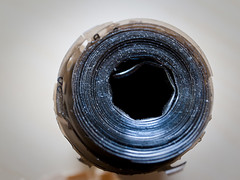
Here is what the film looks like:
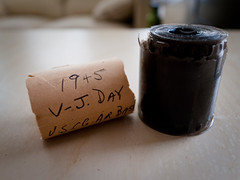


I tried to unroll it a bit, but it was very brittle and started cracking. Also it looks like the inner part of the coil may have had some heat damage or something. However, I was able to see that it labeled as safety film.

Any ideas on how to get this unrolled safely for scanning? I was wondering if a long soak in water and photoflo would help things?

Some more info - The full label says:
1945
VJ Day
USCG Air Base
San Diego

My grandfather was in the coast guard - I assume he shot this roll.

Thanks,
Dan

p.s. I posted this over on rff and they suggested I post here.
 
Pre-war (the second one) Plus-X

I have similar film inherited from an uncle who passed away ten years ago. Most of it was taken in the 1930s on Plus-X. It was stored rolled into the original metal cans left for decades in a closet in upstate NY. The cans prevented humidity from damaging the film.

Of course it too has quite a strong curl, but can be handled without cracking. I cut the film into strips and put these into archival sleeves that I pressed under some books for a few weeks. Maybe decades would be better? The film still has substantial curl but the strips can be printed or scanned. I had to use small pieces of tape to hold it flat enough for the Nikon 9000 scanner to capture it in between its plastic frames. For printing it can be handled in a Bessler glass-less carrier.

A bigger problem came about when making images from the film. There are a LOT of dust and spots that cannot be removed. Some of the films were severly under exposed (remember that there were no cheap light meters in those days) making it nearly impossible to print analog. Washing might help with dirt and spots, but then it could also destroy some of the images and I didn't have the nerve to try that.

I resorted to d*&^%$al corrections and got acceptable renditions. Here is an example taken in 1939 in Washington Park, Albany, NY.
 

Attachments

  • 1939-19.jpg
    1939-19.jpg
    90.1 KB · Views: 201
...I resorted to d*&^%$al corrections and got acceptable renditions. Here is an example taken in 1939 in Washington Park, Albany, NY.

IMO, that is what digital correction SHOULD be used for: Rescuing images of damaged film which would otherwise be lost. Scan the film. Preserve and archive the originals. Work from the digital copies. Only return to the originals if or when it becomes absolutely necessary.

There are products used in the movie theater industry for cleaning and rejuvenating film. I do not know if they will apply to your situation. These products might damage the film even more than it already is. But, if you are willing to experiment, you might see some results.

http://www.chamblesscineequip.com/catalog/Neumade Renovex II.htm

http://www.film-tech.com/products/filmguard.html

Both of these products are designed for motion picture film to be run through 35mm movie projectors. Applying them to 35mm still-picture film would not be out of the question but the results are not guaranteed.

The second product, "FilmGuard" is oil based. It might leave streaks on the film.

This information is supplied as "food for thought" and not as a known solution.
 
Call Kodak.

They have information on companies that can handle and attempt to recover the film. You may start with a search of their site and associated pdf files there.
 
DO NOT soak the film in water. The old emulsion could separate from the base. Best bet is to contact someone who does film restoration. Photographs of that era even if mundane are a part of history.
 
Another thought - if it was in a SEALED can, Does it smell of Acetate (Vinegar, Stop-bath)? that can make the film VERY brittle and also shrink the base warping the emulsion. The Reaction is intensified by closing the film up. Look on the web for Vinegar syndrome.

If that is the case, a Archival pro might be needed to extract the images safly.
 
Wow, VJ day 1945. Be very careful with that.

Maybe you can send a PM to photoengineer. He used to work for Kodak and has forgotten more about film than most people know.
 
Try George Eastman House. They have a staff of Conservators that do just this type of work and travel world wide to teach it.

PE
 
One wonders if, in 65 years, someone will be posting to a thread wondering how to read a memory card or DVD-R. The real beauty of analog photography lies in the fact that the images are still there exactly as the day the film was processed, more or less.
 
Remember when that box of "lost" Robert Capa negatives was found a couple of years ago? His film was all stored in canisters, rolled up. Then I consider that Leica enlargers like Focomats were made with holders on each side of the enlarger head to hold the entire roll of film as one frame was being enlarged. This would seem to indicate that the "normal" practice at one time was to keep film in rolls.

Makes me wonder when photographers transitioned from storing film in rolls to using flat storage. I used glassine as a high school photographer in the late 1960's when I shot 35mm, and of course folks shooting sheet film had used individual envelopes for decades.
 
Photrio.com contains affiliate links to products. We may receive a commission for purchases made through these links.
To read our full affiliate disclosure statement please click Here.

PHOTRIO PARTNERS EQUALLY FUNDING OUR COMMUNITY:


Ilford ADOX Freestyle Photographic Stearman Press Weldon Color Lab Blue Moon Camera & Machine
Top Bottom