
• Welcome to Photrio!
    Registration is fast and free. Join today to unlock search, see fewer ads, and access all forum features.
    Click here to sign up

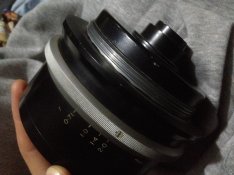
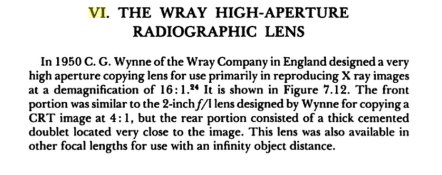
Help indentify this lens: Wray London reduction f0.71 64mm

Stella Niagara Steps

H
Stella Niagara Steps

  • 0
  • 0
  • 19
Up_the_TransAm.jpg

D
Up_the_TransAm.jpg

  • 1
  • 2
  • 41

Recent Classifieds

Forum statistics

Threads
202,874
Messages
2,846,873
Members
101,537
Latest member
And ee
Recent bookmarks
0

jzknight

Member
Allowing Ads
Joined
Mar 23, 2015
Messages
2
Format
35mm
Hi,
I found this huge lens whilst clearing out a loft, I was just wondering if any bright spark could help me indentify what this lens actually is? I am presuming it is not a photography lens? It has an apature ring but no focussing ring. I was thinking it was for a telescope? I have looked online but cant find any information. Not sure if this is the right place to post such a question but just thought I would on the off chance. If there is a better place to post this question please point it out to me.
Any help finding out what this lens actually is would be greatly appreciated.

Many Thanks
Joe

attachment.php
attachment.php
 

Attachments

  • image1.jpg
    image1.jpg
    726.6 KB · Views: 325
  • image2.jpg
    image2.jpg
    718.4 KB · Views: 299
Looks like it may have been for taking pictures of a CRT or fluoroscopy screen.
Wray.jpg
 
What a monster :smile:! Can this be used on some large format camera (I'm guessing it has big coverage)? It would be interesting to see the results.

Because I know nothing of lens design, I assume the coverage would be small (certainly compared to normal x-ray equipment, where 8x10 is one of the smallest commonly available sizes). Maybe I've got "demagnification" backwards, but this makes me think more of the lenses for copying to microfiche.

Joe, have you tried checking the coverage at all? I'd love to see what this thing can do.
 
Pure guess, but some kind of process lens?....thinking that it seems to be for reducing an image in size,i.e. 16:1. The large aperture might assist with slow process films, and the apparent small depth-of-field would not be a problem with a flat subject. Images could be photos for printing plates or X-ray plates or films, as suggested above? And didn't Wray make quite a number of process lenses ?
 
It is a mid-range soft focusing element for the Stargate Photon Laser Death Ray....SPLDR, for short
 
as mentioned, x-ray. the flange-focal distance will be tiny. (e.g. too short to use.)
 
as mentioned, x-ray. the flange-focal distance will be tiny. (e.g. too short to use.)

I agree it's an x-ray lens, but I don't agree that the FFD will be too short to use. X-ray lenses can be fun to use, with some really (for lakc of a better word) 'creative' looks. Of course, it would be for macro level work, but I've free-handed x-ray lenses and have had some interesting results. They do have a bit of a cult following in some circles.
 
How big is the rear element? Assuming the rear is very close to the film plane, the circle of coverage can't be much bigger than the rear element.
A reducing lens to microfilm is possible, as is a CRT trace-capturing lens, like an oscillo-paragon or oscillo-raptar.
At the marked 1:16 reduction, that turns an 8x10" into 1/2" x 5/8"

You'll get very good money if it'll cover aps-c or 4/3rds, by selling it to a digital mirrorless user as a portrait lens. Or by selling it to me to mount on an LF with a 6x6 back, they'd make for very vignetted portraits.
 
This is all great information, thankyou all! The rear element is 22mm diameter, not quite sure what that means the coverage will be. Anyway I was thinking about trying to make my own box camera with it but that might just be one of those projects that I never quite get the time to do. Also I forgot to mention that the elements have a yellow tint to them, I am presuming this means they are radioactive?
 
What is an "X-ray lens" and how is it used ?

An x-ray lens is a lens attached to a medical x-ray device. They are very similar to photographic lenses except that they are usually fixed focus with a very thin depth of field (hence f0.7). In general they have a very large image circle (x-ray film is not enlarged, so 8x10 is pretty standard, but goes up into the ULF sizes for chest x-rays and the like). This one is a reducing lens, which makes it different. As mentioned, at a 16x reduction it'll compress an 8x10 image down to 16mm film size. I'm curious where that would have been used. I suppose with a large enough screen you could take an x-ray of a large animal and compress it down to a small bit of film, but then you'd need a heck fo a loupe to examine it (not to mention the rather large x-ray source that would be needed).
 
Sure looks and sounds to me like it's suited for microfilm "copying" of already-developed X-Rays.
-So not an 'X-Ray' lens in the sense of forming original images from X-Ray radiation... But forming white-light copy images on slow microfilms.

As Dr Croubie says 1:16 reduction, that turns an 8x10" into 1/2" x 5/8"

(Bigger than Microfische, Smaller than 35mm from 8x10... but maybe close to filling 35mm with an 11x14 copy?)
 
or could be used for reduction to an image intensifier tube to relay the image somewhere else (screen). E.g. like for a vidicon or something.
 
Photrio.com contains affiliate links to products. We may receive a commission for purchases made through these links.
To read our full affiliate disclosure statement please click Here.

PHOTRIO PARTNERS EQUALLY FUNDING OUR COMMUNITY:


Ilford ADOX Freestyle Photographic Stearman Press Weldon Color Lab Blue Moon Camera & Machine
Top Bottom