

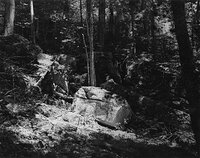

I have about 20 hundred foot rolls of 35mm Kodak 2484 film. Originally, its speed was a mite faster then Tri-X. It 'expired' in 1990. I bought it for $5 a roll about 15 years ago. Being a hoarder of film is sometimes not as prudent as is being a sensible person. At the time of purchase it was somewhat fogged but quite good (but grainy). Then, its speed was about 200.
NOW, its speed is about half the speed of Pan F, or about 12. What to do?
I do the following (and this might be a help to those with similar, unforgiving fast films that become charcoal with time). I expose at EI 12 and develop for three times the time I use for Tri-X. Then stop and fix (for about the same time as Tri-X would need in the fixer.) This delivers true charcoal. But, if held up in front of a lit light bulb there really is a rather contrasty image there. I then place into Farmer's reducer for as long as it takes to bring down the base density to a manageable level. The speed is not REALLY as slow as 12 but I have to overexpose because the reduction in density robs the neg of some shadow detail which overexposure helps compensate for. I end up with a believable and manageable negative that prevents all that film from becoming trash. I have to overexpose and then 'bring back' the density because merely developing for less time gives a very, very low contrast negative. The Farmer's reducer (one solution, not two) preserves most of the contrast that over development has built up.
I am both frugal and addicted to film purchases. - David Lyga
NOW, its speed is about half the speed of Pan F, or about 12. What to do?
I do the following (and this might be a help to those with similar, unforgiving fast films that become charcoal with time). I expose at EI 12 and develop for three times the time I use for Tri-X. Then stop and fix (for about the same time as Tri-X would need in the fixer.) This delivers true charcoal. But, if held up in front of a lit light bulb there really is a rather contrasty image there. I then place into Farmer's reducer for as long as it takes to bring down the base density to a manageable level. The speed is not REALLY as slow as 12 but I have to overexpose because the reduction in density robs the neg of some shadow detail which overexposure helps compensate for. I end up with a believable and manageable negative that prevents all that film from becoming trash. I have to overexpose and then 'bring back' the density because merely developing for less time gives a very, very low contrast negative. The Farmer's reducer (one solution, not two) preserves most of the contrast that over development has built up.
I am both frugal and addicted to film purchases. - David Lyga
Last edited by a moderator:


