• Welcome to Photrio!
    Registration is fast and free. Join today to unlock search, see fewer ads, and access all forum features.
    Click here to sign up

HCC-110 with Fujifilm Neopan 400

Recent Classifieds

Forum statistics

Threads
202,080
Messages
2,834,748
Members
101,101
Latest member
howlingsun
Recent bookmarks
0
OP
OP

dreamingartemis

Member
Allowing Ads
Joined
Apr 22, 2009
Messages
316
Format
Multi Format
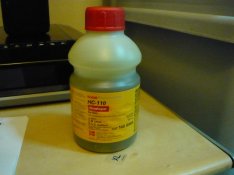
I think the major problem here is that I don't know what kind of version of HCC-110 I have here, I'll post a photo of it up later when I get home. Maybe someone then can tell me what going on.

 

MattKing

Moderator
Moderator
Joined
Apr 24, 2005
Messages
55,359
Location
Delta, BC Canada
Format
Medium Format
Well, I'm not sure how to tell if the possible is the europe version because on the label of the bottle it's indicated that for dilution b, use 1:7. And all the other dilution correspond with the information in the kodak HCC-110 data sheet for working solution......I think the factory here took the concentrate and mixed it to working solution and the sold it in bottles.

By working solution I expect you mean stock solution.

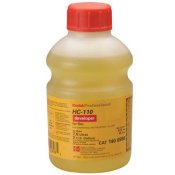
And does this more closely resemble the bottle you have?

If so, it is the US dilution.
 

Attachments

  • KKHC1102G.jpg
    KKHC1102G.jpg
    14.4 KB · Views: 70
OP
OP

dreamingartemis

Member
Allowing Ads
Joined
Apr 22, 2009
Messages
316
Format
Multi Format
By working solution I expect you mean stock solution.

And does this more closely resemble the bottle you have?

If so, it is the US dilution.

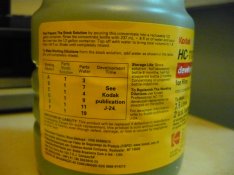
Yes! You hit paydirt! That is the same bottle! But then why does it indicate 1:7 on the bottle for dilution B?

So does that mean I need to mix it up to 1:3 first before mixing it up to 1:7 or what? I'm getting confused here.......:confused::confused:
 

MattKing

Moderator
Moderator
Joined
Apr 24, 2005
Messages
55,359
Location
Delta, BC Canada
Format
Medium Format
Yes! You hit paydirt! That is the same bottle! But then why does it indicate 1:7 on the bottle for dilution B?

So does that mean I need to mix it up to 1:3 first before mixing it up to 1:7 or what? I'm getting confused here.......:confused::confused:

When you look at the text on the label where it says 1:7, does the top of the label include a phrase like "First prepare a stock solution ....?" :smile:

I think it most likely does.

If you want to work with an intermediate dilution stock solution it works well, but you will end up wasting some developer unless you procees a lot of film (the stock solution goes bad after a while).

So most of us mix straight from concentrate - 1 part concentrate plus 31 parts water gives you dilution B.
 
OP
OP

dreamingartemis

Member
Allowing Ads
Joined
Apr 22, 2009
Messages
316
Format
Multi Format
When you look at the text on the label where it says 1:7, does the top of the label include a phrase like "First prepare a stock solution ....?" :smile:

I think it most likely does.

If you want to work with an intermediate dilution stock solution it works well, but you will end up wasting some developer unless you procees a lot of film (the stock solution goes bad after a while).

So most of us mix straight from concentrate - 1 part concentrate plus 31 parts water gives you dilution B.

Will check it out later thanks!!:laugh::laugh::laugh: Man, that means I have wasted a lot of good rolls!
 
OP
OP

dreamingartemis

Member
Allowing Ads
Joined
Apr 22, 2009
Messages
316
Format
Multi Format
P1000494.jpg
P1000495.jpg

Damnit! MattKing was right! I didn't understand the term stock solution until just now! >_< let this be a very very painful and wasteful lesson.
 

MattKing

Moderator
Moderator
Joined
Apr 24, 2005
Messages
55,359
Location
Delta, BC Canada
Format
Medium Format
Damnit! MattKing was right!

My wife has been known to say this too. :smile:

Just so you have some sense of context on this:

1) HC110 was originally designed for high volumes of processing, and the instructions reflect that. They also reflect the fact that it was designed to be incredibly flexible, and therefore work similarly in a lot of different commercial environments, through use of custom tailored dilutions;
2) If you search APUG, you will find lots of people who have been confused by HC110; and
3) Many people find that once they get past the initial confusion, HC110's flexibility is wonderful.

If you are looking for a fairly straightforward approach, you might try Jason Brunner's. He is a moderator here, makes entertaining and informative videos, and has settled on a 1+ 49 dilution because it is easy to work with. Here is a link: http://www.jasonbrunner.com/hc110.html
 
OP
OP

dreamingartemis

Member
Allowing Ads
Joined
Apr 22, 2009
Messages
316
Format
Multi Format
My wife has been known to say this too. :smile:

Just so you have some sense of context on this:

1) HC110 was originally designed for high volumes of processing, and the instructions reflect that. They also reflect the fact that it was designed to be incredibly flexible, and therefore work similarly in a lot of different commercial environments, through use of custom tailored dilutions;
2) If you search APUG, you will find lots of people who have been confused by HC110; and
3) Many people find that once they get past the initial confusion, HC110's flexibility is wonderful.

If you are looking for a fairly straightforward approach, you might try Jason Brunner's. He is a moderator here, makes entertaining and informative videos, and has settled on a 1+ 49 dilution because it is easy to work with. Here is a link: http://www.jasonbrunner.com/hc110.html

Don't I know it >_<...
 

Rudeofus

Member
Joined
Aug 13, 2009
Messages
5,119
Location
EU
Format
Medium Format
1) HC110 was originally designed for high volumes of processing, and the instructions reflect that. They also reflect the fact that it was designed to be incredibly flexible, and therefore work similarly in a lot of different commercial environments, through use of custom tailored dilutions;
Of all the developers, why would HC110 be the developer for high volume processing? Kodak went through great pains to formulate a developer which contains no water and lasts for years, while a high volume lab would go through these bottles in less than a day.

There is a reason I could imagine why Kodak recommends the 1+3 stock solution: let's assume you want to develop 5 different films with different dilutions. In my experience HC110 needs at least 1+3 dilution or it wouldn't mix. Since 1+3 stock is much more pleasant to handle than this thick concentrate, one would benefit from starting with 1+3 stock for all films and then diluting this down to what's actually needed for each film. Basically if you need 1l of 1+32, 0.5l of 1+49 and 0.5l of 1+100, you'd mix 33ml + 10ml + 5ml = 48ml concentrate with 150ml water and use this much more liquid 1+3 stock to conveniently create the final dilutions for each dev run.

This would be a nice way for 5 films today, 2 tomorrow and another 4 films next month kind of volumes. For much higher volumes one doesn't have to mess around with and also pay extra for such a concentrate.
 
Joined
Jan 21, 2003
Messages
15,715
Location
Switzerland
Format
Multi Format
Getting the water out of the developer makes it easier to handle (lower volume) for shipping and distribution. The small bottle appeals to those that don't like powders, and it lasts practically forever.

Whatever it was designed for, HC-110 sure is a neat little package!
And, you don't have to use it at the recommended dilution either. Just dilute it like you would Rodinal, like 1+50 or 1+25, and work out your own times, which you have to do anyway to fit your process.
 

MattKing

Moderator
Moderator
Joined
Apr 24, 2005
Messages
55,359
Location
Delta, BC Canada
Format
Medium Format
Of all the developers, why would HC110 be the developer for high volume processing? Kodak went through great pains to formulate a developer which contains no water and lasts for years, while a high volume lab would go through these bottles in less than a day.

There is a reason I could imagine why Kodak recommends the 1+3 stock solution: let's assume you want to develop 5 different films with different dilutions. In my experience HC110 needs at least 1+3 dilution or it wouldn't mix. Since 1+3 stock is much more pleasant to handle than this thick concentrate, one would benefit from starting with 1+3 stock for all films and then diluting this down to what's actually needed for each film. Basically if you need 1l of 1+32, 0.5l of 1+49 and 0.5l of 1+100, you'd mix 33ml + 10ml + 5ml = 48ml concentrate with 150ml water and use this much more liquid 1+3 stock to conveniently create the final dilutions for each dev run.

This would be a nice way for 5 films today, 2 tomorrow and another 4 films next month kind of volumes. For much higher volumes one doesn't have to mess around with and also pay extra for such a concentrate.

Hi Rudeofus.

HC110 used to be available in larger packaging. In addition, it was common for commercial labs who used it to use it replenished, and the replenisher was very economical.

But most important, it was designed to be usable in automated processors, and with different materials. The different dilutions were designed to compensate for those material differences - thus permitting using the same, equipment specific development time for different materials.

And I agree that it is more convenient to make the stock solution, because the viscosity makes measuring small quantities of the concentrate a challenge. It is just that the stock solution can go bad before one uses it up (generally one bottle of HC110 lasts me somewhere between 48 and 72 rolls).
 
Photrio.com contains affiliate links to products. We may receive a commission for purchases made through these links.
To read our full affiliate disclosure statement please click Here.

PHOTRIO PARTNERS EQUALLY FUNDING OUR COMMUNITY:



Ilford ADOX Freestyle Photographic Stearman Press Weldon Color Lab Blue Moon Camera & Machine
Top Bottom