• Welcome to Photrio!
    Registration is fast and free. Join today to unlock search, see fewer ads, and access all forum features.
    Click here to sign up

HC-110??

Forum statistics

Threads
203,279
Messages
2,852,249
Members
101,756
Latest member
rsj1360
Recent bookmarks
0

stradibarrius

Member
Allowing Ads
Joined
Jan 17, 2009
Messages
1,452
Location
Monroe, GA
Format
Medium Format
I searched of HC-110 threads and came up with "0".
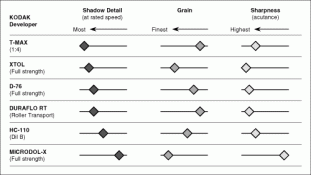
How does HC-100 results compare to XTOL or D-76 with everything else being equal?
What are the advantages and disadvantages to HC-110? HC-110 and D-76 available at my local photo shop and XTOL is not available I have to order it and have it shipped.
 
Try the google search instead - hundreds of results searching HC-110 within APUG.
 
I have found that HC110 is a bit more grainy (my observation and process) than D-76. I notice this the most on 35mm enlargements--on MF and LF I can hardly tell. I really appreciate its ease of storage and one shot mixing. I can mix up enough for a roll of 35mm or just as easily 12 sheets of 4x5. Almost every image in my gallery is HC110. Can't speak to Xtol as I haven't gotten around to trying that one out. Its cheap, predictable, stores superb and gives a lot of option with various dilutions. HP5 and HC110 is what I use 80% of the time. My two cents.
 

Attachments

  • f002_0072hc.gif
    f002_0072hc.gif
    7.3 KB · Views: 216
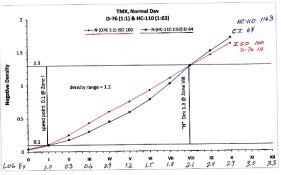
Typically there is a pronounced alteration of the curve shape of the film with HC-110 compared with D76 and XTOL. Not a bad thing just different. Depending on your goals it can be great or not so great. as a for instance TX400's when processed in HC110 curve is a little more toward the curve shape of TXP in D76 give similar activity levels.

RB
 
HC 110 working stock when "ripened" with a few rolls of film will give much smoother results than when mixed one shot. I used to use it processing newspaper film, replenished the stuff is a wonder. Only problem you need to be processing about every day to make this route worthwhile and workable. I'd love to have a version of HC 110 that will work one shot like the ripened replenished version does.
 
Typically there is a pronounced alteration of the curve shape of the film with HC-110 compared with D76.........

I've shown these before but they apply to your comment. Here's an example of the difference in curve shape between d-76 (1:1) and hc-110 (1:63) in the case of TMX. With the speed target density and the normal development target density controlled, the difference in both developers and dilutions can clearly be seen in how they developed the remaining points along the curve. For equal increases in log exposure, hc-110 develops a longer toe than does d-76, meaning, it builds density/contrast more gradually with each one zone increase in exposure in the toe region.
 

Attachments

  • comparison-curves001-W.jpg
    comparison-curves001-W.jpg
    43.6 KB · Views: 188
How does HC-100 results compare to XTOL or D-76 with everything else being equal?

Film processing is a great deal like working wood.

You may work at a superficial level (what my Dad, a good carpenter, called "Being out of control".)
or you may push through the basic, mechanical process to reach the intuitive mastery where we integrate
methodical perfection with instinctive vision.

It really doesn't matter WHICH developer you use. It doesn't.
Furthermore, until you've throughly mastered the craft,
you don't really approach the true differences between, say, HC-110 and Xtol.

Photography is systematic; integrating the film, the developer AND the paper and paper developer with
your technique, in service to your vision is what makes the difference. Just changing one part of the system
prevents you from any progress, but takes you on an endless sideways journey.

All craft is about personal transformation. The curse of photography is the seduction of uncountable developers,
multiplied by dozens of films, and the persistent falsehood that one is better than another, that secret knowledge will somehow perfect our pictures.

A Strad with a badly adjusted bass bar is just a cigar box.

 
HC 110 working stock when "ripened" with a few rolls of film will give much smoother results than when mixed one shot. I used to use it processing newspaper film, replenished the stuff is a wonder. Only problem you need to be processing about every day to make this route worthwhile and workable. I'd love to have a version of HC 110 that will work one shot like the ripened replenished version does.

I wonder if using a developer starter with HC-110 would ripen the solution sufficiently?
 
How does HC-100 results compare to XTOL or D-76 with everything else being equal?

Film processing is a great deal like working wood.

You may work at a superficial level (what my Dad, a good carpenter, called "Being out of control".)
or you may push through the basic, mechanical process to reach the intuitive mastery where we integrate
methodical perfection with instinctive vision.

It really doesn't matter WHICH developer you use. It doesn't.
Furthermore, until you've throughly mastered the craft,
you don't really approach the true differences between, say, HC-110 and Xtol.

Photography is systematic; integrating the film, the developer AND the paper and paper developer with
your technique, in service to your vision is what makes the difference. Just changing one part of the system
prevents you from any progress, but takes you on an endless sideways journey.

All craft is about personal transformation. The curse of photography is the seduction of uncountable developers,
multiplied by dozens of films, and the persistent falsehood that one is better than another, that secret knowledge will somehow perfect our pictures.

A Strad with a badly adjusted bass bar is just a cigar box.
I certainly understand what you mean by this comparison...I am often asked what makes the difference between one violin and another and IMO it is how the maker "hears" the sound that is made by the parts as it is crafted and tuned. But I can also say that there is always room for improvement and pickng up a new technique. . But to your point to appreciate how well the new technique really works, the experience to judge and quality the technique is needed.
But... even as an advance beginner, I can tell the difference between films when everything is equal. Take a look at the thread I started a couple of days ago..."TMAX 400 and Neopan 400 FWIW". It is easy to see that with everything being exactly the same the two films produce different results.

So of course I wonder if I take two rolls of film using the same camera, lens, lighting, subject combo and processed one roll in XTOL 1:1 ( very common dilution) and HC110 in a dilution that is very common, what would be the difference?
I don't at this moment have any HC110 or I would try it for myself.
 
Most likely the difference will be very subtle. I did exactly that test, but used xtol and pyrocat. When you look at the prints side by side the difference is more of a "feeling", than something you can describe in concrete terms. In looking at them on the monitor the high values are a little more defined in Xtol, and I remember in looking a tthe prints the pyro shadows have slightly more "definition".

(there was a url link here which no longer exists)

To expand on your analogy, it takes a lot of completed violins to understand the differences made by the parts and techniques used to assemble it. The situation in photography isn't any different.
 
What DF cardwell wrote is an expression of what Edward Weston called acquiring the ability "to see photographically." Both are right.
 
It is easy to see that with everything being exactly the same the two films produce different results.

With great respect, not EVERYTHING was the same: you used the recommended times for each developer, BUT the films were developed to different contrasts. THAT is why I included the Xtol curves from Kodak. The difference between the film's performance in your test was not due to the films being different, but due to the development time. The nature of Xtol is to ameliorate the differences between the test films over the range of normal CI / gamma. Give the Fuji more development, and it will match the TMY2. Really. This is just like saying "put a better edge on that old plane's iron, and it will cut like that Lie-Nielsen". Develop the Fuji longer, and it would have been the same.

That said, there are differences between the test films in Xtol AT HIGHER contrast. AND, developed in another developer, you'll see differences between those films at NORMAL contrasts. As for HC-110, and its similarity to D-76, the differences will only become evident if you seek to exploit them. The biggest advantage for you might be the the facts that HC-110 makes a wonderful developer for occasional use. It lasts forever. And mixing it 1+63, it will be so close to D-76 1+1 in performance, it really doesn't matter.

Your intent for the images, and your vision, are more important than which of these developers you will use, as long as there is adequate shadow contrast for your scanner to see (further comments on this line are surely hybrid and best addressed in another place, although I think it would be fair to say that were you to shoot the same shot 10 times, and give different development times to each one, then scan each one to see how you are able to achieve the feeling of the violin's figure THAT would be fair to say here.)

More important than anything, I think, when photographing a violin, is to be able to move the fiddle and camera independently. You can only do that to a degree, but every bit helps. A small table on a big tripod is a good place to put the violin. (I built one years ago, and then laughed myself silly when a sailing friend observed that if I made fiddles for the moving platform, the fiddle would not crash to the earth. And I did.

Next, it is good to move the light around. The light needs to move if you want to light the flame, and the view of the fiddle is already established. Controlling the light itself is pretty simple, but beyond the scope of the thread. Finally, filtering the light (or the lens) will emphasize or suppress the figure.
 
The most important thing to say is that Brother Stradibarrius is one fine luthier,
and I'm in envy beyond words.

http://www.dudleyviolins.com/
 
does more agitation equal to more contrast? If I am getting consistance results with Neopan 400 and XTOL 1:1, for example, if I were to just increase the agitation, would the contrast increase?

I would recommend that you keep your agitation sequence the same for "N", "minus", and "plus" development times and adjust contrast by a "time" adjustment only. The agitation variable is easier to control in doing so, IMO.

Situations where you are trying to achieve rather serious compensating effect is when the agitation sequence is significantly altered.
 
The short answer to does more agitation increase is Yes (mostly). The Long Answer I'll leave for anyone who wants to comment, but I will say that if you agitated 5 inversions every 30 seconds using Rodinal at 1:25, it will be a more contrasty neg versus 3 inversion agitations every minute.

"Situations where you are trying to achieve rather serious compensating effect is when the agitation sequence is significantly altered."

I completely agree. Well put.

Cardwell's point about development time is a good one. As he pointed out in the Neo vs Tmy-2 test, at some point the Neo hits the shoulder as density is increased, leading to somewhat Lower contrast to highlights, (really nice to have with use on bright white dresses in full sun at the beach BTW). TMY-2 doesn't really seem to have the same tendency, that is to me the highlight contrast seems to stay the same regardless of the overall density, but I am just really starting to get to know TMY-2. My last few sets of negs from Xtol look almost starting to be a little thin, but they print fine ,just at like 2/3 my normal print exposure. TMY-2/Xtol seems to me that I could add significant amounts of additional time and the contrast would be about the same.

Stradibarrius I would suggest doing a controlled shoot again and just vary the development time, say 3, one using "standard" time, then do one maybe 15% and another + 30%, but you may prefer a lower density neg for scanning. Since I do optical printing I can let the neg sizzle with a long print exposure.
 
does more agitation equal to more contrast?


Not necessarily. Given the same development time, more or less agitation will heighten or lessen contrast Compensate for increased or decreased agitation by adjusting development time, and you can get very close to the same results.
 
Photrio.com contains affiliate links to products. We may receive a commission for purchases made through these links.
To read our full affiliate disclosure statement please click Here.

PHOTRIO PARTNERS EQUALLY FUNDING OUR COMMUNITY:


Ilford ADOX Freestyle Photographic Stearman Press Weldon Color Lab Blue Moon Camera & Machine
Top Bottom