
I am just finishing up my first bottle of (American) HC-110, so I got a new one. I noticed that the consistency seems to be different in my new bottle. My old bottle had the syrupy consistency I would say is a bit like thin honey. This new bottle is not watery, but seems closer to maple syrup. Which one is the outlier?
-
Welcome to Photrio!Registration is fast and free. Join today to unlock search, see fewer ads, and access all forum features.Click here to sign up
You are using an out of date browser. It may not display this or other websites correctly.
You should upgrade or use an alternative browser.
You should upgrade or use an alternative browser.
HC-110 viscosity
-
A
- Thread starter Grim Tuesday
- Start date


Recent Classifieds
-
Want to Buy WTB: 4x4 Resin 81B Filter
- Started by NortheastPhotographic
-
For Sale LINHOF SUPER TECHNIKA III VERSION 5 with Raptar 135, film holders and FP4
- Started by Simon Benton
-
For Sale LINHOF TECHNIKA III ver 5 LENSBOARDS
- Started by Simon Benton
-
Sold KODAK COLOR THERMOMETER F
- Started by Jon Shiu
-
Want to Buy Sinar P2 8x10 Bellows (Need the frames)
- Started by Jessxi
Forum statistics

I use a pyrex 25 mL graduated cylinder left over from undergraduate chemistry to measure stock (from the Kodak bottle) HC110. It takes a while for it to run run down to the bottom in order to get a proper measurement. That has remained consistent over time (decades). Somewhere between honey and maple syrup (the real stuff that now comes in small plastic jugs).
I don't use HC-110 any longer. The original was designed to be diluted into a stock solution which was further diluted for use in large replenished tanks. Could be that it's been changed a bit??
All the chemistry that Tetenal is making for Kodak is excellent. The XTOL from Germany is cleaner than the material that was produced by Kodak.
All the chemistry that Tetenal is making for Kodak is excellent. The XTOL from Germany is cleaner than the material that was produced by Kodak.

In my experience, HC-110 always seemed less viscous when the bottle was new than when it was older.
I expect that the contents of the litre bottles seem less viscous because the bottles are more than twice the size of the old 16 fluid ounce bottles.
I expect that the contents of the litre bottles seem less viscous because the bottles are more than twice the size of the old 16 fluid ounce bottles.
I remember people reporting a thinner consistency of HC-110 after Kodak changed the manufacturer. If your bottle says "Made in Germany" then it is the new stuff and was most likely produced by Tetenal (as mshchem noted). This change doesn't seem to affect development times or results in any way.

Use a syringe much more accurateI use a pyrex 25 mL graduated cylinder left over from undergraduate chemistry to measure stock (from the Kodak bottle) HC110. It takes a while for it to run run down to the bottom in order to get a proper measurement. That has remained consistent over time (decades). Somewhere between honey and maple syrup (the real stuff that now comes in small plastic jugs).
I use a 50 ml graduated cylinder similar to the one that Focomatter uses, but I use it in a different way.
I put something like 20 ml or 30 ml of water in it. I then slowly add the syrup to the water, making sure that the syrup doesn't contact the side of the cylinder above the water. I watch the level of the water rise until it reaches my target total - from 30 ml to 36 ml, if I am trying to add 6 ml.
I then rinse the graduated cylinder thoroughly into my final measuring graduate, and then top it up to the final volume.
I put something like 20 ml or 30 ml of water in it. I then slowly add the syrup to the water, making sure that the syrup doesn't contact the side of the cylinder above the water. I watch the level of the water rise until it reaches my target total - from 30 ml to 36 ml, if I am trying to add 6 ml.
I then rinse the graduated cylinder thoroughly into my final measuring graduate, and then top it up to the final volume.
- Joined
- May 18, 2014
- Messages
- 797
- Format
- 35mm
I have a dinky little spring top Kilner jar that I keep topped up from the main bottle. Makes it easier to use the syringe. 6ml to 300ml of water. The syringe gets flushed in the water and again under the tap.
Does anyone have experience of using HC-110 as a print developer?
Does anyone have experience of using HC-110 as a print developer?

Helinophoto
Member
I use a 50 ml graduated cylinder similar to the one that Focomatter uses, but I use it in a different way.
I put something like 20 ml or 30 ml of water in it. I then slowly add the syrup to the water, making sure that the syrup doesn't contact the side of the cylinder above the water. I watch the level of the water rise until it reaches my target total - from 30 ml to 36 ml, if I am trying to add 6 ml.
I then rinse the graduated cylinder thoroughly into my final measuring graduate, and then top it up to the final volume.
Question:
Why don't you just add the HC-110 first?
Then you can rinse and have all kinds of fun,
and fill up with water, to your target level.
I use a syringe too,
I always put the HC-110 in first,
then I stir well with a spoon after the water is in.
I use a simple kitchen measuring-jug with 0.5 dl markings.
Does anyone have experience of using HC-110 as a print developer?
Yes, it works, perhaps not as well as a standard print dev and the general consensus is that using film devs for paper is more expensive.
Look under "unusual uses": http://www.covingtoninnovations.com/hc110/
I remember people reporting a thinner consistency of HC-110 after Kodak changed the manufacturer. If your bottle says "Made in Germany" then it is the new stuff and was most likely produced by Tetenal (as mshchem noted). This change doesn't seem to affect development times or results in any way.
+1 for this. I don't remember when the change happened, but I'm getting close to the end of my first bottle after the change.
Because if there is no water, the viscose HC-110 sticks to the side of the graduated cylinder and it is much more difficult to measure.Question:
Why don't you just add the HC-110 first?
Then you can rinse and have all kinds of fun,
and fill up with water, to your target level.
The meniscus created by a mixture of a relatively small amount of syrup in a larger amount of water is very consistent and easy to read against the graduations in the cylinder. The meniscus created by a 6 ml (for example) quantity of the syrup - not so easy to read against the graduations in the cylinder.

I remember people reporting a thinner consistency of HC-110 after Kodak changed the manufacturer. If your bottle says "Made in Germany" then it is the new stuff and was most likely produced by Tetenal (as mshchem noted). This change doesn't seem to affect development times or results in any way.
Michael A. Covington's website http://www.covingtoninnovations.com/hc110/index.html explains the difference between the US and the European versions of HC-110. Mr. Covington writes:
Note: In Europe, HC-110 is also sold in 500-mL bottles as a less concentrated syrup which you dilute 1:9 to make dilution B. If you are using that product (Kodak CAT 500 1466), follow the instructions for the European concentrate, not those for the syrup. Although the European type of HC-110 is sold in England, there does not seem to be an English data sheet for it. Full-strength syrup is also sold in Europe so make sure you know which one you have.
You will also find dilution guidelines for the two versions in this article.
I believe Covington's webpage addresses the two configurations (domestic vs European) of HC-110 when Kodak was manufacturing the product and doesn't address the current product produced by Tetenal. Tetenal has been manufacturing HC-110 in Germany since Kodak folded its tent and farmed out its products.Michael A. Covington's website http://www.covingtoninnovations.com/hc110/index.html explains the difference between the US and the European versions of HC-110. Mr. Covington writes:
Note: In Europe, HC-110 is also sold in 500-mL bottles as a less concentrated syrup which you dilute 1:9 to make dilution B. If you are using that product (Kodak CAT 500 1466), follow the instructions for the European concentrate, not those for the syrup. Although the European type of HC-110 is sold in England, there does not seem to be an English data sheet for it. Full-strength syrup is also sold in Europe so make sure you know which one you have.
You will also find dilution guidelines for the two versions in this article.
I also want to mention that using Tetenal's product produced different results from Kodak's version. First, Tetenal's product is less viscous than the original and the color is a lighter yellow. Second, I found that I had to increase development time 20% to match densities of negs developed with the original. I believe the Tetenal formula is less active than the original; Kodak's HC-110 was a very active developer.
Conclusion: I believe the formula was adjusted when Tetenal assumed production and even though they claim development times should be the same, the resultant negs do not reach the same densities as the original formula when comparing negs in my files using both developers. If you search the web, you will find others have made the same observation.
Conclusion: I believe the formula was adjusted when Tetenal assumed production and even though they claim development times should be the same, the resultant negs do not reach the same densities as the original formula when comparing negs in my files using both developers. If you search the web, you will find others have made the same observation.
Thanks very much for your important update, Arvee. I’ll keep your information in mind when my stash of HC-110, bought eight (!) years ago, finally runs out.
Helinophoto
Member
Because if there is no water, the viscose HC-110 sticks to the side of the graduated cylinder and it is much more difficult to measure.
The meniscus created by a mixture of a relatively small amount of syrup in a larger amount of water is very consistent and easy to read against the graduations in the cylinder. The meniscus created by a 6 ml (for example) quantity of the syrup - not so easy to read against the graduations in the cylinder.
Ah, sorry I did not see that you do not use a syringe.
Then it makes perfect sense.
I tried measuring HC-110 "normally" in the jug too, but found that the syringes can give me best results, recommended.

Michael A. Covington's website http://www.covingtoninnovations.com/hc110/index.html explains the difference between the US and the European versions of HC-110. Mr. Covington writes:
Note: In Europe, HC-110 is also sold in 500-mL bottles as a less concentrated syrup which you dilute 1:9 to make dilution B. If you are using that product (Kodak CAT 500 1466), follow the instructions for the European concentrate, not those for the syrup. Although the European type of HC-110 is sold in England, there does not seem to be an English data sheet for it. Full-strength syrup is also sold in Europe so make sure you know which one you have.
You will also find dilution guidelines for the two versions in this article.
Covington's website is a bit outdated. I queried Kodak Alaris regarding the European product last March as follows:
Question: Can you confirm that a European version of HC-110 developer available in 500ml bottles (CAT 500 1466) is no longer produced?
Answer: Correct – this item was discontinued.
So the only legitimate version available today is the 1-liter bottle.
I feel a bit silly -- I just checked my old bottle and it seems to have miraculously become thinner as well. Surely it must have nothing to do with the fact that it is now summer time and I have an un-airconditioned house...

I use graduated pipettes (either 10ml or 25ml) that can accept a hand pump device attached to the end opposite the intake. This allows me to draw in the measured amount without having a meniscus and then release it into a beaker partially filled with water. I can then place the pipette tip into the water and use the pump to repeatedly draw in and eject fluid thus thoroughly rinsing the pipette and insure that ALL the concentrate is in the beaker. Then top up the beaker to the target dilution and stir. Takes less time than to describe. Picture of pump attached.
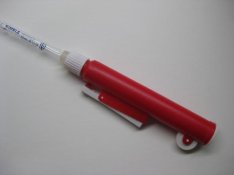
Last edited:

I use a 50 ml graduated cylinder similar to the one that Focomatter uses, but I use it in a different way.
I put something like 20 ml or 30 ml of water in it. I then slowly add the syrup to the water, making sure that the syrup doesn't contact the side of the cylinder above the water. I watch the level of the water rise until it reaches my target total - from 30 ml to 36 ml, if I am trying to add 6 ml.
I then rinse the graduated cylinder thoroughly into my final measuring graduate, and then top it up to the final volume.
That works fine if the two liquids add volumetrically. Some don’t. An example is water and ethanol, which, when mixed result in 10% less volume than the volume of the two constituents.
Whether this is a factor when mixing HC-110 I don’t know, but it might be.
That works fine if the two liquids add volumetrically. Some don’t. An example is water and ethanol, which, when mixed result in 10% less volume than the volume of the two constituents.
Whether this is a factor when mixing HC-110 I don’t know, but it might be.
Even if the difference was 10%, it wouldn't be significant, given the numbers involved - particularly since the mixing isn't very complete in that 50 ml graduate. The syrup tends to sink to the bottom, while the water rides up. It is only after you rinse out the graduate several times into the target container that the syrup is fully mixed in with the diluting water.
In any event, with this sort of application, what is important is that you are consistent in how you do the measuring.
Michael A. Covington's website http://www.covingtoninnovations.com/hc110/index.html explains the difference between the US and the European versions of HC-110. Mr. Covington writes:
Note: In Europe, HC-110 is also sold in 500-mL bottles as a less concentrated syrup which you dilute 1:9 to make dilution B. If you are using that product (Kodak CAT 500 1466), follow the instructions for the European concentrate, not those for the syrup. Although the European type of HC-110 is sold in England, there does not seem to be an English data sheet for it. Full-strength syrup is also sold in Europe so make sure you know which one you have.
I wonder why HC 110 was sold as a less concentrate syrup in Europe and why then sell the full strength stuff as well? Was there a large enough group of European consumers who would only buy HC110 if it was less concentrated and for what reason, I wonder?
pentaxuser
| Photrio.com contains affiliate links to products. We may receive a commission for purchases made through these links. To read our full affiliate disclosure statement please click Here. |
PHOTRIO PARTNERS EQUALLY FUNDING OUR COMMUNITY:  |