• Welcome to Photrio!
    Registration is fast and free. Join today to unlock search, see fewer ads, and access all forum features.
    Click here to sign up

Hazards of shooting digital medium format

1972

A
1972

  • 11
  • 7
  • 113

Forum statistics

Threads
202,584
Messages
2,842,764
Members
101,390
Latest member
Kman35743
Recent bookmarks
0

Mainecoonmaniac

Member
Allowing Ads
Joined
Dec 10, 2009
Messages
6,295
Format
Multi Format
That is absolutely hilarious!! I was talking to my local dealer and he was crying about the bullshit situation being described. Digital MF killed his analogue MF biz but created nothing exciting, new or affordable for him to sell. Either way he lost. It is pathetic.
 
Didn't know 12 year-olds were down with medium format...
 
The funny thing is that Leica linked to that clip. I found that funny, if a company has that kind of humour and self-distance I wanna buy their products.
 
Didn't know 12 year-olds were down with medium format...
If she left my Hasseblad on the front lawn and went into the house, she wouldn't live to be thirteen :wink:
 
FYI: The original link was taken down from the website you linked to. They claim the reason is for profanity.

Here is another link which goes directly to the site where it was originally published:
Dead Link Removed

Basically, it says to me that advertising and hype are more important than function but people still don't want to pay what things are worth. :rolleyes:
 
Basically, it says to me that advertising and hype are more important than function but people still don't want to pay what things are worth. :rolleyes:

Sure but digital medium format is not even close to worth what you get for the price.

It's basically a scam. You get the equivalent of a 6x4.5 sensor for some god-awful price usually in 20-30k+ range.

Said rip-off price buys 1000s and 1000s of rolls of 120 film - all of which can be used from 645 to 6x9. And none of it suffers from the pitfalls of digital image recording.

The core issue is that people want everything now, now, now and they'll gladly invest in ridiculous technology just to avoid waiting a day.

Patience is no linger a virtuous aspect of our society - it's all about the "give it to me now" effect.
 
You're right. Those poor digital commercial photographers that have to constantly have to "upgrade" their gear. Those photographers are probably working so they could get the next greatest thing. What a trap. Always trying to get more MPs. I work with a food photographer and he's had cameras that are decades old. His partner have told me that his clients want high end digital capture. Shooting that way is very capital intensive.
 
Thanks for bringing back beautiful memories. Still have some flash cubes?

No more flash cubes here... haven't broken down and cut my own 126 format film yet for nostalgia either. The rotating flash cubes were quite ingenious weren't they? I think you can still get some on eBay.

Ironically the much older cameras with PC sockets are much easier to light, they sync great with their leaf shutters. If I had a dead flash cube around I wonder what voltage is put out, could you run it to a PC cord flash without frying something? Someone must have done this already...
 
If I had a dead flash cube around I wonder what voltage is put out, could you run it to a PC cord flash without frying something? Someone must have done this already...

You need a battery, a resistor and a capacitor to fire a flash bulb reliably. The battery charges the capacitor up via the flash bulb and the resistor. The resistor limits the current so it doesn't set off the flash.

The camera's sync contacts are then arranged to discharge the capacitor directly into the bulb to fire it.

The capacitor is used as it has a low internal resistance and can provide a short pulse of high current. If a simpler circuit was used with just a battery, its higher internal resistance would lead to a lower current and unreliability due to variances in the time it takes to fire the bulb.


Steve.
 
You need a battery, a resistor and a capacitor to fire a flash bulb reliably. The battery charges the capacitor up via the flash bulb and the resistor. The resistor limits the current so it doesn't set off the flash.

The camera's sync contacts are then arranged to discharge the capacitor directly into the bulb to fire it.

The capacitor is used as it has a low internal resistance and can provide a short pulse of high current. If a simpler circuit was used with just a battery, its higher internal resistance would lead to a lower current and unreliability due to variances in the time it takes to fire the bulb.


Steve.

Thanks. We're totally off topic here so perhaps a mod should split this off...

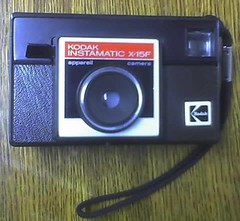
I don't recall the Instamatic taking a battery but I'll check it again tonight; was it in the flashcube?
 
I have got to see this video, stupid work firewall.

Way off topic now, Instimatics like that one use Magicubes, they ignite without power, there is a little tab on the camera that pokes into the flash cube to make it go off. higher end Instimatics do use a battery, but it is for metering, not flash.
 
There were cubes that held (two?) flat cell batteries that could be inserted between instamatic camera and flash cube. That's what i used back then.
 
Sure but digital medium format is not even close to worth what you get for the price.

It's basically a scam. You get the equivalent of a 6x4.5 sensor for some god-awful price usually in 20-30k+ range.

Said rip-off price buys 1000s and 1000s of rolls of 120 film - all of which can be used from 645 to 6x9. And none of it suffers from the pitfalls of digital image recording.

The core issue is that people want everything now, now, now and they'll gladly invest in ridiculous technology just to avoid waiting a day.

Patience is no linger a virtuous aspect of our society - it's all about the "give it to me now" effect.

Said scam is precisely the reason I didn't buy a digicam.

I looked at new cameras and found the cheapest price for even a half-decent Digital SLR was $750 to $1,000. That was for the entry level models. For a "good" one, you'll be paying $2,000 and up.

Then I looked in my closet and found my old Pentax. I added up the cost of getting back into shooting film and it was a no-brainer. For a couple-few hundred bucks I could have my camera cleaned, buy film, chemistry and supplies and produce photos as good as or better than any digicam. For a couple hundred more, a cheap flatbed scanner can be had which will produce images that are better than I would ever need to have.

I would NEVER pay the price of a new car to buy a MF digicam. I'd rather have the new car! :wink:
 
Sure but digital medium format is not even close to worth what you get for the price.

It's basically a scam. You get the equivalent of a 6x4.5 sensor for some god-awful price usually in 20-30k+ range.

Said rip-off price buys 1000s and 1000s of rolls of 120 film - all of which can be used from 645 to 6x9. And none of it suffers from the pitfalls of digital image recording.

The core issue is that people want everything now, now, now and they'll gladly invest in ridiculous technology just to avoid waiting a day.

Patience is no linger a virtuous aspect of our society - it's all about the "give it to me now" effect.

that......I have 4 35mm SLR's and one DSLR.....guess which one takes the best pictures.....:laugh:
 
I've heard digital will save on film, processing make shooting faster blah, blah blah. I do think digital has it's place, but I wonder if some pros are just put on this tread mill of shooting just to make their camera payments? I think there's a race to recoup money before the camera depreciates next to nothing. Once the camera has been paid off, the vicious circles starts again. Will clients see pros that shoot film as backwards? Or Clients are sophisticate to hire a photographer based on the work?
 
As far as I recall Flash Cubes were triggered electronically, Magi cubes chemically.
 
Haha, memories. At least we started out with a square format LOL. I still have it too:


Kodak Instamatic by Harry Pulley, on Flickr

The first camera I shot as well. When one wore out, we went to the thrift shop and got a new one for five bucks. I remember one with red badges (like the one pictured) and one with blue badges.
 
Interesting: just last night I was talking to a photographer co-worker. His doesn't shoot film anymore, but he used to be hardcore 4x5. I told him about MF digibacks but he didn't believe me - until he looked up the prices and nearly passed a brick. WTF?! Why is it so expensive?! on and on he went.

Makes me think back to the $100 RB67 I saw a month ago. $100 for the RB, $5 for a roll of film and $5 for developing.
Compared to $20,000+ for just a back.
 
The problem I see with the current digital medium format cameras is not only the price, but the price in relation to the estimated life time of the product. The classic Hasselblads and Rolleis (and don´t forget about the lenses) also did cost a lot of money back then, but a mechanical medium format camera, or any well made mechanical camera, will work without problems if well maintained, regardless of age. On the other hand I do not expect a current Hasselblad H4D to be useable in another 10 or 15 years. The sensor or some other electronic part will fail and the whole thing will be beyond repair. I cannot imagine that Hasselblad will be able to deliver a sensor as a replacement part for cameras that are then 10+ years out of production. This is the real scam imho.
 
Yes, this is the real problem with digital photography. With film cameras the sensor is updated constantly so a 50 or 100 year old camera can use modern film for much better pictures than it could take. Old film images can be scanned with today's scanners for a better images than you could have scanned 10 years ago. With digital, the day you buy it the sensor is as good as it will ever be (firmware upgrades notwithstanding) and the moment you take a picture the result is frozen in time, a higher resolution image can never be derived from it.

Film formats go out of production, then you have to cut it yourself which is annoying but try cutting a 60x45mm sensor down to 36x24mm...

I do use digital, it is simply faster for a lot of jobs where I need to produce results that afternoon. Film used to give me this but today it does not; I suppose if all I did was photography then I could shoot, process it and have results this afternoon but aside from Polaroid or other instant film I couldn't have results in 5 minutes which I can with digital. That is digital's advantage, it is available right now but that is also its downfall for it is obsolete the moment after!

 
Photrio.com contains affiliate links to products. We may receive a commission for purchases made through these links.
To read our full affiliate disclosure statement please click Here.

PHOTRIO PARTNERS EQUALLY FUNDING OUR COMMUNITY:


Ilford ADOX Freestyle Photographic Stearman Press Weldon Color Lab Blue Moon Camera & Machine
Top Bottom