• Welcome to Photrio!
    Registration is fast and free. Join today to unlock search, see fewer ads, and access all forum features.
    Click here to sign up

Has Photography Gotten Too Big?

Valencia

A
Valencia

  • 0
  • 0
  • 11
Tied to the dock

D
Tied to the dock

  • 4
  • 0
  • 75

Recent Classifieds

Forum statistics

Threads
203,085
Messages
2,849,666
Members
101,652
Latest member
Mayorbeez
Recent bookmarks
2
I think it is no surprise that the large print movement (which I assess at larger than 24x30) coincides with the ease of making large prints with large format inkjet printers, and other advances in the digital printing industry. How prevalent are silver gelatin prints in large formats compared to previous decades?
 
Printed photographs just keep getting bigger. I mean REALLY bigger. Yes, there is Gursky with his 12 foot photos,. but even less accomplished photogs are printing out ever larger images now that dot printers can come in billboard sizes.

Does size make pictures better? Is 16 feet by 20 feet somehow really better than 16" x 20"? I guess so. Or maybe not.

Size of photographs seems to be correlated to the size of hamburgers, which now have four patties, plus bacon, plus a chicken breast or two.

Personally, I think it is a stretch.


I believe that 'some photographers' really believe the 'bull-s**t that a bigger is AWAYS better without realizing that there is a 'proper viewing distance' that is based on the 'linear magnification' of the print from the original negative.

Ken
 
they gain power and relevance when printed large.

Without some meaningful qualifiers, that statement would apply to any photograph, no? The corollary is that photographs lose relevance and power when printed small. If such criteria were established norms, you'd find them in judging standards, and art critiques, and by now all artists would be making the largest prints possible within their means. A kind of arms race.

I don't at all argue that large prints are popular, sell for more money, make marvelous wall decor, and may yield lots of "OMGs" when viewed whether or not there is any photographic merit aside from size. But I can't yet see an intrinsic property of size as a qualitative measure. If size was such a quality measure, there would be subjective and possibly objective formula for determining the optimum size for any photograph. Should "Migrant Mother", shot on 4 x 5, be displayed as a 40' x 50' print to communicate the power of the photograph, or is size irrelevant to the power?

I also yield, of course, to personal subjective preference. "I dig massive photographs," is a routine expression of subjective preference. But, "massive photographs are better" needs a rigorous rationale.

 
How prevalent are silver gelatin prints in large formats compared to previous decades?
I don’t know the answer to your question, but I do know I’ve had to go larger with my silver prints to compete at the venues where I exhibit. In the old days, my 20x 24 prints were considered large. Now, not so much...
 
I believe that 'some photographers' really believe the 'bull-s**t that a bigger is AWAYS better without realizing that there is a 'proper viewing distance' that is based on the 'linear magnification' of the print from the original negative.

Ken
Indeed! There are exact understandings of the viewing phenomenon, and that's why, for instance, a billboard photo can be made from a 35mm negative.
 
Indeed, it does... I don't know why some people use the word as a pejorative.
Didn't mean to offend. But, decor is to art what carpentry is to architecture - - related but with their own unique rationalizations.
 
I think it is no surprise that the large print movement (which I assess at larger than 24x30) coincides with the ease of making large prints with large format inkjet printers, and other advances in the digital printing industry. How prevalent are silver gelatin prints in large formats compared to previous decades?
I just made a set of 72 inch wide silver gelatin prints for Larry Towell using the lambda which would have been next to impossible to equal (in my darkrooms) of past. But I do see much more inkjet large prints than silvers for sure.
 
Didn't mean to offend. But, decor is to art what carpentry is to architecture - - related but with their own unique rationalizations.
So, you're saying decor can't be art? Or, art can't be decor? That's the sort of comment I was referencing, in questioning why "decor" is seen as derogatory.
 
So, you're saying decor can't be art? Or, art can't be decor? That's the sort of comment I was referencing, in questioning why "decor" is seen as derogatory.
I'm not saying either, eddie. I am saying each discipline obeys their own long established doctrines, principles, and values.
 
im saying they aren't LOL
someone wants to buy a photogram from me
that is a unique piece of artwork and 2x3"
the same artwork is printed to 6 feet by 8 feet and sold
for a lobby its the same thing, the same photograph
and hung on the wall small its decorative, on a countertop of end table
or gigantic .. no difference

they both have to go with the surroundings, match the couch and the curtains
 
Are you saying they aren't?
Yes. I'm saying they're no different. Anything visual (photography, painting, sculpture...) evokes an aesthetic response. We may not care for the "art" or "decor", but it doesn't change a thing. Just because it goes well with the sofa doesn't diminish its validity as art. When the Medicis were commissioning Michelangelo, they did so for decorative reasons (as well as an expression of wealth). No doubt, when the primitive painters at Lascaux finished a bison painting, they said, "It goes well with the rocks we sit on."
 
Just because it goes well with the sofa doesn't diminish its validity as art.

Nor does it add validity as art (photographic or otherwise). The coincidence, or anecdotal matching of sofas and pictures, offers no hint of any kind about artistic virtues. When judging photographic exhibitions I have yet to hear from a judge who says, "I picked this one because it would go great over a mauve sofa." Have you? Have you read any critiques of exhibitions where the critic spends time discussing how a piece in the exhibit would go with Colonial, or Danish Modern, or Provincial decor? Can you really imagine Robert Frank taking a photograph because it would go well with mom's doilies?

Again, I think I want to say that I am not arguing "personal preferences." A person takes pictures of purple stuff to match his sofa = = Viva la difference! I am rather trying to discover if there is an explicit qualitative principle at work in printed photographs wherein "size" can be optimized as a quality element. I'll ask again, "what's the best size to display "Migrant Mother?"

Thanks for the great comments though, it's fun to hear the ideas.
 
I'll ask again, "what's the best size to display "Migrant Mother?"
I think the image is so iconic it can be done at any size. Generally, I don't think there is a right size for a photograph. I think most images can be successfully printed in various sizes. I think "best" size is venue dependent.
 
You need to ask Dorthea that question...

As best I know, she never printed it. The 4x5 neg was given to the newspapers. It was a piece of work paid for by the gub-mint.

But, I have certainly viewed the photograph in different sizes. Maybe as small as a few inches on a computer, to 8 x 10 in a book, to something like 11 x 14 in a museum. The understanding of the photo for me was not compromised in any way by the various sizes. I didn't see any change in communication at all.
 
It was all there in my opening post. I highly qualified my inquiry, and asked the pertinent question.

Threads evolve as people add to them, as people with other views and broader or different experience comment.

You don't own the thread, and you can't control how people respond to it. Trying to drag a thread that's evolving back to where you want it to be is usually a task worthy of Sisyphus, so good luck with that.

It sounds really as if you have an axe to grind and don't want to hear anything that disconfirms your personal belief that "prints are too big these days" or maybe that "big prints aren't really photographs" or similar.
 
It sounds really as if you have an axe to grind and don't want to hear anything that disconfirms your personal belief that "prints are too big these days" or maybe that "big prints aren't really photographs" or similar.
I'm not seeing that. Instead, I see a search for some objective guide to print size which doesn't exist.
 
Threads evolve as people add to them, as people with other views and broader or different experience comment.

You don't own the thread, and you can't control how people respond to it. Trying to drag a thread that's evolving back to where you want it to be is usually a task worthy of Sisyphus, so good luck with that.

It sounds really as if you have an axe to grind and don't want to hear anything that disconfirms your personal belief that "prints are too big these days" or maybe that "big prints aren't really photographs" or similar.

In other words, you don't know a way to describe how "size" is an intrinsically important qualitative criteria in photographs. So, just because you don't have a contribution regarding the specific topic doesn't mean you need to keep railing on about my character. Very bad form.

My advice to you is "tackle the ball, not the man." Give it a try! It works.
 
I am rather trying to discover if there is an explicit qualitative principle at work in printed photographs wherein "size" can be optimized as a quality element.
My business makes it necessary to offer my work in different sizes to meet various price points. Buyers will purchase the size appropriate to their spacial needs. Big wall- big print. Small wall- small print. The various sizes have nothing to do with the "quality" of the image. It does change the financial value, for both me and my buyers. From a business perspective, size does matter.
 
Yes, I acknowledged "commercial" motives a couple times already, and ruled it out as any kind of intrinsic doctrine defining best size of a photograph.

As we know, one can even hire a hit-man to kill someone, so the demands or desires of a paying patron, by itself has no bearing on this particular inquiry.

Lacking an alternative hyposthesis, I'd posit that the only intrinsic size characteristic for a photograph is that the viewer be able to view it from the optimal distance. Usually estimated as 1,5X the diagonal measurement, and secondly dependent on the visual acuity angle vis a vis resolution. Anything other than that is mere subjective preference.
 
Without some meaningful qualifiers, that statement would apply to any photograph, no? The corollary is that photographs lose relevance and power when printed small
Some photographs do lose relevance and power when printed small. And many, many photographs just look lousy when printed large.
At the risk of terminal redundancy, I'll refer again to Jeff Wall. If you see a single image of his in a book, you may very well find it interesting, but you probably won't feel in any way overwhelmed.
If, however, you see his print in the form that he was planning when he constructed it - and he definitely will have constructed it, because he is as much a director working in the still film medium as anything else - then the wall size, back-lit Ilfochrome with life size elements and/or human figures will be much more likely to overwhelm.
This discussion has strong parallels with some of the discussions about alternative process prints. If you, like me, consider that prints are artifacts that have physical characteristics that at least support but often ad to the inherent value of the image depicted thereon, than surely discussions about those characteristics -- including the size of the print - are meaningful discussions.
Ironically, while individual Jeff Wall images may not be as strong when seen small, if you see several of his images together the small size doesn't matter as much.
 
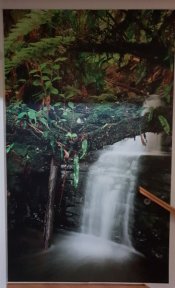
I have printed this photograph to 5x7" at the small extreme and 2.70 metres tall at the biggy end. A 5x7" print is $2.40. Permatex wallpaper (one full sheet, relocatable) is $400, and more small to medium size prints have been sold than wallpaper, for obvious reasons of economics and that fact that many viewers of this work do not have a wall they can cover like this! Is it the size that moves people? No, it is not, but people cannot deny what they see in front of them by size that might otherwise be missed (which is common). Whatever size people see of this work, it always illicits amazement, not because of the size (which is impressive for 10mpx -- we could have gone much higher, but the roof would need to be raised!), because of the story behind the image -- a rigorous trek through rainforest, and most in the party couldn't see the potential for this hitherto hidden scene. Except me! :smile:

06_18_18_01_39_53_20180618_133923.jpg
 
Last edited:
Photrio.com contains affiliate links to products. We may receive a commission for purchases made through these links.
To read our full affiliate disclosure statement please click Here.

PHOTRIO PARTNERS EQUALLY FUNDING OUR COMMUNITY:


Ilford ADOX Freestyle Photographic Stearman Press Weldon Color Lab Blue Moon Camera & Machine
Top Bottom