
• Welcome to Photrio!
    Registration is fast and free. Join today to unlock search, see fewer ads, and access all forum features.
    Click here to sign up

Has any photographer depicted war with artistic intent?

Recent Classifieds

Forum statistics

Threads
202,673
Messages
2,843,933
Members
101,459
Latest member
ldbrousseau
Recent bookmarks
0
I don't disagree re: Goya but I do think it's long past the time when we deserve to see "artistic intent" in war photos.

Bob Carnie provided a good example.

Admitting that one doesn't know what "artistic intent", or some other idea "means" is both honorable and reasonable.

I am really not sure that Carnie's example proves the point about "artistic intent". Assuming that any war photographer has the ability to take reasonable good pictures and there are some photographers who just seem to have an innate talent for composition that always seems to be a part of every shot, this does not mean that they had an "artistic intent", by which I assume that you mean that they intended to create a work of Art (intentionally in caps) rather than presenting the conditions of war as well as they could under difficult circumstances. Or do you mean that after taking pictures the photographer selected those that were considered the best of the lot that they considered to be noteworthy pictures (This would seem to be the circumstances of Carnie's example). I believe that the question is not what I believe the expression "artistic intent" means but what you believe "artistic intent" means. That is what I am still not very clear about. Among my artist friends, unfortunately most of them "late friends", all represented in many of the great museums of the world, I don't remember ever hearing the expression "artistic intent" ever being used.
My own candidate for war pictures is Letizia Battaglia's pictures of the Mafia wars in Sicily. Her pictures resulted in the conviction of a number of Mafiosi, including a Prime Minister. Not beautiful pictures but they give expression of the terror that Sicilians lived under. But did they have "artistic intent" or some other intention?
May I suggest a book: "Intention" by the philosopher G.E.M. Anscombe. I read it when published in 1957, so I am not sure if still in print.
 
I am really not sure that Carnie's example proves the point about "artistic intent". Assuming that any war photographer has the ability to take reasonable good pictures and there are some photographers who just seem to have an innate talent for composition that always seems to be a part of every shot, this does not mean that they had an "artistic intent", by which I assume that you mean that they intended to create a work of Art (intentionally in caps) rather than presenting the conditions of war as well as they could under difficult circumstances. Or do you mean that after taking pictures the photographer selected those that were considered the best of the lot that they considered to be noteworthy pictures (This would seem to be the circumstances of Carnie's example). I believe that the question is not what I believe the expression "artistic intent" means but what you believe "artistic intent" means. That is what I am still not very clear about. Among my artist friends, unfortunately most of them "late friends", all represented in many of the great museums of the world, I don't remember ever hearing the expression "artistic intent" ever being used.
My own candidate for war pictures is Letizia Battaglia's pictures of the Mafia wars in Sicily. Her pictures resulted in the conviction of a number of Mafiosi, including a Prime Minister. Not beautiful pictures but they give expression of the terror that Sicilians lived under. But did they have "artistic intent" or some other intention?
May I suggest a book: "Intention" by the philosopher G.E.M. Anscombe. I read it when published in 1957, so I am not sure if still in print.


guangong, I don't think "artistic intent" is a difficult idea for people who talk about art (whatever that is).

Someone wiyh what you call "innate talent" (by your standards) probably doesn't have "artistic intent" if s/he doesn't call her/himself an artist.

A dead painter doesn't have "artistic intent" but he probably did...wouldn't you agree?

Did Battaglia shoot intending produce art? If not he didn't have artistic intent....whether or not he produced the "beautiful pictures" that some think have to do with art.

WeeGee is still popular at galleries and he considered himself an artist...do you think he's an artist? He went out intentionally to produce expressive/evocative pictures...What do you think? What would your "late friends" have said?
 
Last edited:
Weegee’s best work was not done when he donned the moniker of artist, but when he was out shooting news and human interest pictures. His “artistic “ pictures, done with distortion lenses are rather dull. One of the dangers of becoming a celebrity. It’s best if one does what one does best. According to one of my best friends, who helped Weegee’s widow rescue his negatives and compiled a book of Weegee’s pictures, came to the realization that while he was very unsure of composition he was able to document life, death and everything in between with his own unique style. That is what made Weegee special.
By the way Letizia is a woman’s name.
You still haven’t told me what you mean by “artistic intent”. I have heard artist friends say, “Well, I really didn’t intend to do that”. Usually said about something good that happened by accident, or “What I really intended...”, usually when things things don’t turn out as expected, but “artistic intent” is when people talk about art ( whatever that is). Beats me!
 
Sounds like you're uncomfortable with photography as art. That's ok with me...I often have reservations about art claims as well.

I won't say that I disbelieve your claims about your dead or otherwise unknown experts...but I don't think you've expressed any idea on your own. Please try again...I may not be too dense to see value there.
 
Let's face it, war is photogenic and often produces beautiful pictures.

And BTW, I believe that Mr. Nachtwey has a degree in art history.
 
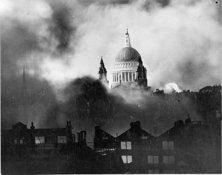
An Iconic picture of St Pauls during the blitz, has some artistic merit I think.
photographer Herbert Mason
1 Air_Raid_Damage_in_Britain_during_the_Second_World_War_HU36220A.jpg
 
Sounds like you're uncomfortable with photography as art. That's ok with me...I often have reservations about art claims as well.

I won't say that I disbelieve your claims about your dead or otherwise unknown experts...but I don't think you've expressed any idea on your own. Please try again...I may not be too dense to see value there.
This has little to do with "artistic" war pictures but in my lifetime I have known at least one person who "made art" every time he took a photograph. He was born into an "art" household. His father was a painter and his mother was a concert pianist. He grew up with "composition". Many times he did not realize that every time he tripped the shutter, developed the film and made a print, it was a "work of art". I would look at his pictures and marvel and he would say that he worked on making a print until it looked "right". If he shot a "war" picture, it would be artistic because the knew no other way. You may scoff but these people do and have existed. I was proud to consider him a good friend. He moved away, became a photographer for a religious organization. I am sure he probably is no longer alive........Regards!
 
image.jpeg image.jpeg Yeah, I thought about Jeff Wall too, he's great!

Have a loo at this also:
David Levinthal and Gary Trudeau "Hitles moves east"
Martha Rosler "Red stripe kitchen, from bringing the war home ..."
Robert Heinecken "Periodical No. 5"
Brassai, a photograph that could represent something like war.


Of course, there is also documentary photography, like Gilles Peress, which can be seen as art. (But then, what is the definition of art...)
 
Sounds like you're uncomfortable with photography as art. That's ok with me...I often have reservations about art claims as well.

I won't say that I disbelieve your claims about your dead or otherwise unknown experts...but I don't think you've expressed any idea on your own. Please try again...I may not be too dense to see value there.

You have still not defined “artistic intent”! Is this your own original idea? Sounds like something only an academic could come up with. My comments have nothing to do with whether photography is art or not, but with your ideas regarding “artistic intent”, which seems to me to explain nothing.

By the way, a number of years ago, as a member of a group of photographers based in NYC, I put together an evening forum of volunteer participants that included Ralph Gibson, Dwayne Michaels, Lou Stettner, Eve Rubinstein, and Roy DeCarava. Quite a mix of approaches to the art of photography. A great evening enthusiastically and aggressively discussing the art of photography . So, while perhaps not as profoundly knowledgeable as you about art, including photography, I do have a a little familiarity with art, including photography.
 
The intent to make art arises in the artist. Regardless of what artifact results, if the intent was an expression of art, it is therefore art to the artist.

External criticism, for example someone saying, "Hey, that ain't art," is irrelevant to the original intent. From the outside, it may not be obvious that the artifact in question, say a photograph, was intended to be art or not. Without direct knowledge expressed by the creator, the world has to guess. Looking at some particular photograph, it certainly may not be obvious what intentions were behind it. So, artists have some responsibility to make their intentions understood. This is more true with photography than say painting, because there aren't so many documentary painters, or journalistic painters.
 
Most war photography is made under conditions of commercial pressure, the photographer is there because he has a contract with a press agency, the artistic intent would seem to consist of meeting the requirements of the picture editors and publishers "back home". Having your images chosen by the higher paying publishers might constitute reward for the application of this artistic intent.

Some of the photomontage work done by John Heartfield in the 1930s might qualify as having artistic intent. He combined photographic images of military subjects with text to attack the Nazis https://en.wikipedia.org/wiki/John_Heartfield
 
The intent to make art arises in the artist. Regardless of what artifact results, if the intent was an expression of art, it is therefore art to the artist.

External criticism, for example someone saying, "Hey, that ain't art," is irrelevant to the original intent. From the outside, it may not be obvious that the artifact in question, say a photograph, was intended to be art or not. Without direct knowledge expressed by the creator, the world has to guess. Looking at some particular photograph, it certainly may not be obvious what intentions were behind it. So, artists have some responsibility to make their intentions understood. This is more true with photography than say painting, because there aren't so many documentary painters, or journalistic painters.

Very good remarks and also to the mark! Although one could say that the artist, having created a given work, has already stated his intention and if intention is not understood the work perhaps doesn’t work. But then perhaps the viewer or listener is at fault. Art is a conversation between work and viewer. One of my best friends was a combat photographer during WWII in both European and Pacific theatres who had those remarkable eyes that always produced a well composed picture (like a musician with perfect pitch), but while the question never came up, I really doubt if at that time he was primarily interested in producing a work of art in battle situations although of course some images could have the power to be considered art because of their ability to communicate something to the viewer. Since he was a soldier, film must have been government property so he probably never saw any of the images that he shot.
 
You have still not defined “artistic intent”! Is this your own original idea? Sounds like something only an academic could come up with. My comments have nothing to do with whether photography is art or not, but with your ideas regarding “artistic intent”, which seems to me to explain nothing.

By the way, a number of years ago, as a member of a group of photographers based in NYC, I put together an evening forum of volunteer participants that included Ralph Gibson, Dwayne Michaels, Lou Stettner, Eve Rubinstein, and Roy DeCarava. Quite a mix of approaches to the art of photography. A great evening enthusiastically and aggressively discussing the art of photography . So, while perhaps not as profoundly knowledgeable as you about art, including photography, I do have a a little familiarity with art, including photography.

Sorry you don't like the phrase. Perhaps it's too common for you. Perhaps you are incapable of addressing the question.

Dragging names of popular photographers into the discussion seems outright unethical, since they evidently had nothing to say about "artistic intent." Yes, you do know the names of big name photographers (from another era), but use of those names doesn't relate to the OT. Does it?
 
I don't know what was going on in the minds of the war photographers when they made their images, so it is hard to say which one's had artistic intent and which ones did not. I don't think you can make that determination after the fact unless the photographer is on the record one way or the other.
 
I don't know what was going on in the minds of the war photographers when they made their images, so it is hard to say which one's had artistic intent and which ones did not. I don't think you can make that determination after the fact unless the photographer is on the record one way or the other.

faberry, yes, your point is reasonable...

However, as we see in a number of posts in this thread, some of us do recognize art, some recognize artistic intent...

Others refrain from, or are afraid to express their own ideas...

Some defer to asserting that various photographers are "artists" because they have art degrees or appear in college presentations...or have appeared in Popular Photography etc.

Importantly, some photographers produce both what they call art along with their professional non-art and aren't afraid to say that. Ansel Adams was one example, and I've personally known many others (often with degrees from RIT).
 
However, as we see in a number of posts in this thread, some of us do recognize art, some recognize artistic intent...Others refrain from, or are afraid to express their own ideas...Some defer to asserting that various photographers are "artists" because they have art degrees or appear in college presentations...or have appeared in Popular Photography etc. Importantly, some photographers produce both what they call art along with their professional non-art and aren't afraid to say that. Ansel Adams was one example, and I've personally known many others (often with degrees from RIT).
You may recognize resulting images as art or infer that photographer had artistic intent, but, without more, that is just post facto categorization. The most important factor is what the photographer intended at the time he made the images. Some you can guess, like the linked photographer who used IR film. Presumably that was intentional, and the photographer intended to go beyond (mere) documentation, though it just seems to be different for the sake of being different.
 
Last edited:
The intent to make art arises in the artist. Regardless of what artifact results, if the intent was an expression of art, it is therefore art to the artist.

External criticism, for example someone saying, "Hey, that ain't art," is irrelevant to the original intent. From the outside, it may not be obvious that the artifact in question, say a photograph, was intended to be art or not. Without direct knowledge expressed by the creator, the world has to guess. Looking at some particular photograph, it certainly may not be obvious what intentions were behind it. So, artists have some responsibility to make their intentions understood. This is more true with photography than say painting, because there aren't so many documentary painters, or journalistic painters.
Shouldn't the photographer's work speak for itself and leave it to the viewer to decide whether it is "art" or not? Or are all the viewers too stupid to make that determination because they might not be photographers. I have seen that attitude voiced by entrants in photographic salons where one judge out of three was a professional "paint" artist. in an attempt to insure that some of the pictures might not be completely judged on photo-technique alone. In this group, must you be a photographer to recognize photographic "art"?.......Regards!
 
This reminds me of photographer Joshua Corbett, who photographed Dead Link Removed. I haven’t read why he chose to use a plastic camera in a war zone, but the fact that he did so seems to indicate that he did so with artistic intent.
 
This reminds me of photographer Joshua Corbett, who photographed Dead Link Removed. I haven’t read why he chose to use a plastic camera in a war zone, but the fact that he did so seems to indicate that he did so with artistic intent.
Some fantastic picture there Rachelle, specially like the last.
 
Sorry you don't like the phrase. Perhaps it's too common for you. Perhaps you are incapable of addressing the question.

Dragging names of popular photographers into the discussion seems outright unethical, since they evidently had nothing to say about "artistic intent." Yes, you do know the names of big name photographers (from another era), but use of those names doesn't relate to the OT. Does it?

You have still not defined what you mean by “artistic intent”. Since you seem unable to do that, or assume that I’m to dense to understand your massive intellect, let’s drop the discussion.
If you live long enough a lot of your friends will be referred to in the past tense.
 
Shouldn't the photographer's work speak for itself and leave it to the viewer to decide whether it is "art" or not?

Viewers can decide if they like some art or not, but they can not declare what is or isn't art. i.e. you can't pull that choice from the artist.
 
Viewers can decide if they like some art or not, but they can not declare what is or isn't art. i.e. you can't pull that choice from the artist.

Declarations would be foolish...however speculations, like questions, can inspire thought and seeing...which are good things. Questions suggest intelligence.
 
Declarations would be foolish...however speculations, like questions, can inspire thought and seeing...which are good things. Questions suggest intelligence.

One interesting thing I've heard: anything that makes you stop, even for just a second, to question if it's art or not, most surely is.
 
Photrio.com contains affiliate links to products. We may receive a commission for purchases made through these links.
To read our full affiliate disclosure statement please click Here.

PHOTRIO PARTNERS EQUALLY FUNDING OUR COMMUNITY:


Ilford ADOX Freestyle Photographic Stearman Press Weldon Color Lab Blue Moon Camera & Machine
Top Bottom