
• Welcome to Photrio!
    Registration is fast and free. Join today to unlock search, see fewer ads, and access all forum features.
    Click here to sign up

Harman Red new film

Filling In

H
Filling In

  • 1
  • 1
  • 9
Painted Hills # 3.jpg

H
Painted Hills # 3.jpg

  • 4
  • 0
  • 71

Recent Classifieds

Forum statistics

Threads
203,208
Messages
2,851,369
Members
101,721
Latest member
rptn
Recent bookmarks
0
It'll affect sharpness a little. Not as much as you may think, though. There's basically just a very limited focus shift that in many cases drops away against effects like depth of field - and user variability. I've tried red-scaling film on occasion; sharpness turned out OK. Keep in mind it's only something like 110um shift on the focal plane.

I have been thinking of a 1/10 of a mm deviation and from a technical view at least this should be off a lot. When a lens is collimated, i think it`s done down to a few um. Also i have an old camera where the pressure plate offers pretty exactly 0.1mm deviation - and as the old lens does not produce as much DOF, focus is off by like 10ft. When focusing at about 50ft and aperture around f11.
Close-up range should be even worse.

You can always compensate for this effect by turning the focus ring a few hundredth of a degree away from infinity. Jokes aside, people who shot red scale rarely care about sharpness. If anything critical sharpness is detrimental to "the look".

I'm aware... in fact i once had a camera where the lens wasn`t collimated properly or the groundglass got out off alignment - and i did just that. After focusing on the glass i always turned the focusing ring for about 1mm - and it worked.

But i see that people doing red scale don`t care about sharpness in the first place - this technical aspect just gotten into my mind and as no-one had mentioned it before...
 
I'm sure this is a really neat film and millions and millions of people are going to rush out to buy some. But wouldn't it have been much better to start making a real infrared film instead? It isn't like the recipe for making it hasn't been around for 75 years. But I understand. NASA keeps planning a new moon trip some day with an all new rocket, as soon as they can figure out a way to make one work as well as a Saturn.
 
But wouldn't it have been much better to start making a real infrared film instead?

Do you mean this in relation to 'redscale' film in particular, or just a general preference of yours? There's of course no relation at a technical level between redscale and infrared film.
 
Since my first try with Phoenix in E3 turned out much too blue this would be veeery interesting!
YT channel Attic darkroom actually has done this - see his take on Red. Very contrasty with very little latitude.
 
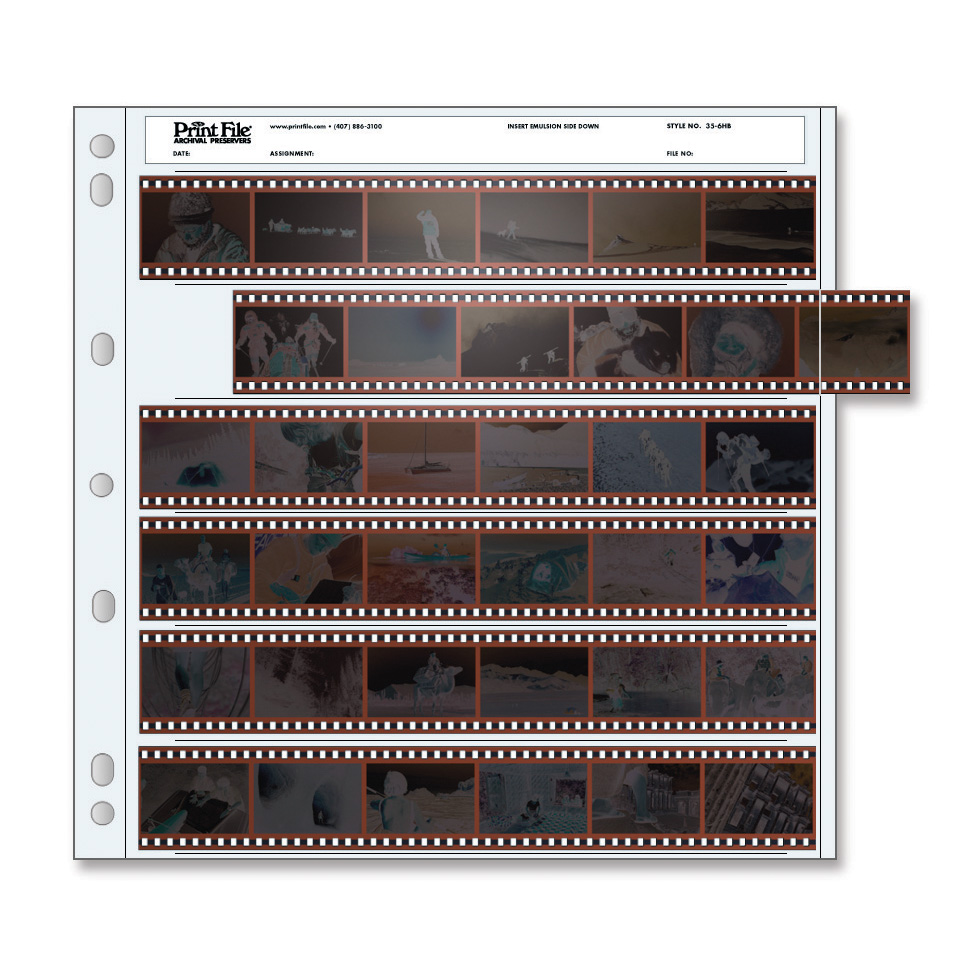
Speaking of sleeves. Why do we have 36 exposure film when only 35 exposures will fit a contact sheet from a Printfile. Now that's an important topic. 😅

The sleeves I buy take 7 strips of 6 frame width, although they don't contact print to 8x10. https://www.printfile.com/product/35-7bxw_25/

The 6x6 pages claim to contact to 8 1/2x11, although that's also not a paper size I generally see outside office printing paper...I suppose the folks cutting RA4 off bulk rolls could do it. Ilford apparently makes it and it's only a little more expensive than 8x10 https://www.bhphotovideo.com/c/product/1527758-REG/ilford_1179970_multigrade_rc_deluxe_paper.html


BTW, I buy the 7 strip pages because most of my cameras will shoot 37 or 38 frames on a roll. I always end up doing some quick mental math toward the end of the roll since the strip feeder on my scanner likes 3 frame strips
 
The sleeves I buy take 7 strips of 6 frame width

I've used those same sleeves too, forever. Binder after binder of them, with the 7th row usually containing just one or two frames, if any...
 
I'm sure this is a really neat film and millions and millions of people are going to rush out to buy some. But wouldn't it have been much better to start making a real infrared film instead? It isn't like the recipe for making it hasn't been around for 75 years. But I understand. NASA keeps planning a new moon trip some day with an all new rocket, as soon as they can figure out a way to make one work as well as a Saturn.

Have to walk before you can run. Lomo hipsters inadvertently funding R&D of an eventually-serious film is a win.
 
The sleeves I buy take 7 strips of 6 frame width, although they don't contact print to 8x10. https://www.printfile.com/product/35-7bxw_25/

The 6x6 pages claim to contact to 8 1/2x11, although that's also not a paper size I generally see outside office printing paper...I suppose the folks cutting RA4 off bulk rolls could do it. Ilford apparently makes it and it's only a little more expensive than 8x10 https://www.bhphotovideo.com/c/product/1527758-REG/ilford_1179970_multigrade_rc_deluxe_paper.html


BTW, I buy the 7 strip pages because most of my cameras will shoot 37 or 38 frames on a roll. I always end up doing some quick mental math toward the end of the roll since the strip feeder on my scanner likes 3 frame strips

I usually burn a couple of frames so everything will fit on a 5x7 Printfile 🤔
 
I usually burn a couple of frames so everything will fit on a 5x7 Printfile 🤔
That works too! We all have our solutions.
I've used those same sleeves too, forever. Binder after binder of them, with the 7th row usually containing just one or two frames, if any...

The lab I used in the mid-2000s stocked them as their only Printfile, but for whatever reason the camera stores near me only ever carried the 5x7s or occasionally 6x6s.

I've heard at least one person say they don't like the 6x6/6x7 pages as they stick out of a standard binder. That's true, but generally if you move up to a larger size binder(say 3" or so), especially a D ring one, they will fit. I've never needed to buy the special Printfile binders for them.

Actually truth be told, at least once a month someone at work will decide to clear out a bunch of old binders, sometimes nice heavy duty ones that once contained textbooks or the like. Usually those get piled by a garbage can under a "Free, please take" sign. When that happens, I grab all the good heavy duty binders I can get. I haven't actually bought binders in years...
 
I'm sure this is a really neat film and millions and millions of people are going to rush out to buy some. But wouldn't it have been much better to start making a real infrared film instead? It isn't like the recipe for making it hasn't been around for 75 years. But I understand. NASA keeps planning a new moon trip some day with an all new rocket, as soon as they can figure out a way to make one work as well as a Saturn.

I think the idea is to add an effect film to the product range, not a true infrared film. They call it Redscale as the dominant color is red, but it is probably not meant to be or imitate an infrared film.
Apart from being a different emulsion and needing quite some funds to do an infrared film, it also is more problematic in use as infrared films should be stored rather cool to prevent fogging of the heat-sensitive emulsion. This here is probably meant to be a fun-film, easy use etc. .
 
It's amusing how many people see Red and think Aerochrome. Is the understanding of EM spectrum realy this poor or does Phoenix 200 has some extended red sensitivity?
 
Is the understanding of EM spectrum realy this poor or does Phoenix 200 has some extended red sensitivity?

Neither. Aerochrome has a clear base, fine grain and adequate characteristic curves. These properties make it a good alternative to Red for shooting through the base (red-scaling). I have not seen any examples of red-scaled Aerochrome and suggested that this would be a nice comparison.

@F4U's question concerning infrared film being a more welcomed addition to the film market is not related to the spectral sensitivity of the new Harman film. That said, comparing the datasheets of Red and SFX200 one does notice that the spectral sensitivity of Red goes beyond that of "conventional" film (see SFX 200 datasheet).

I think we are all slightly disappointed that Harman was unable to make any noticeable progress towards proper color negative film over the past year and chose to release a "flipped over" version of Phoenix. If their next year release happens to be "slide" film (cross-processed Phoenix) they will lose my support completely.
 
I think we are all slightly disappointed that Harman was unable to make any noticeable progress towards proper color negative film over the past year and chose to release a "flipped over" version of Phoenix. If their next year release happens to be "slide" film (cross-processed Phoenix) they will lose my support completely.
While I completely get the sentiment - the traditional stock is up there, going strong and isn't taken down or affected whatsoever - I say let them have some fun and have some money from lomo clientele as that doesn't degrade anything - just expands.

And color me red - I'm not disappointed or impressed. Harman doesn't owe me nothing and I'm not feeling entitled. It just is there, exists - an option for those who will appreciate this. Life is better outside the Hype Train.
That said - I'd be impressed if Ilford would extend the IR sensitivity of SFX 200 to say 900nm - I'd buy that on a whim!
 
Last edited:
..........

I think we are all slightly disappointed that Harman was unable to make any noticeable progress towards proper color negative film over the past year and chose to release a "flipped over" version of Phoenix. If their next year release happens to be "slide" film (cross-processed Phoenix) they will lose my support completely.

I agree. They claimed (just a marketing ploy?) that the original Phoenix was a 12-month start-to-finish project and 14 months later have the sole "innovation" of rolling the film inside out in the cassette. And yes, we can look forward to a "new slide film" from Harman, cross-processed original Phoenix 200. If Harman were genuinely working on improving Phoenix, they would already have produced Phoenix 2 a few months ago. I suspect their marketing department have told the techies: let's milk this rubbish for all its worth!

Meanwhile, Lucky Film, Light Lens Lab and doubtless other companies (Adox?) are beavering away trying to produce quality products for us ... not always succeeding of course, but at least trying to make something decent.
 
If Harman were genuinely working on improving Phoenix, they would already have produced Phoenix 2 a few months ago.

I still hope they are, but facing some (predictable) difficulties. Not being transparent about the next incarnation of Phoenix is not a good sign especially considering that we the consumers are funding this development, at least partially.

With Lucky Film and others joining the race towards film shooters' money the situation is becoming more interesting. Could this be the reason why Harman decided to "innovate" and capitalize on what they already have?
 
that we the consumers are funding this development, at least partially.
How come? Please explain your logic. Does Harman have a startup at kickfarter and similar platforms - promising gold from direct funding, but delivering nothing?
 
How come? Please explain your logic.

I got this impression from reading the thread on Harman Phoenix:
and watching multiple reviews on Youtube.

A lot of people said something along the lines of "this film is pretty bad, I have no real use for it, but I'll buy and shoot some more hoping that it'll get better, eventually".

They did not promise gold and they did deliver something resembling a color negative film. In the world of Minimal Viable Products Harman is doing quite well.
 
Photrio.com contains affiliate links to products. We may receive a commission for purchases made through these links.
To read our full affiliate disclosure statement please click Here.

PHOTRIO PARTNERS EQUALLY FUNDING OUR COMMUNITY:


Ilford ADOX Freestyle Photographic Stearman Press Weldon Color Lab Blue Moon Camera & Machine
Top Bottom