• Welcome to Photrio!
    Registration is fast and free. Join today to unlock search, see fewer ads, and access all forum features.
    Click here to sign up

Guessing long exposure reciprocity failure!

Tractor & Tulips

A
Tractor & Tulips

  • 1
  • 1
  • 26
Tree with Big Shadows

Tree with Big Shadows

  • 3
  • 0
  • 80

Forum statistics

Threads
203,457
Messages
2,855,055
Members
101,853
Latest member
DJFOX
Recent bookmarks
0
I am actually using light meter but since the data sheet shows only up to 30sec, I will have to guess longer exposures anyway.

I find hard to understend.

Marcio,

Since you are using Delta 100, why not just try the times Bond suggests and not worry about figuring out the entire article in a foreign language.

Here they are:

100 Delta (times in seconds)
Indicated -- Give
1 --- 1
2 --- 2
4 --- 4.5
8 --- 9
15 --- 19
30 --- 41
60 --- 93
120 --- 230
240 --- 560

For longer times, you can extrapolate easily if you use graph paper and just extend the line upwards. If you can't do that, try the times below, which I got from an astronomy photography web site

10 min --- 30 min
20 min --- 1 hr 10 min
1 hr --- 3 hr


All of these times should be approximately valid for all Delta and T-Max films and can serve as starting points. For "conventional" films (Tri-X, FP-4 etc.), try multiplying the above times by 1.6 to find a starting point.

Best,

Doremus
 
Doubling the time to double the exposure doesn't always work that way in long exposures. Reciprocity failure may require more than double the time to double the exposure. With some films, there is a quite significant increase in required time when doubling the exposure.

Jim,

Yes, of course you are right! I was intentionally over-simplifying to make a point without adding in the complexity of reciprocity adjustments, which, of course, make added time even less of an issue.

But, keep in mind that for overexposing a film, although the original exposure was adjusted for reciprocity, the extra exposure functions neither linearly nor according to the reciprocity adjustment curve for the correct exposure...

Best,

Doremus
 
I find hard to understend.

This is the important part.

Dead Link Removed

Ilford Delta 100 is one of the films where you take your meter reading in seconds, and then use the exposure time that Bond lists as your shutter time.

Easy peasy.
 
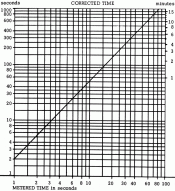
Several editions of Kodak Professional Black-and-White Films included a reciprocity correction chart. Due to the inexplicable gulf between some photographic engineers and practical photographers, the chart has linear horizontal and vertical scales. Much more logical are log scales. This revised chart is for many Kodak films of a few decades ago. If testing indicates errors in the chart, it might be corrected with a simple straight line. The straight line on the chart follows the formula T=(t/1.6) raised to the 1.4 power where T = the corrected exposure time and t= the metered time.
 

Attachments

  • RecipCor05a.gif
    RecipCor05a.gif
    194.9 KB · Views: 147
Thank you Doremus Scudder and Thomas Bertilsson.

I actually went out today and shoot my first sheet of Delta 100. I used the table given by Mr.Pinhole.

It was a dark day and the reciprocity pointed to 2h (or 32min) exposition. Then I shot at ISO 400 to get about 12m exposition.

I just finish developing it with Ilfortec HC and I had to estimate the development time since the massive chart didn't had it at ISO 400. I developed for 12min and now the negative is drying and as far as I can tell it looks ok.

So it seems the Mr.Pinhole reciprocity chart is accurate.
 
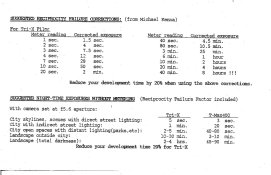
Michael Kenna's exposure guide:
 

Attachments

  • Kenna's Night Exposure Recomendations_Page_1.jpg
    Kenna's Night Exposure Recomendations_Page_1.jpg
    169.8 KB · Views: 169
For my limited expérience with pinhole,
I found a good exposure 1 hour, f250, HP-5+(4X5) in my office. Mix of daylight and fluorescent light. Easy to print.

I hope this help.

Normand
 
You can but you should probably expect a lot of failures during the learning experience. Bracketing a lot will help insure you end up with something usable.

my rules of thumb are:
1. small exposure increases are a waste of time and altering light intensity is better than extending exposure time;therefore I at least double the measured exposure and triple it as a bracket;just in case. opening the aperture a stop does more than doubling the time.:smile:
 
Chart

The attached is a chart based on Bond's testing as mentioned in this thread. The numbers are calculated using a modified version of Patrick Gainer's formula in a follow up article in PhotoTechniques that gave a mathematical model that fit Bond's data very well. Unfortunately Mr. Gainer is no longer able to participate on the forum.

I've posted versions of this here before, but it's been a while. The chart includes Delta 100 I know a number of people who have used this chart, and all report excellent results. I've used it myself for some pinhole work. Notes are at the bottom of the chart.

Lee
 

Attachments

  • BondReciprocity.pdf
    17 KB · Views: 172
Photrio.com contains affiliate links to products. We may receive a commission for purchases made through these links.
To read our full affiliate disclosure statement please click Here.

PHOTRIO PARTNERS EQUALLY FUNDING OUR COMMUNITY:


Ilford ADOX Freestyle Photographic Stearman Press Weldon Color Lab Blue Moon Camera & Machine
Top Bottom