• Welcome to Photrio!
    Registration is fast and free. Join today to unlock search, see fewer ads, and access all forum features.
    Click here to sign up

Gridless Sinar ground glass?

Maniqui

D
Maniqui

  • 0
  • 0
  • 0
Redwood Park

A
Redwood Park

  • 4
  • 0
  • 53

Recent Classifieds

Forum statistics

Threads
203,572
Messages
2,856,608
Members
101,908
Latest member
lokiloki
Recent bookmarks
0

Dazzer123

Member
Allowing Ads
Joined
May 30, 2023
Messages
128
Location
Amsterdam
Format
4x5 Format
Hi folks,

The grid on my Sinar ground glass is pretty distracting.

I have a spare metering back, i was wondering if it's possible to buy a gridless ground glass to put in there as an alternative?

Does such a thing exist, or would i need to either order a custom one or even make it myself?

Perhaps the grid is removible? (is it paint?) If so, i could just buy one offa Ebay and remove it myself.

Thanks for your time!
 
The ground glass on a Sinar can easily be replaced. Just locate any seller who offers one to your taste. And yes, the lines can be rubbed/scratched off of a ground glass. DIY-ing a GG is perfectly feasible but commercially made ones will generally be brighter and finer grained.
 
The dotted lines show the asymmetric tilt and swing axes. The grid lines can be rubbed off, and this has been a complaint of many long time users.

Kumar
 
OK!

Well their complaint is my good luck! I'll look for one on Ebay.

Are there different grades or qualities of Sinar ground glass? Any pitfalls to be aware of?

I'm curious, how do people manage to rub off the grid, surely it's not something you're really gonna touch on a regular basis?
 
Without the axes lines, you lose the references for the tilts and swings, which sort of negates one of the advantages of the Sinar P2. The grid also helps in aligning vertical and horizontal lines in your subject.
But hey, it's your camera, and you can do whatever you want with it.

Just spray some IPA on a microfiber cloth and rub on the lines.

Kumar
 
Are there different grades or qualities of Sinar ground glass?

Mind that the ground glass doesn't have to be Sinar. It's really just a piece of glass in a frame. There are probably plenty of sellers of '3rd party' ground glasses.

I'm curious, how do people manage to rub off the grid, surely it's not something you're really gonna touch on a regular basis?

The lines are generally on the smooth side, facing the photographer. It's easy to drag a loupe or dark cloth across them. They wear away over time as a result.

I'm with @B.S.Kumar with it that getting rid of the lines is probably not a good idea. It sounds to me you're relatively new to using a view camera and there's a good chance that you'll figure out soon enough that the grid serves a purpose. I wouldn't want to trade the gridded ground glasses on my view cameras for unmarked ones!
 
Cheers!

Like i already mentioned, i have a spare metering back, so it doesn't need to be either / or, i can quickly swap out one for the other.

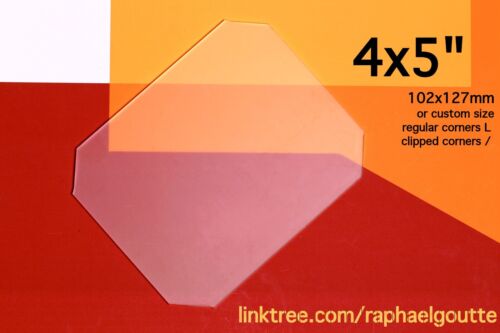
After a little more searching on the Ebays, i see a few people selling gridless ground glasses, so i'll probably pick up one of these:

 
Sorry, one other question for which i won't bother making a new thread: I'm using an old Pentax-M 1:1.7 50mm lens as a loupe, which works great.

But one thing that slightly worries me is the possibility of radioactivity in the lens if i'm constantly hold it right against my eye.

Are there any resources with a list of radioactive lenses? Is a geiger counter something a vintage lens shop would generally have lying around?

Thanks!
 
Perhaps the grid is removible? (is it paint?) If so, i could just buy one offa Ebay and remove it myself.

Just hold the glass under your faucet and rub it gently with your finger. The lines comes off super easy.
 
GBut one thing that slightly worries me is the possibility of radioactivity in the lens if i'm constantly hold it right against my eye.

Don't worry. That lens does not use thorium glass. It's not radioactive.

Even if it were, the minimum amount of time you actually spend holding it up to your eye won't constitute any danger. You mention 'constantly' holding it up to your eye, but if you actually do the math on how many minutes per year that really boils down to and what kind of radiation dose you'd typically get from a thorium lens element that way, the conclusion would very firmly be that it's not a concern.

re there any resources with a list of radioactive lenses?

Google turns up lots of stuff if you search for a lens and add 'radioactive' to it.
 
I also agree with swapping out a plain ground glass rather than removing the grid from a GG. It is easy to make a plain GG, but harder to put a good grid on.

A lens as late as your Pentax-M won't be radioactive. Highly thoriated lenses mostly date from around the time of Pentax Spotmatics and so on (1960s-early 1970s). There are many lists of radioactive lenses on the web, but some of them are very unreliable. Here's a discussion of the subject from a reliable source at Oak Ridge: https://www.orau.org/health-physics.../products-containing-thorium/camera-lens.html Their list doesn't contain every lens reputed to be radioactive but mentions some of the more common ones.

Thoriated glass was banned from use in eyepieces, but the concern was professional use like a TV cameraman that would have their face to the eyepiece all day, not looking at a ground glass for a minute at a time.
 
Without the axes lines, you lose the references for the tilts and swings, which sort of negates one of the advantages of the Sinar P2. The grid also helps in aligning vertical and horizontal lines in your subject.
But hey, it's your camera, and you can do whatever you want with it.

Just spray some IPA on a microfiber cloth and rub on the lines.

Kumar

hi Kumar. what is IPA thanks!
 
Hi folks,

I bought a new ground without markings glass offa Ebay (around 25 euro + post)...... (with unclipped corners..... scary! 😅)

Question: I notice that the (newly manufactured) GG has thicker glass, and is less opaque.

So if i hold it a few centimeters from a well-lit object, i can actually see the object's details, albeit very faintly.

If i hold the original Sinar GG at the same distance, there's no details discernable, only completely diffuse areas of color.

So this brings me to awondering: how can you judge the quality of a GG? I would guess that thinner and more opaque means better quality, but i really have no idea.

Obviously i can just try them out and see for myself, but the approx. 5 minutes it takes to change the GG means that i may be unable to draw a conclusion if the difference is too subtle.

Thanks!
 
The fineness of grind of the ground glass affects the brightness, opacity, and the degree to which the in-focus image "pops" into focus. The limiting case of course is a nearly smooth surface, which would be clear, super bright, and not really help you to focus [*]. It's not simply better or worse quality, but a matter of what works for you. Just be sure to get the new glass mounted the same way around as the old glass. Usually the ground side goes toward the lens and is pressed against a fiducial surface so that the thickness of the glass substrate doesn't matter, but the exact scheme differs.


[*] On a clear glass with a grid or crosshairs, one can focus on an aerial image, but this is a technique for experienced users in special situations, such as astrophotography or microscopy.
 
It’s hard to tell if one ground glass is better than another because of the psychological effect called change blindness.

You can make it easier to see the difference by setting your f stop to the highest possible value that still barely produces a visible image then switching the backs. If the second back is dimmer you will not be able to discern the image.

The brightness of the screen is only one factor in its quality though.
 
There is a "sweet spot" in terms of the ideal grind to a glass. Too fine, and you get hot spots. My favorite glass is Satin Snow (no longer available), and my second most favorite is Sinar glass itself. Incidentally, I hate accessory fresnel lenses, and never use them. With an ideal glass grind, the focus just seems to snap into place using a moderate magnifying loupe or 4X to 7X. Grid lines have been removed from my ordinarily use ground glasses on all my view cameras, because I too regard that as distracting. But I do keep a gridded Sinar glass stored in reserve if I ever really need it.
 
Photrio.com contains affiliate links to products. We may receive a commission for purchases made through these links.
To read our full affiliate disclosure statement please click Here.

PHOTRIO PARTNERS EQUALLY FUNDING OUR COMMUNITY:


Ilford ADOX Freestyle Photographic Stearman Press Weldon Color Lab Blue Moon Camera & Machine
Top Bottom