
• Welcome to Photrio!
    Registration is fast and free. Join today to unlock search, see fewer ads, and access all forum features.
    Click here to sign up

Greeting card masks

Somewhere...

D
Somewhere...

  • 5
  • 2
  • 112
Iriana

H
Iriana

  • 8
  • 1
  • 179

Recent Classifieds

Forum statistics

Threads
202,753
Messages
2,845,134
Members
101,505
Latest member
PeterFFM
Recent bookmarks
2

RSImages

Member
Allowing Ads
Joined
Oct 7, 2015
Messages
63
Format
35mm
Over the last several years I've collected a handful of the Christmas card masks from Kodak. I vaguely remember seeing other companies selling something similar back when I was a kid.

I'm curious if anyone knows what the process was that they used to make them. Or what the process might look like today to create a mask that could be used in the darkroom. Easy enough of you wanted to do digital printing.

It seems like if you designed a greeting card in photoshop and printed it to white paper and then photographed the paper with it backlit you'd get texture in the negative from the paper and it would be difficult to get a sense negative. So I'm curious how they did it and what the hobbyists method would look like today.

I realize the original process would have been mechanized in some way and that a hobbyist couldn't easily replicate the process.
 
Last edited:
  • RSImages
  • Deleted
  • Reason: Edited original
Back in the day, I used lithographic film and photographed artwork with a 4x5 camera to make etched printed circuit boards and nameplates. There are still some lith products available. My PC artwork was with tape on a frosty surface Mylar which I would then photograph taped to a backlit sheet of plastic sold as a light diffuser for overhead lighting.

There are transparency type materials sold to use in laser printers. That might offer producing the mask directly. It would certainly work to make the master artwork (wish I'd had it in 1980!!!)
 
These Christmas card masks are something that are news to me. Is it possible to show us what they looked like and exactly what they were meant to be able to do?

Thanks

pentaxuser
 
These Christmas card masks are something that are news to me. Is it possible to show us what they looked like and exactly what they were meant to be able to do?

Thanks

pentaxuser
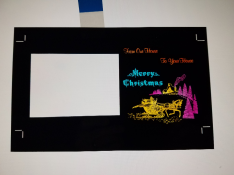
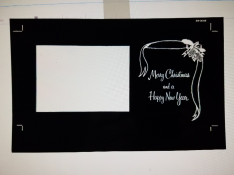
Think of a mask with an opening for a stripped in photo negative, surrounded by a black area with clear text - e.g. "Merry Christmas" - all in a size that could be put into a contact printer or enlarger and then printed together on to photographic paper.
If you purchased the service from Kodak or others, the text could be coloured and/or decorated.
 
These Christmas card masks are something that are news to me. Is it possible to show us what they looked like and exactly what they were meant to be able to do?

Thanks

pentaxuser
I'll upload an image when I get home in a few hours.
 
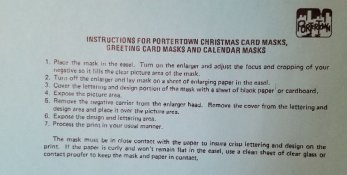
Here are a couple of greeting cards I used back at the turn of the century. I got them from Porter's Camera back in the 1990s. Colour Mask.png B&W Mask.png Mask Info.jpg
 
My dad use to make our Christmas cards in the darkroom when I was a kid. I use to help him. I think I still have the masks and the Kodak mask and paper holder.
 
I've got several of the old Kodak masks. Mine take a 6x9 negative. Kodak sold Azo in 4 1/2 × 5 1/2 regular and deckle edges. Red and green dye to color the edges etc.
 
Circa 1946. Kodalith ortho film in Kodalith developer. Easy enough to make, especially in an era with a small process camera and high contrast developer. You can still buy litho film ,my problem would be cutting the window and Appling the guides to the back of the negative. :smile:
 
Easy enough to make with even a 4x5 view camera--just get the artwork, and photograph it onto litho, with a black paper rectangle for the appropriate size opening. You don't need to cut the window out if you have a clear litho field, just make the window a little smaller than your negative and tape the negative in place--keep the graphics a bit away from the edges of the window do the paper can conform to the different thicknesses.

If you want to do it in color, just tape appropriate filters over the graphics for the color you want (inverse, of course).
 
Stupid phone. I didn't even catch that it used the wrong word. Lol.

I blame all misspellings on my phone. It's the digital age thing to do. Right?

No worries! My phone betrays me daily!
 
Easy enough to make with even a 4x5 view camera--just get the artwork, and photograph it onto litho, with a black paper rectangle for the appropriate size opening. You don't need to cut the window out if you have a clear litho field, just make the window a little smaller than your negative and tape the negative in place--keep the graphics a bit away from the edges of the window do the paper can conform to the different thicknesses.

If you want to do it in color, just tape appropriate filters over the graphics for the color you want (inverse, of course).
Very good point about the clear window. As long as you have a contact print with the negative against the paper.
 
Easy enough to make with even a 4x5 view camera--just get the artwork, and photograph it onto litho, with a black paper rectangle for the appropriate size opening. You don't need to cut the window out if you have a clear litho field, just make the window a little smaller than your negative and tape the negative in place--keep the graphics a bit away from the edges of the window do the paper can conform to the different thicknesses.

If you want to do it in color, just tape appropriate filters over the graphics for the color you want (inverse, of course).
I love the detail of your description. Thanks for sharing.
 
Over the last several years I've collected a handful of the Christmas card masks from Kodak. I vaguely remember seeing other companies selling something similar back when I was a kid.

I'm curious if anyone knows what the process was that they used to make them. Or what the process might look like today to create a mask that could be used in the darkroom. Easy enough of you wanted to do digital printing.

I realize the original process would have been mechanized in some way and that a hobbyist couldn't easily replicate the process.

Are you referring to the sheets of kodalith with a cutout for the negative? What do you need to know. I had a full set of all masks; in horizontal and vertical layout. Some had a Christmas greeting as part of the litho. The greeting cards also had little strips of hard card stock to help you align the negative.

These cards were printed by contact to a paper Kodak once offered made specifically for these masks. There was no automation required because they were sold to amateurs. Assuming we are conversing about the same product.

It was called (as I recall) "Kodak Greeting Card Paper." It was double weight paper with a deckle edge.

I have made hundreds of these cards over the years.

Incidentally, Kodak also offered other non-photographic cards as well as envelopes. I carted away perhaps at least a hundred pounds of these things a number of years ago.

Bob
 
Photrio.com contains affiliate links to products. We may receive a commission for purchases made through these links.
To read our full affiliate disclosure statement please click Here.

PHOTRIO PARTNERS EQUALLY FUNDING OUR COMMUNITY:


Ilford ADOX Freestyle Photographic Stearman Press Weldon Color Lab Blue Moon Camera & Machine
Top Bottom