From Memory, CI above 1.8?
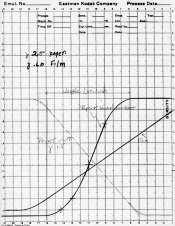
The contrast index, as I recall the term, is used to measure how much light is needed to cause the paper to go from all white to no longer discernable levels of black. Most paper manufacturers discolse this in thier literature, as well as the sensitivity of the emulsion, in an ISO format, which ends up multipluing the contrast range nmumber by 100. So if a paper says at , say for grade 3, .8 to go from white to black it will have arating of 80.
I am up on this because I was recently gifted a huge whack of old paper. It is still all usable, but not necessarily as originally labelled.
To test it I project a step wedge on the easel, and use an old verison of what is in essence an exposure meter (melico timer for those who remember that far back) to pick of the time for a lightest grey tone. If a paper says it was say grade 3, and my memory is right that it coresponds to 0.8, and I am using a 0.15 increment step wedge, then I measure the recommended exposure time at 5 steps up from the first not fully clear step. I expose, then develop for a standard two minutes in MG 1+9 developer.
Once the test strip is dry, I look at it and count the number of steps that can be discerned between all white and full black. If I can still count only 5 steps, then CI if 5x.17 or .75, close enough to 8 for me.
If the lightest grey is not occuring on the strip where I metered it to be, I go back to the unchanged enlarger projected step wedge, and meter where the actual lightest grey happened. I can then do a bit of math to figure out how relatively sensitive to some arbitrary reference the newly tested paper is.
I find that old paper that was graded and developer incorporated ( like old agfa 'speed' lines) tends to a) fog a bit, and b) tends to soften with age. If it started out as grade 4, at twenty years ago, it is likely the equivalent to a 2. If it started out as a 2, it might now be a 1.5.
If it was FB, and not developer incorporated, it is likely still viable. I recently bought 25 8x10 E3SW Kodabromide, expired in '73. for a couple of bucks on a lark, and mostly to puit the envelope it cam in on display with my old products shlef in the rec room, and low and behold it is still as good as new.
For tanning developers, Sandy King warns that don't develop to thin if you want to print on VC papers, as the green stain tends to counteract the VC filters. Go the other way and developing too long to get higher CI's also will build grain, although the stain of a tanning developer will tend to hide that.
There is also the issue of unsharp masking to consider in the balance. If you want to unsharp mask, then the resulting sandwich with mask will reduce the effective overall contrast, and then you will need to make sure that you still fit within the 0-3.5 grade window if using VC paper.