
• Welcome to Photrio!
    Registration is fast and free. Join today to unlock search, see fewer ads, and access all forum features.
    Click here to sign up

Good news for dark room fans

pared_amarilla.jpg

H
pared_amarilla.jpg

  • 0
  • 0
  • 22
December Path

H
December Path

  • 3
  • 0
  • 39

Recent Classifieds

Forum statistics

Threads
201,676
Messages
2,828,392
Members
100,882
Latest member
Photriо
Recent bookmarks
0

otto.f

Subscriber
Allowing Ads
Joined
Aug 18, 2017
Messages
365
Location
Netherlands
Format
Multi Format
I'm working on a project of wet printing 35mm negatives on 11x14" Rollei 111 fibre based variable grade paper developed in Moersch's Eco 4812. Although I now work on 6 prints only for on the walls at home, the final goal is a book based on a great deal of original AAA prints.

I bought a new liter Eco 4812 for that but tried out first a bottle from 2019 which I had poured into a brown glass bottle which I had vacuumed with Vacuvin, a device known in my country to keep wine fresh. I stored the bottle at the North side of my attic. To my surprise this developer worked as new, whereas it was 1 or 2 years beyond the expiration date defined by Moersch. So that's good news number one and a compliment for Wolfgang Moersch, who earns an elevation to nobility.

The second good news is that my negatives turned out to be very stable over the last 5 years, including different brands but mostly Delta100, Rollei Infrared and Adox 100 CHS ii. All these films were developed in times following The Massive Dev Chart, plus 15% because I use the Heiland Splitgrade head with leds which asks for rather hard negatives compared to the traditional condenser heads. With all these negatives the Splitgrade comes up with mostly the same grade and exposure times, which implies very few corrections and test strips. This is good news number two with a compliment for The Massive Dev Chart and a bit for me too 😃.
 

koraks

Moderator
Moderator
Joined
Nov 29, 2018
Messages
26,670
Location
Europe
Format
Multi Format
Nice, have fun with the project! Please feel free to share the results as they materialize.

I'm kind of torn on the Vacuvin thing because it's not something that will actually build a proper vacuum. It's like 300-500mbar at best, which you could argue is about "half vacuum" or so. However, in the case of a print developer, I can see how the remaining oxygen in the bottle will be captured by the sulfite in the developer (which will be plentifully present). The Vacuvin cap/lock may just be good enough to prevent too much air from seeping in over time.

Btw, in wine enthusiast circles, I see the Vacuvin now being replaced by Coravin-type solutions, that replace the drained liquid with a similar volume of argon gas. I can imagine this works very well for photochemistry/developers as well - although it's a vastly more expensive system than vacuvin.

For long-term storage of developers, a system of just filling a glass bottle with a well-fitting cap to the rim is hard to beat in simplicity, effectiveness and cost.
 

John Wiegerink

Subscriber
Allowing Ads
Joined
May 29, 2009
Messages
4,007
Location
Lake Station, MI
Format
Multi Format
I don't want to change the OP's subject, but did anyone ever come up with any real idea as to who makes Rollei 111 and 112 paper? Is it really made by Foma?
 

Andrew O'Neill

Moderator
Moderator
Allowing Ads
Joined
Jan 16, 2004
Messages
12,868
Location
Coquitlam,BC Canada
Format
Multi Format

snusmumriken

Subscriber
Allowing Ads
Joined
Jul 22, 2021
Messages
2,761
Location
Salisbury, UK
Format
35mm
Do you mean 6 prints on display at a time, or 6 permanently on display?

On the Vacuvin subject, I bottle everything with a squirt of butane gas (cigarette lighter gas) on top before screwing on the cap. Dirt cheap and works 100%. I keep all my chemicals in a cupboard inside the darkroom, so in my case the main reason for using brown glass bottles is that the caps are effective!
 

MattKing

Moderator
Moderator
Allowing Ads
Joined
Apr 24, 2005
Messages
55,059
Location
Delta, BC Canada
Format
Medium Format

Donald Qualls

Subscriber
Allowing Ads
Joined
Jan 19, 2005
Messages
12,532
Location
North Carolina
Format
Multi Format
replace the drained liquid with a similar volume of argon gas.

This does work very well. Argon is heavier than air and chemically inert. In a room with very still air, you could even get away without capping or corking the bottle because the argon will cover the liquid surface and prevent oxygen from contacting the chemistry.

Perhaps not surprisingly, butane (from lighter refill cans) also works for this, and is quite a bit cheaper than argon. Some are concerned about flammability, but unless you're switching electrics on and off or shuffling on a carpeted floor in the darkroom while storing your developers, IMO it's not a major hazard. If you get your butane at a tobacconist or head shop it won't even have the garlic-adjacent odorant (makes it harder to detect leaks, but won't stink up your chemicals).
 

gordrob

Subscriber
Joined
Jan 29, 2005
Messages
1,048
Location
Western Cana
Format
Multi Format
I top off any bottles of chemistry with either nitrogen or a wine preserver. Before I cap the bottles I put a piece of Parafilm - a self sealing plastic film used in laboratories - over the mouth of the bottle just to ensure no air gets in the bottle and stop any cross contamination from the cap.
 

Craig

Subscriber
Joined
Apr 8, 2004
Messages
2,522
Location
Calgary
Format
Multi Format
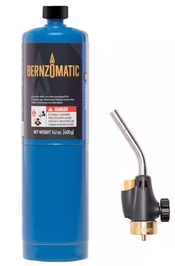
Propane works just as well too, also heavier than air. A quick squirt from an (unlit) plumbers torch works well, and the bottles are cheap. Something like this:
torch.JPG
 

john_s

Member
Allowing Ads
Joined
Nov 19, 2002
Messages
2,203
Location
Melbourne, A
Format
Medium Format
..... In a room with very still air, you could even get away without capping or corking the bottle because the argon will cover the liquid surface and prevent oxygen from contacting the chemistry.
......

I don't think that would work for long. Argon is heavier than air (MW=40) whereas air is 29 but the gas would diffuse reasonably quickly I think.
 

DREW WILEY

Member
Allowing Ads
Joined
Jul 14, 2011
Messages
14,852
Format
8x10 Format
AAA - either Ansel Adams with a stutter, or Alcoholics Anonymous with a stutter, or American Automobile Association (AAA Insurance) without the stutter - they do publish scenic travel photos in their official magazine, including large format stock shots.

I've never tried Superman's Kryptonite in relation to darkroom chemicals, but those argon-based wine preservative canisters make the most sense to me.
 
OP
OP

otto.f

Subscriber
Allowing Ads
Joined
Aug 18, 2017
Messages
365
Location
Netherlands
Format
Multi Format
AAA is Analogue photo: shot on film, not scanned but contact-printed for selection and wet printed for the final image, you might call it AA indeed. But the other way is ADD, shot on film, scanned and inkjet printed.
 
Last edited:
OP
OP

otto.f

Subscriber
Allowing Ads
Joined
Aug 18, 2017
Messages
365
Location
Netherlands
Format
Multi Format
Nice, have fun with the project! Please feel free to share the results as they materialize.

Thanks! Sharing it here would imply digital interference which is a shame and a sin 🤣 . No, but seriously, I could make a flatbed scan of FB print which is mostly better, to avoid the strange effect of excessive grain when scanning negatives; I hate scanning negatives anyway.
 
Last edited:

koraks

Moderator
Moderator
Joined
Nov 29, 2018
Messages
26,670
Location
Europe
Format
Multi Format
Haha, I get your drift. Well, feel free to drop by and show me the prints in person!
In any case, digital output and physical prints are just worlds apart; that's OK. At least with a digital preview/snapshot the rest of us can form an impression of what you're actually looking at. It'll never be as good as the real thing, but it's the best we got!

No pressure though. Have fun with the project!
 

Hassasin

Member
Allowing Ads
Joined
Feb 23, 2023
Messages
1,614
Location
Hassasstan
Format
Multi Format
So have been waiting, are the actual "good news for darkroom fans" coming? Yet to see anything of the sort.
 

koraks

Moderator
Moderator
Joined
Nov 29, 2018
Messages
26,670
Location
Europe
Format
Multi Format
are the actual "good news for darkroom fans" coming?
Please read:
To my surprise this developer worked as new, whereas it was 1 or 2 years beyond the expiration date defined by Moersch. So that's good news number one and a compliment for Wolfgang Moersch
The second good news is that my negatives turned out to be very stable over the last 5 years, including different brands but mostly Delta100, Rollei Infrared and Adox 100 CHS ii.
OP reports on something they're enthusiastic about and mentions a few things that may be relevant to others. If you're not part of that group, it's perfectly fine to shrug and move on. Thanks for your consideration.
 
  • Hassasin
  • Hassasin
  • Deleted
  • Reason: Argumentative

Donald Qualls

Subscriber
Allowing Ads
Joined
Jan 19, 2005
Messages
12,532
Location
North Carolina
Format
Multi Format
I don't think that would work for long. Argon is heavier than air (MW=40) whereas air is 29 but the gas would diffuse reasonably quickly I think.

You might be right -- I'm not a gas dynamics expert at all. I know acetone vapor pools on a floor (making furnace pilot lights a major hazard if you use acetone in a basement), but I don't know how much density difference it takes to overcome thermal diffusion due to Brownian motion.
 

john_s

Member
Allowing Ads
Joined
Nov 19, 2002
Messages
2,203
Location
Melbourne, A
Format
Medium Format
You might be right -- I'm not a gas dynamics expert at all. I know acetone vapor pools on a floor (making furnace pilot lights a major hazard if you use acetone in a basement), but I don't know how much density difference it takes to overcome thermal diffusion due to Brownian motion.

Maybe its molecular weight makes its vapor more likely to sit around. I think LPG is like that too, causing fires inside when there is a leak.
The poisonous gas phosgene worked so well to disable soldiers in the first world war because, for a gas, it's very dense and could be dispersed over enemy lines in still weather.
For protecting developer with a heavy inert gas the best would probably be xenon, but it would be expensive!
 

John Wiegerink

Subscriber
Allowing Ads
Joined
May 29, 2009
Messages
4,007
Location
Lake Station, MI
Format
Multi Format
If I'm going to try and keep a developer as pure as possible in the oxidation department I use acetylene gas. It's very dense and a real heavy weight that does a very good job of protect the developer from any outside nasties that would do it harm. We used it in a very different way in Vietnam during that conflict, but the tendency to sink rather than rise made it very useful for tunnel work over there.
 

reddesert

Member
Allowing Ads
Joined
Jul 22, 2019
Messages
2,599
Location
SAZ
Format
Hybrid
Maybe its molecular weight makes its vapor more likely to sit around. I think LPG is like that too, causing fires inside when there is a leak.
The poisonous gas phosgene worked so well to disable soldiers in the first world war because, for a gas, it's very dense and could be dispersed over enemy lines in still weather.
For protecting developer with a heavy inert gas the best would probably be xenon, but it would be expensive!

Acetone is a liquid at room temperature - just barely so because its boiling point is low (56 deg C) and its vapor pressure is high compared to many liquids. This makes it volatile, but it's still a liquid mostly. Argon is a gas at room temperature (boiling point -186 deg C). It will mix with ordinary air quickly. The molecular weight is less important than the boiling point, IMO. Butane has a lower molecular weight than xenon, but a much higher boiling point (0 C, vs -108 C). For the sake of completeness, phosgene also has a high boiling point (8 deg C), but not recommended for darkroom use.
 

tykos

Member
Allowing Ads
Joined
Jun 26, 2020
Messages
156
Location
italy
Format
4x5 Format
i use butane too (lighter refills), never double tested some chemistry left for years but it's cheap, easy to find, easy to use and store.
 

Donald Qualls

Subscriber
Allowing Ads
Joined
Jan 19, 2005
Messages
12,532
Location
North Carolina
Format
Multi Format
Acetone is a liquid at room temperature - just barely so because its boiling point is low (56 deg C) and its vapor pressure is high compared to many liquids. This makes it volatile, but it's still a liquid mostly. Argon is a gas at room temperature (boiling point -186 deg C). It will mix with ordinary air quickly. The molecular weight is less important than the boiling point, IMO. Butane has a lower molecular weight than xenon, but a much higher boiling point (0 C, vs -108 C). For the sake of completeness, phosgene also has a high boiling point (8 deg C), but not recommended for darkroom use.

I've never seen this explanation -- I understood the issue in both cases was entirely due to relative density, which is proportion (in gases at the same temperature and pressure) to molecular weight. As noted above, air is 29, argon 40, butane 60 (C4H10), and acetone only 56; acetone won't work here because of its higher boiling point and solubility in water, but butane is better than argon. I would note that both carbon dioxide (MW 44) and sulfur hexafluoride (MW 146) will pool in a container with little mixing; I'd expect butane and argon to behave similarly.
 
Last edited:

gordrob

Subscriber
Joined
Jan 29, 2005
Messages
1,048
Location
Western Cana
Format
Multi Format
So where does nitrogen fit into this discussion. Is it a good option for topping off bottles to replace the oxygen or is it a waste using it.
 
Photrio.com contains affiliate links to products. We may receive a commission for purchases made through these links.
To read our full affiliate disclosure statement please click Here.

PHOTRIO PARTNERS EQUALLY FUNDING OUR COMMUNITY:


Ilford ADOX Freestyle Photographic Stearman Press Weldon Color Lab Blue Moon Camera & Machine
Top Bottom