• Welcome to Photrio!
    Registration is fast and free. Join today to unlock search, see fewer ads, and access all forum features.
    Click here to sign up

"Golden Tetras" or Cubic Grains and the Tetradecahedral

Somewhere...

D
Somewhere...

  • 5
  • 2
  • 102
Iriana

H
Iriana

  • 7
  • 1
  • 164

Recent Classifieds

Forum statistics

Threads
202,750
Messages
2,845,060
Members
101,501
Latest member
David99
Recent bookmarks
0

Ray Rogers

Member
Allowing Ads
Joined
Aug 27, 2005
Messages
1,543
Location
Earth
Format
Multi Format
Golden Tetras)Cubic Grains and the teradecahedral

Anybody out there know how to describe a tetradecahedral grain?
or have a picture handy?

I can't seem to find one.

Ray
 
Anybody out there know how to describe a tetradecahedral grain? :confused:
or have a picture handy?

I can't seem to find either.

Ray
 
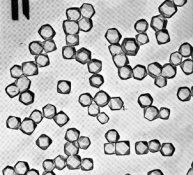
This is the closest I can get. You be the judge.

OTOH, if it is doable, why don't you make one? :D Then you can show us the pix.

PE
 

Attachments

  • Double run octahedra resized.jpg
    Double run octahedra resized.jpg
    80.5 KB · Views: 228
Groobled it.
 

Attachments

  • tetradecahedron.bmp
    30.8 KB · Views: 214
  • tetradecahedron2.bmp
    39 KB · Views: 210
PE's 14 sided crystals are prettier than mine, though.

:sad:
 
This is the closest I can get. You be the judge.

PE

Actually, they do look like tetradecahedral grains to me.
Why are they marked "octahedra"?

Ray
 
Actually, they do look like tetradecahedral grains to me.
Why are they marked "octahedra"?

Ray

After thinking about my own question, I think I came up with an answer.
I will give it a try anyway.

Octahedral grain can be derived from tetradecahedral grain by continued ripening....

The grain in your picture were supposed to be octahedra...
but had there portrait taken before they were completely mature.

They were "toddlers"!
 
PE's 14 sided crystals are prettier than mine, though.

:sad:

Thats true. :tongue:

In addition, I am not sure they actually have the same structure!
There seems to be several possible shapes for a tetradecahedron.

Ray
 
Did you try Googleing "photos of a tetradecahedron grain"? I think I saw a drawing of one once but I cant remember where. I think it was a patent for a silver halide grain for photography held by a japanese fellow. Hope that helped.

Rick
 
Octahedra = 8 sided, Tetra deca hedra = 4 10 sided. An octahedron in emulsion parlance in the case above is a cube with clipped corners. A cube has 6 faces and 8 corners. If you look closely at my photomicrograph, you see that each side has 6 edges but there are 8 + 6 sides making 14. Go figure!

There are several possible shapes possible. AFAIK, there is nothing "golden" or special about them.

PE
 
This might be close--:>)
http://www.enterprisemission.com/moon5.htm

.......
When earth and sun are frozen clods,
When, all its matter degraded
Matter in aether shall have faded,
We, that is, all the work weÂ’ve done
As waves in aether, shall for ever run
In swift expanding spheres, through heavens beyond the sun.

Great Principle of all we see,
Thou endless Continuity!
By thee are all our angles gently rounded

-James Clerk Maxwell

http://www.southalabama.edu/mathstat/personal_pages/silver/last.poem.pdf
 
Duplicate threads merged.
 
Allow me to ask what's probably obvious to everyone else - Are these the "T" grains we'd all like to make with double run emulsions?

(preferably , Computer vAg Controlled, sensitized with unobtanium dye, and impossibly perfectly coated )
 
They would have to be controlled, but what the run conditions are I don't know offhand.

They are apparently not T-Grains.

PE
 
So looking at my crystal shape diagram someone posted a while back - These are the corner nibbled cubes that are produced when pAg is around 7.5 - 8. T grains (the flat octahedral ones) are made around 9.5.

So in our single run emulsions where pAg (or vAg, if that is what we are measuring) is not held constant - do we have a multitude of grain types, or do the grains shift as the emulsion ripens?
 
In a single run, the vAg shifts as the run continues and you get a variety of shapes and sizes which we call K grains (Klunkers). The emulsion in question would probably look like a soccer ball. It requires a double run.

If ammonia is present, or another solvent, in a single run, the grains tend to one size and shape but are rather amorphous giveing smooth rounding tending towards spherical. Without the solvent, and with control, the ends and edges tend to be sharp and well defined.

PE
 
Last edited by a moderator:
Octahedra = 8 sided, Tetra deca hedra = 4 10 sided. An octahedron in emulsion parlance in the case above is a cube with clipped corners. A cube has 6 faces and 8 corners. If you look closely at my photomicrograph, you see that each side has 6 edges but there are 8 + 6 sides making 14. Go figure!

There are several possible shapes possible. AFAIK, there is nothing "golden" or special about them.

PE
Exactly.
An octahedron is a cube with clipped corners,
but only if they are clipped in such a way so as to compleatly eliminate the [100] faces of the cube.

Shallow clipping that only reduces the area of cube faces but does not elimnate them, produces tetradecahedral grains
(the 6 cube faces + the 8 slightly truncated corners)

Yes...
"Golden Tetras" was something that sprung up in my mind from once having had an interest in Tropical Fish.

My dendrites were streching! :smile:

Ray
 
That is a good point.

But it suggests a question:
What advantages do the various grain types offer?

If digital imaging had not encroached upon the advancement in silver halide imaging,
do you think the variety of grain types used in actual products would have increased
(optimizaton by specialzation) or decreased (optimizaton by progress toward common goals)?
 
Well, aside from amorphous, there are cubes, octahedra, tetrahedra, pyramid and t-grains to mention a few. Each has advantages and disadvantages, but I'm not sure I am the person to describe these fully.

T-Grains offer high speed, finer grain and better sharpness in many cases. Cubes offer similar advantages, especially fine cubes in print films. A mix of these two are uesd in the new Ektar 100 according to Kodak literature.

Then there are thick and thin T-Grains. Well, you get the picture.

Entire textbooks could be written on these subjects alone. And then you get into the epitaxial crystals and the different halide ratios and the field expands from there.

So, to answer you, we saw this in Ektar 100 so the answer is yes. We were on the brink of something. OTOH, the yield was getting slower per unit of money spent, so we knew that the well was going dry. By some estimates, we might have had that 25,000 speed film by now or maybe higher. IDK. I'm sure we would have had a better Kodachrome. :wink: JK.

PE
 
I understand little of what anyone is saying in these threads, but they always intrigue me.

By some estimates, we might have had that 25,000 speed film by now or maybe higher.

I've often wondered about what types of new film would exist if digital cameras didn't become as popular as they are.
 
PE,
Someone said(it may have been you)that they were told to go to Japan if he wished to continue doing film research. Are there Japanese companies still doing commercial research in film?
If the internal cumbustion engine had not caught on, where might we be with steam today?
Bill
 
Bill;

I never said that.

The Japanese R&D effort is about the same as the US effort. Remember that Konishiroku went out of the analog photo business leaving only Fuji when you get down to it. Fuji is hurting too.

PE
 
PE,
Someone said(it may have been you)that they were told to go to Japan if he wished to continue doing film research. Are there Japanese companies still doing commercial research in film?
If the internal cumbustion engine had not caught on, where might we be with steam today?
Bill

Hi Bill.

That was Keith quoting J. D. Mitchell.

Mitchell was one of a handfull of theorists who helped work out the theory behind the latent image and, well, how slver halide photography works on the atomic/ionic scale.

Ray
 
Hi Bill.

That was Keith quoting J. D. Mitchell.

Mitchell was one of a handfull of theorists who helped work out the theory behind the latent image and, well, how slver halide photography works on the atomic/ionic scale.

Ray

Where and when did this comment by Mitchell come about?

I'm curious because it really might have been true in the 80s in universities but no longer. In fact, as you know, most of Chiba and other universities are doing almost all digital work. It was not true regarding EK and Fuji until about the late 90s when they both started cutting back. And, the decisive year was about 2005.

PE
 
Photrio.com contains affiliate links to products. We may receive a commission for purchases made through these links.
To read our full affiliate disclosure statement please click Here.

PHOTRIO PARTNERS EQUALLY FUNDING OUR COMMUNITY:


Ilford ADOX Freestyle Photographic Stearman Press Weldon Color Lab Blue Moon Camera & Machine
Top Bottom