
• Welcome to Photrio!
    Registration is fast and free. Join today to unlock search, see fewer ads, and access all forum features.
    Click here to sign up

Glass plate newcomer

Somewhere...

D
Somewhere...

  • 2
  • 1
  • 63
Iriana

H
Iriana

  • 6
  • 1
  • 123

Recent Classifieds

Forum statistics

Threads
202,740
Messages
2,844,935
Members
101,493
Latest member
aekatz
Recent bookmarks
0

mri_tech

Member
Allowing Ads
Joined
Nov 6, 2006
Messages
12
Format
Medium Format
Greetings to all. I recently came upon a 5x7 glass plate view camera with several glass plates and holders. I've seen several posts regarding making emulsions and coating glass plates. But, with all the different recipes and techniques shown, is there one that can be recommended to this glass plate beginner that can at least get me started in a right direction. Many thanks to all your help.

Tom
 
I've done dryplate a la the alternativephotography.com article. My first batch was disastrous, and I'm going to try another in the near future. I'll let you guys know of any refinements I might incorporate. Silver Gelatin is a great book if you can find it.
 
Silver Gelatin New Edition?

I've done dryplate a la the alternativephotography.com article. My first batch was disastrous, and I'm going to try another in the near future. I'll let you guys know of any refinements I might incorporate. Silver Gelatin is a great book if you can find it.

Not so simple, 'Silver Gelatin' is out of print now - I was going to PDF it and put it in the public domain, but unfortunately the type is so small and fine that I can't get satisfactory scans, and needless to say the original files are scattered to the winds. So the best option may be do a revised edition, and as it's now 10 years since the first one, there should be plenty of good new work - we already have some worthy of inclusion. Anybody who feels they have original emulsion work that 'pushes the envelope', please email me.

Slight shift of topic, we started an 'emulsion archive' on the Silverprint website for the same reason as this series of threads has been developing, the feeling that it's worth trying to pull together emulsion lore. Maybe in due course some arising cottage industries might possibly look at going into production again, just as they did at the start in the 1870's. It's still early days, but the content so far is linked from page 7 in the Silverprint 'News', and there's a link back to this APUG forum heading.
 
Martin;

I have read your book cover to cover and then gone back and reread most of it again. I find it an excellent book, especially the first part.

The last part, regarding formulas, is rather out of date though, as are the descriptions of coating methods. Much of this could be seriously upgraded. In particular, you seem to refer a lot to Wall (and you mention him on your web site) but I find that his books are inferior to those of Baker in the same time frame. Using Wall as a starting point can be pointing the newcomer in the incorrect direction if one wants to re-create emulsion making of the early part of the century with reasonable results.

Best of luck in your second edition.

PE
 
www.abebooks.com turns up a few used examples of the book, if someone would like to get a copy of Silver Gelatin.
 
Here's what I did:

I bought 8x10 window glass at the hardware store and washed with Dawn liquid soap and hot water. Scrubbed, rinsed, dried on rack.

I took Rockland Colloid Ag+ emulsion (from Freestyle) and heated the bottle upside down under hot water. (Approximately 140 deg. F)

In a small glass graduate, I mixed 5-10mL of Photo-Flo with warmed emulsion to a total volumn of about 45-50mL. This was then poured on the dry glass plate starting in the center and spread in the style of wetplate collodion.

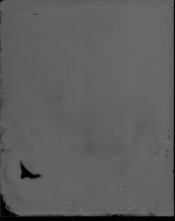
Here's 2 results: one of the worse and my best.

Unfortunately, my 8x10 plate holders don't fit my 8x10 camera, so I haven't tried the negs. But at least I have a rough idea of emulsion volumn for 8x10, and I found I don't absolutely need a subbing layer.
 

Attachments

  • 8x10plate.jpg
    8x10plate.jpg
    19.6 KB · Views: 203
  • 8x10plate2.jpg
    8x10plate2.jpg
    13.5 KB · Views: 206
If it contains any wax, as the name implies, it would probably repel the gelatin in water mixture. Organic solvent based materials would stick well to it though.

PE
 
If it contains any wax, as the name implies, it would probably repel the gelatin in water mixture. Organic solvent based materials would stick well to it though.

PE

Glass Wax contains no wax. That is just a brand name of a glass cleaner that contains "whiting" which is a very mild abrasive that polishes the glass.
 
I have been making emulsion for a short time using the simple photographic emulsion shown on the unblinking iye site. I find that adding all the silver at once gives better contrast.

When coating large plates with Rockland emulsion it is best to heat the plate first, and if the emulsion starts to set up before it is evenly coated use a heat gun to remelt and it will even out.

In making my emulsion I have calculated that the cost for 8oz. is less than a few dollars for materials compaired to $30. for a commercial brand. It is not such a waste when you screw up a plate. But the time to make emulsion is a couple of hours or so as opposed to collodion wich only takes a few minutes.
 
I wonder if final cleaning of the glass with a product such as Glass Wax, which is recommended for wet plate, would also be good for gelatin?
The brand of "Glass Wax" that was used for cleaning glass for wet plate collodion is no longer made. There is still a product by that name, but it's not the same. They had to change it due to a chemical hazard issue. From what I've heard from fellow wet-heads, the new stuff does not work well for collodion. It causes chemical fogging problems.
 
I have been making emulsion for a short time using the simple photographic emulsion shown on the unblinking iye site. I find that adding all the silver at once gives better contrast.

When coating large plates with Rockland emulsion it is best to heat the plate first, and if the emulsion starts to set up before it is evenly coated use a heat gun to remelt and it will even out.

In making my emulsion I have calculated that the cost for 8oz. is less than a few dollars for materials compaired to $30. for a commercial brand. It is not such a waste when you screw up a plate. But the time to make emulsion is a couple of hours or so as opposed to collodion wich only takes a few minutes.

Speeding up silver addition when making an emulsion generally gives a higher contrast slower result, while slowing down addition speeds up the emulsion but lowers contrast.

This, like everything in emulsion making, is a generalization. But, the textbooks referred to fast addition as plopping or pouring it in. In German this was "gekipped" or tipped.

This is probably one of the worst ways to add silver to the halide gelating mixture, but it does work.

PE
 
Photrio.com contains affiliate links to products. We may receive a commission for purchases made through these links.
To read our full affiliate disclosure statement please click Here.

PHOTRIO PARTNERS EQUALLY FUNDING OUR COMMUNITY:


Ilford ADOX Freestyle Photographic Stearman Press Weldon Color Lab Blue Moon Camera & Machine
Top Bottom