• Welcome to Photrio!
    Registration is fast and free. Join today to unlock search, see fewer ads, and access all forum features.
    Click here to sign up

general question about surface

Recent Classifieds

Forum statistics

Threads
203,175
Messages
2,850,956
Members
101,713
Latest member
notlithe12
Recent bookmarks
0
One year later, this thread motivated me to obtain and print on some matte Ilford Multigrade Classic. I hadn't tried a silver gelatin paper that wasn't glossy since the early 1970s.

I'm not sure whether cadmium removal had anything to do with it, but weakness of blacks was even worse than I remember from lo those many decades ago. I agree that, aesthetically, the surface itself is exquisite, but can't overcome a dislike for no image tone denser than dark gray being available.

It is a shame, since matte inkjet prints, while unable to totally match the black levels of glossy gelatin silver, do quite a bit better dealing with low values. Perhaps HARMAN can learn something from that technology and apply it to 'our' papers.
Missed the "one year later" remark. Do you get low dMax when you expose a strip fully and develop three minutes? Dark gray isn't how I would describe the matt paper I've used. It's just measurably less density.
 
You aren't alone. I use Illford MGiv gloss fiber n dry to the matt. I don't like the super shinny surface because its hard to view with my reflection staring back at me.
 
Missed the "one year later" remark. Do you get low dMax when you expose a strip fully and develop three minutes? Dark gray isn't how I would describe the matt paper I've used. It's just measurably less density.
I don't own a reflection densitometer, but would estimate the maximum black I'm obtaining from matte Multigrade Classic is approximately 1.5 density, as expected. "Dark gray" was my hyperbolic way of describing how that looks compared to what one gets from the air-dried glossy version of Classic. :smile:
 
One year later, this thread motivated me to obtain and print on some matte Ilford Multigrade Classic. I hadn't tried a silver gelatin paper that wasn't glossy since the early 1970s.

I'm not sure whether cadmium removal had anything to do with it, but weakness of blacks was even worse than I remember from lo those many decades ago. I agree that, aesthetically, the surface itself is exquisite, but can't overcome a dislike for no image tone denser than dark gray being available.

It is a shame, since matte inkjet prints, while unable to totally match the black levels of glossy gelatin silver, do quite a bit better dealing with low values. Perhaps HARMAN can learn something from that technology and apply it to 'our' papers.

I have used Multigrade IV 5K in the past and got best blacks with Adox Neutol NE, 1+7, followd by some strong Harman selenium toner. Charcoal blacks, lovely surface, my favorite in fact! I don't know if the latest incarnation of the paper is comparable though (meanhwhile I quite using selenium as I got scared of it thanks to this site!).
 
It isn't so much a lack of blacks, but rather the character of the blacks that are there.
Ink vs charcoal.
 
Am I the ONLY one out there who finds the matt surface the most exquisite in terms of aesthetics?

I know that the blacks are not up to the level that gloss imparts

And that is why I don't agree.
 
I like FB glossy paper best, dried in an old-fashioned blotter roll. I've been doing this since the days before RC paper; somehow additional labor often seems to yield the kind of results I like.
 
The blacks in mat prints are just really lacking.
 
The blacks in mat prints are just really lacking.
Only if you used a Hasselblad to shoot the negativebandit:.
Papers with texture need to be printed using a slightly different approach. And they suit some subjects, while others not so much.
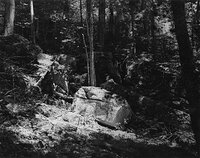
This one looks good in satin.
2010-04-19-22b_927233.jpg

Of course, that was shot with a Trip 35 that cost me $2.10:whistling:
 
Only if you used a Hasselblad to shoot the negativebandit:.
Papers with texture need to be printed using a slightly different approach. And they suit some subjects, while others not so much.
This one looks good in satin.
View attachment 181942

Of course, that was shot with a Trip 35 that cost me $2.10:whistling:

Satin is not mat, Matt.
 
Satin is not mat, Matt.
Matt asks which version of matte is the matte that matters to you:whistling:?
As satin has more texture than pearl/semi-matte, I'm curious where your dividing line is.
As a lifelong Kodak fan, I miss Ektalure "E".
 
I much preferred the N surface on Kodak's RA 4 color papers over the glossy F surface. Actually, to me it feels a little like the Portriga Rapid 111 glossy fiber base surface. A friend had images of the Chaco Canyon ruins on Portriga Rapid 118 (matt) -- the black windows sink into the paper surface...quite amazing.
 
Matte is good for cheap lenses whose glass has no brilliance.
 
Matt asks which version of matte is the matte that matters to you:whistling:?
As satin has more texture than pearl/semi-matte, I'm curious where your dividing line is.
As a lifelong Kodak fan, I miss Ektalure "E".

I just do not care to look at nor use mat surface paper because it just looks so flat and boring.
 
I got 1.2 density on one of my Matt prints. It is of a dusty shrub in a creek that looks convincingly "dusty", some prints look fine even with the limited density.
 
I wish someone would have a variety pack of paper to try out. Reading this and looking at all the selections at Freestyle makes my head swim.
 
I prefer a glossy surface as the matte surface lowers the print contrast. If you use RC paper then there is no need to ferrotype the print.
 
Depends on the subject. Glossy will look sharper than Matt. I prefer the fiber F glossy surface when framing under glass.
 
I was primarily a glossy guy for a really long time, about 10 years ago I switched to matt (with toning) and multiple gum prints.. for me the matt surface rocks!!!!!
 
I wish someone would have a variety pack of paper to try out. Reading this and looking at all the selections at Freestyle makes my head swim.

Kodak used to make one. In fact, mine is sitting in front of me right now! Thirty nine, count 'em (I just did), thirty nine different papers and surfaces!! There is even "Translite," a vellum like paper coated on both sides! Depending on the paper, could be available in SW or DW, and up to five contrast grades! Not sure when this handy thing was made, each paper is a real print.

Kodak, of course, used letter designations for each type of finish. The famous F, Glossy, for instance.

Several have mentioned N surface positively. I had a roll of Polycontrast (II?) with luscious warm black tones and the N surface. Man, was I bummed when I ran out. Loved it.

In digital (I see we can now say such things here) printing, I use matte for just make an image because it is cheap. Canon's best elite papers are all glossy, so sometimes, no choice. But I mostly use Luster, and when I ran Ilford, Pearl. The Dmax of gloss w/o the reflection issues. I print up to 13"x19". Again, digital.

But back to the original question, yes, you would think that each company would make something like Kodak did, or at the least, a sampler within a paper type. Even without an image printed, it would be helpful to just have a piece of paper in your hand and eye. And of course, one company's Luster could be another company's Satin. Or, something.

Anyone have a link to a list of the old Kodak paper surfaces an their equivalent names? I'm especially curious about N, and what was the letter for Lustre?
 
I too love FB matt paper. I have a box of 16 x 12 that I get out occasionally for certain prints.

I always tell recipients of my prints, NOT to compare it to other surfaces, for until then the blacks look a gorgeous black - or a charcoal black as mentioned. Lovely paper.


Terry S
 
Matte, and only matte!

Anything else bothers me.
Shiny, half-shiny... it’s distracting.
 
Found it! Kodak paper surfaces, 1948. In the Google archives.

On my way to stumbling across that, I read a lot of forums and blogs on surfaces. Wow, so much misplaced beliefs, and the fact that one company's X surface is not the same as X at another company adds to the subjective confusion. For instance, many called Kodak N, matte. Well, a look at my sample and it's obviously too shiny for that. In fact, Kodak describes it as white, smooth, lustre, same as A but different paper stock. But not the same as E, white fine grained lustre. And yet, I think it more like Satin w/o the Faux Fabric calendaring.

Well, well, "image to large for server to process." Sheesh, in this day and age, not auto-corrected? OK, so here's a link to the musings of The Great Yellow Father it on my Onedrive: https://1drv.ms/u/s!AmOl9vH70YvYlPkbo1ihBHMlWNWw2g
 
Photrio.com contains affiliate links to products. We may receive a commission for purchases made through these links.
To read our full affiliate disclosure statement please click Here.

PHOTRIO PARTNERS EQUALLY FUNDING OUR COMMUNITY:



Ilford ADOX Freestyle Photographic Stearman Press Weldon Color Lab Blue Moon Camera & Machine
Top Bottom